Work has started on the first driverless metro line in Wien, and investments are being made in other modes as well.
The latest metro expansion project in Wien took a step forward in February with the start of work on the future Frankhplatz-Altes AKH station. This will be part of the city’s first driverless metro line, which is due to open in 2024.
The construction of Line U5, and the associated project to expand Line U2, forms the largest transport project currently underway in the Austrian capital. The €1bn U2xU5 project aims to close a gap in network coverage, which is important in the rapidly growing city. Wien already has 1·9 million inhabitants, with a further 1 million in the wider urban area, and public transport use is growing: in 2018 total ridership was 961·7 million passengers, up from 954 million in 2016, although metro ridership fell from 440·1 million passengers to 428·8 million.

Metro network development
U2xU5 was officially launched on October 8 with a ceremony at the site of the future Matzleinsdorfer Platz U2 station, which will offer interchange with main line services.
The Matzleinsdorfer Platz station site will initially be used as a launching shaft for the tunnel boring machines that will excavate tunnels north to Neubaugasse and Augustinplatz. These will become part of Line U2 when they meet the existing route at Rathaus. This extension of U2 is due to open in 2027, with a further southern extension from Matzleinsdorfer Platz to Wienerberg following in 2029 at the earliest.
The 1·7 km section of the existing U2 from Rathaus to Karlsplatz will become part of Line U5. The new line will use the existing U2 platforms at Rathaus, before running north to Frankhplatz in 2025 and to Elterleinplatz by 2026. The latter phase would include an interchange with Line U6 at Michelbeuern-AHK.
Work on the interchange between the U2 extension and Line U4 at Pilgramgasse is due to begin in mid-2019 and will coincide with a partial blockade of U4. Operator Wiener Linien and the city are investing a total of €335m in refurbishing U4, which is expected to take until 2024. In addition to station work, rails will be replaced and new crossovers built. Work is also underway to refurbish stations on Line U6, having started in 2017.
Barcelona metro operator TMB is providing technical assistance on the U2xU5 project. According to Wiener Linien forecasts, the U2 extension would carry 170 000 passengers a day, and Line U5 120 000 passengers.
A new fleet
Line U5 will be operated with a fleet of Type X trainsets being supplied by Siemens under a contract awarded in 2017, which covers 34 trainsets and options for 11 more, as well as 24 years of maintenance.
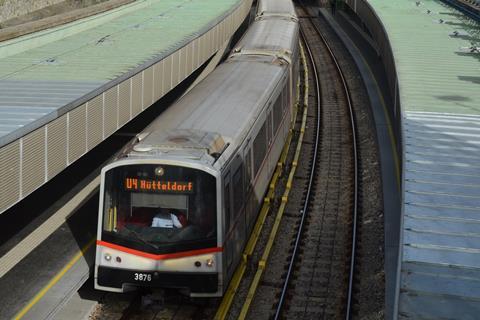
Deliveries from Siemens’ Wien factory are scheduled to run from mid-2020 to 2030. The Type X sets will also be able to operate at a lower level of automation on existing metro lines, and they are expected to replace all the Type U trainsets still in use. These were manufactured by Simmering-Graz-Pauker in 1972 and 1987.
The six-car Type X trains will be 111·2 m long and 2 850 mm wide, with capacity for 928 passengers, including 200 seated. Several features would help to improve passenger flows, including the seating layout, walk-through gangways and a passenger information system providing directions for connections at each station. A transparent partition behind the driver’s cab would give passengers a view of the line.
The aluminium bodied trains would have a maximum starting acceleration of 1·2 m/s². In addition to regenerative braking, the trains will utilise energy reduction measures such as LED lighting and efficient HVAC.
New trams on new routes
Tram projects are also pressing ahead, after Wiener Linien decided in 2017 to invest €70m into tram and bus services in 2018-20.
A 1·1 km southern extension of Route D is due to open in mid-2019, taking the line from Alfred-Adler-Straße to Gudrunstraße, adding two stops. This is intended to serve the newly built district at Sonnwendviertel.
Construction on the next tram project is due to start in mid-2019. The northern Route O extension would run for 1·4 km from Praterstern to Nordbahnviertel, adding four stops. Opening is due by late 2020.
Further network expansions are planned. In the Nordbahnviertel district a new route is to be built, known as Route 12. Route 67 is to be extended southeast from Reumannplatz, and two extensions of Route 25 are also planned. In the south of the city, Route 15 is to be built between Meidling and Altes Landgut after 2028.
Investments are also being made into rolling stock. At the end of 2018 the city welcomed its latest generation of trams, when the first Flexity Wien entered revenue service on Route 67 on December 6.
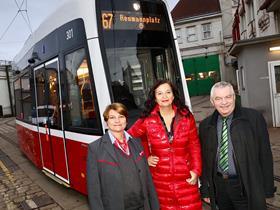
Bombardier Transportation is delivering 119 trams from its factory in the city at a rate of one a month under a €431m contract signed in 2015. This includes options for 37 more trams, as well as 24 years of maintenance support under Bombardier’s FlexCare programme.
Deliveries of the base order are due to be completed in 2026. The trams are stabled at Favoriten depot and will be used on lines D, 1, 6, 67 and 71. The 34 m long trams have capacity for 211 passengers and an entrance height of 215 mm. The Flexity Wien fleet will allow Wiener Linien to withdraw the remaining class E1 and E2 high-floor trams.
New WLB stock
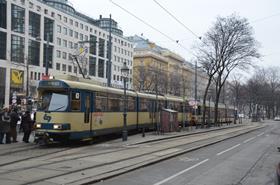
Bombardier is also supplying Flexity vehicles for use on the light rail line operated by Wiener Lokalbahnen which runs from Oper in the city centre to Baden. WLB ordered 18 TW500 light rail vehicles on December 20 2018, with the option for an additional 16. As with the Flexity Wien contract, the €94m order includes 24 years of maintenance under FlexCare. The first LRVs are due to enter service in 2021 and will replace the TW100 LRVs that date from 1979-93.
The WLB fleet is stabled at the Inzersdorf depot, which opened on March 21 2018. The 6 500 m2 facility replaces the Wolfganggasse depot, which closed a few weeks after the new depot opened; the line near it was rerouted through Flurschützstraße. Built in 26 months, the Inzersdorf depot features 1 720 m of stabling tracks and a two-storey office building.
The new LRVs will enable WLB to introduce 7 min headways from 2021, doubling the service from the current 15 min. The route carried 12·7 million passengers in 2018.
Autonomous vehicle trials
Wiener Linien expects to carry its first passengers on a driverless road vehicle this year. The auto.Bus Seestadt project, which started in mid-2017, involves two autonomous shuttles supplied by Navya running on a 2·2 km route between Seestadt metro station and Gisela-Legath-Gasse.
The autonomous shuttles have a maximum speed of 20 km/h and can carry up to 10 passengers plus an attendant. Travel will be free.
In addition to Navya, Wiener Linien has partnered with the Austrian Institute of Technology, the Austrian Road Safety Board, Siemens and TÜV Austria.
These are not the only electric road vehicles in operation in Wien. Since mid-2013, bus routes 2A and 3A have been operated with a fleet of 12 battery buses supplied by Siemens. The 7·7 m long vehicles have capacity for 40 passengers including 13 seated, and have so far covered a total of 1·3 million km. The buses are equipped with 96 kWh lithium iron phosphate batteries, which power a 150 kW motor.
In 2019-20 seven electric buses are to enter service on Route 4A. The 12·1 m long buses supplied by Rampini have capacity for 63 passengers including 28 seated. Like the Siemens buses, the batteries on these will be charged through a roof-mounted pantograph.
Railway investment

Wien is also served by a suburban rail network, branded S-Bahn. This is receiving a €450m investment following an agreement signed between ÖBB, the city authorities and the Ministry of Transport in June 2016. The government is providing €380m, with the balance coming from the city budget. This is to be used for the purchase of new rolling stock and station modernisation.
A separate funding package is being used to upgrade the Hütteldorf – Meidling section of Line S80. Level crossings are to be eliminated, and the line will be double-tracked on the bridge across the River Wien. Stations will be built at Hietzinger Hauptstrasse and Stranzenbergbrücke, and the existing Speising station will be modernised. Once the €265m project is completed in 2025, services on Line S80 can be made more frequent.
The work is being funded as part of a €4bn package announced by rail infrastructure manager ÖBB Infrastruktur in January covering the Länder of Wien, Niederösterreich and Burgenland. ÖBB Infrastruktur manages around 2 000 route-km of railway in these three regions.
The initial tranche in 2019 is put at €600m, with the full €4bn to be disbursed to 2023. Several regional projects are to be carried out under this investment package, including a route study for a second line to Wien airport.
Graz tram investment
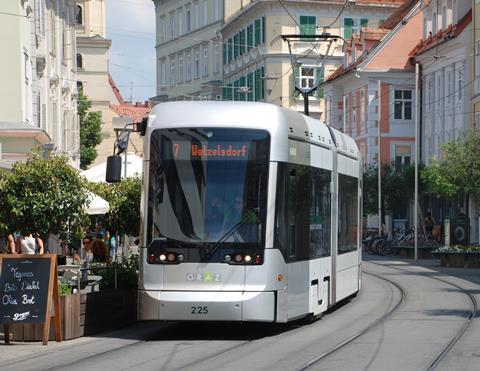
Five projects intended to relieve congestion on the Graz tram network are due to be completed by 2023. The 67·2 km network in Austria’s second-largest city carries 170 000 passengers a day.
The Land of Steiermark is providing €43·8m, the city €44·5m and the federal government €29·1m under a financing agreement signed on February 5 2018 between Mayor Siegfried Nagl and Steiermark Infrastructure Minister Anton Lang.
Three of the projects are extensions. The most important will provide a second connection between the northern and southern parts of the network, which are currently only connected by a congested line along Herrengasse. A 1 km route is to be built from Jakominiplatz to Annenstraße via Neutorgasse, Belgiergasse and Vorbeckgasse. Work on the €27m project is due to take place in 2020-23.
The Reininghaus extension is a 1·8 km route from Eggenberger Straße to a new turning loop at the former Hummel Barracks in the west of the city. In addition to the tram line, around 4 km of footpaths and cycle paths will be built, bringing the project cost to €44·1m. Work is due to begin this year and last until 2021.
The 1·1 km Smart City extension is intended to run north from Asperngasse to Peter-Tunner-Gasse. It would be built in 2020-21 at a cost of €22·4m.
Two double-tracking projects are also planned. In the south, 1·4 km of Route 5 between Zentralfriedhof and Puntigam is to be doubled in 2022-23 at a cost of €15·3m.
The northeastern end of Route 1 is also to be doubletracked, between Mariatrost and Hilmteich. The 1·2 km first phase has been underway since 2018, and the doubletracked Mariatrost – Mariagrün section is due to open this year. The 700 m Mariagrün – Hilmteich section is due to follow in 2023. The total cost is €8·6m.
In February 2019 the city council discussed two further extensions at an estimated combined cost of €200m. One extension to Gösting would carry 55 000 passengers/day, and the other, to Strassgang, between 30 000 and 40 000. An extension to Don Bosco railway station is also planned. Separately, a cable car has been proposed across the Mur River. This is still at an early stage of planning, and several routes for the so-called Murgondelbahn have been proposed.