A project which aims to develop a more affordable alternative to traditional tramways is taking its next major step. Andrew Grantham reports from the Very Light Rail National Innovation Centre.
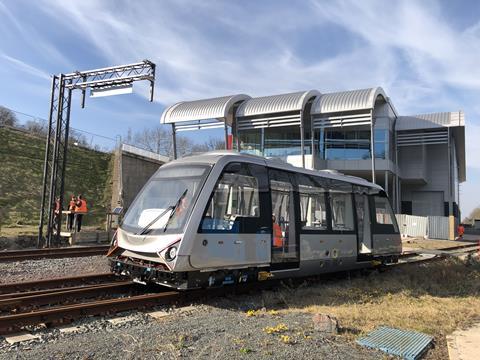
UK: A prototype Very Light Rail vehicle and a novel design of track are to be demonstrated under real-world conditions in Coventry this year, the latest step in a research project which aims to reduce infrastructure and operating costs to a level which would make trams an affordable option for medium-sized cities.
The project is being led by Coventry City Council, which has longer term ambitions to establish a network of routes around the city. Development is being funded by the Department for Transport through the City Region Sustainable Transport Settlement awarded to the West Midlands Combined Authority.
It is classed as research rather than a transport project, which simplifies some of the funding, procurement and technical requirements. In particular, the prototype vehicle does not meet normal light rail standards, and so it is unlikely to carry fare-paying passengers.
If demonstration operation between May 28 and June 18 is deemed successful, the city council hopes to apply for funding for the construction of a passenger-carrying line in Coventry and a fleet of vehicles suitable for passenger operation.
Novel track
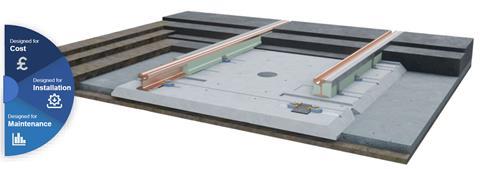
The novel track is designed to be significantly more affordable than current light rail infrastructure with less need to move utilities.
Developed by the University of Warwick with Coventry City Council, French civil engineering company Ingerop Conseil et Ingénierie and its UK subsidiary Rendel, it comprises 100 mm deep precast panels of ultra-high performing concrete. These require excavation just 300 mm into the road surface, significantly shallower than conventional light rail tracks. The design assumption is that most existing road structures will provide sufficient support, enabling integration with minimal disruption to surrounding infrastructure.
Removing the requirement for large-scale excavations, road modifications and buried utility diversions is expected to reduce the cost and time need for light rail projects. Other benefits include reduced carbon emissions during the installation works, and easier removal to provide access for utility maintenance.
Standard grooved rail and fastenings are used.
As well as facilitating VLR projects, it is hoped that the track design could also be used on traditional tramways to make network expansion more affordable.
An initial prototype section of track was installed at the University of Warwick.
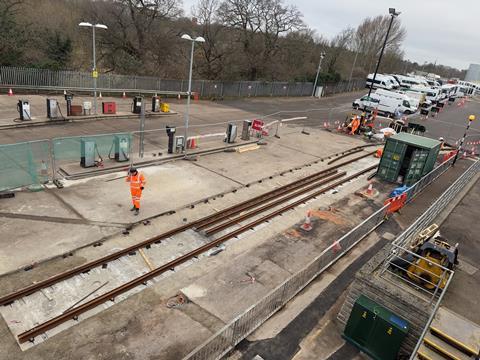
A second section was installed at Coventry city council’s Whitley Depot in 2023. This location was chosen so that the track would be regularly driven over by heavy lorries, enabling its long-term performance to be tested under stress conditions.
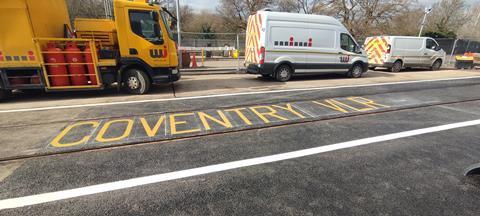
Sensors weighed lorries as they crossed the track, and recorded vibrations for analysis by researchers.
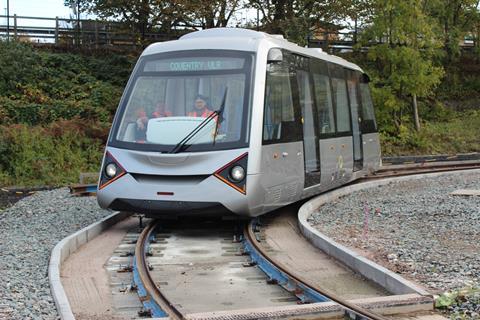
A third section of track suitable for operational testing was installed by contractor Galliford Try at the Very Light Rail National Innovation Centre, housed by not-for profit research and technology body the Black Country Innovative Manufacturing Organisation.
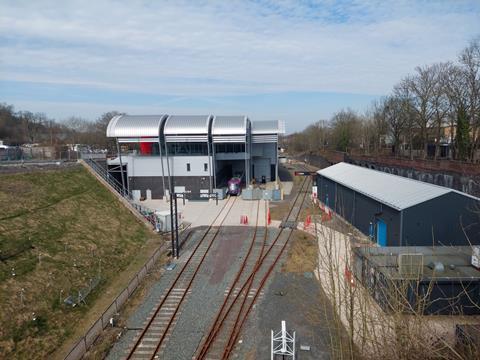
The BCIMO site next to the zoo in central Dudley provides R&D facilities where new technologies can be trialled away from the main rail network, in contrast to other test facilities which require working to operational railway standards, are expensive to use or are simply fully booked. It has engineering labs and equipment available for third party use, as well as serviced offices and event spaces.
There is a 2·2 km test track on a former railway alignment which includes a tunnel. This conventional track is connected to a 65 m long section of the novel VLR track which includes a very tight 15 m radius curve and a 250 m radius vertical hump, a feature which can be a challenge for traditional slab track designs. The track is instrumented to assess how it interactes with the prototype Coventry VLR railcar.
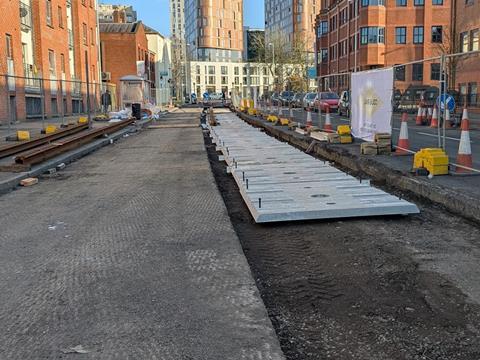
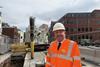
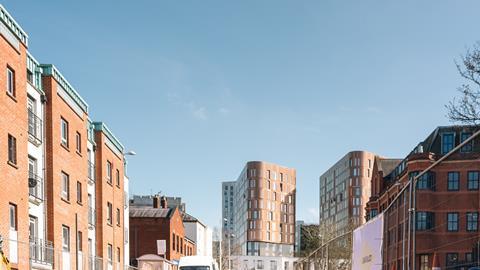
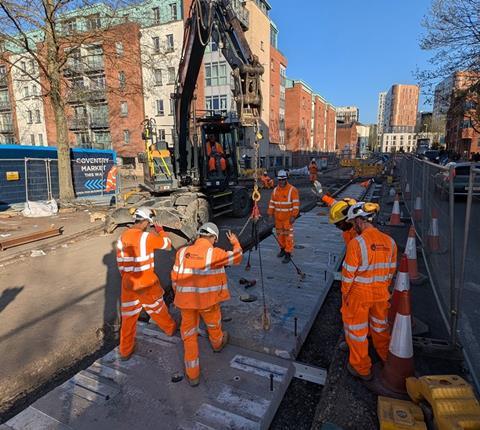
The latest section of test track — and the first to be installed in a real-world urban environment — is being built on Greyfriars Road and Queen Victoria Road in Coventry. The contract was awarded to Colas Rail UK, which will use its expertise in railway construction to provide feedback on the process.
The test section was initially going to be 800 m long, but the project team determined that only 220 m would be needed to assess the viability of installation and the interaction with the different types of utilities under the city’s streets; it crosses clean and foul water, gas, electricity and telecoms routes. This reduction in length has cut the cost of the trial, freeing money for other research projects.
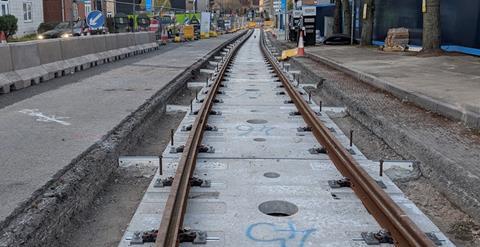
The alignment was chosen to test real-world challenges typical of city centres. It traverses a longitudinal gradient between 1·5% and 3·5%, incorporates a 30 m radius curve, and there is a continuous cant to facilitate compatibility with existing road geometry.
Construction was undertaken within a strictly constrained corridor, with no full road closures or traffic diversions required. Installation required a 14 tonne wheeled excavator, a small breaker and a dumper, with the relatively low weight of the UHPC slabs enabling handling by a small crew.
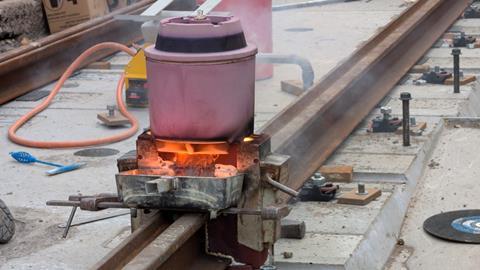
Pandrol provided the rail joint welding system, with project-specific adjustments to suit the geometry and fastening arrangement.
‘This trial installation demonstrates how innovative rail infrastructure can be delivered in real city environments with minimal disruption’, said Iain Anderson, Managing Director of Colas Rail UK. ‘Our teams worked closely with Coventry City Council to adapt to complex site conditions in real time, showing what’s possible when engineering meets digital responsiveness.’
The track will be used for four weeks of demonstration runs with the prototype railcar. It will then be used to test gaining access to utilities. The track section has a high-frequency structural health monitoring system including strain gauges embedded within the UHPC slabs, asphalt strain gauges, accelerometers, pressure sensors, relative movement sensors and AI-enabled camera systems.
This will enable engineers to study the behaviour of the infrastructure under ambient conditions, a moving railcar and general road traffic over the short and long term. The data will feed into a digital twin of the track form, allowing predictive modelling, life-cycle assessment and future specification refinement.
Installing the trial section of track ’represents a step-change in the technology readiness level of the novel CVLR track system’, said Dr Christopher Micallef, CVLR Track Programme lead at Coventry City Council. ‘Having progressed through concept design, laboratory testing and a series of increasingly complex pilot installations in controlled environments, we are now proving the system in a dense, operational urban corridor for the first time.’
Universal Signalling is providing ‘state-of-the-art vehicle protection solutions’ to ensure the safe operation during this trial. The company’s Product Director Mark Beeson said ‘our company ethos perfectly matches Coventry City Council’s vision of providing a fully featured system, but delivered at a much reduced cost base and short timescale via employing cutting edge innovation. This is an exciting opportunity for us to showcase our capabilities in a live operational environment.’
Once the trial runs end the site will be returned to regular highway use, but it will continue to serve as a long-term testbed. Regular road traffic will contribute live loading to the track form, providing data to validate the system’s performance over time.
If the testing is successful, a business case will be developed for a commercial VLR route in Coventry.
Concept vehicle
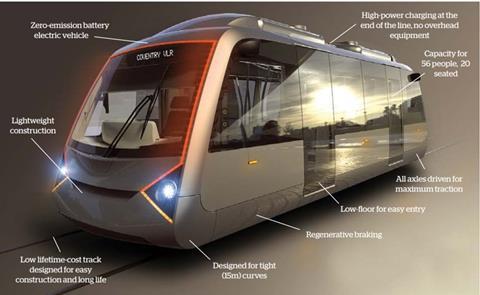
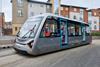
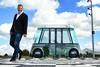
Meanwhile, the battery-powered prototype Coventry Very Light Rail vehicle is on test at the VLR National Innovation Centre.
The CVLR was developed in collaboration with the University of Warwick and manufactured in Coventry at NP Aerospace
Angus Brummitt-Brown, Senior VLR Project Manager at Coventry City Council, stresses that this first vehicle is for research and development, and as such is not suitable for commercial passenger operations in uncontrolled environments. ‘It is a concept vehicle which includes some really great ideas, but as with all concepts, next time you wouldn’t do it like that’, he explains.
Funding is now being sought for a second generation vehicle.
The existing vehicle is bidirectional and weighs about 1 tonne per metre. All wheels are powered, and each has its own axle, enabling it to negotiate tight curves down to 15 m radius. The window glass takes into account the findings of the Croydon tram crash of 2016.
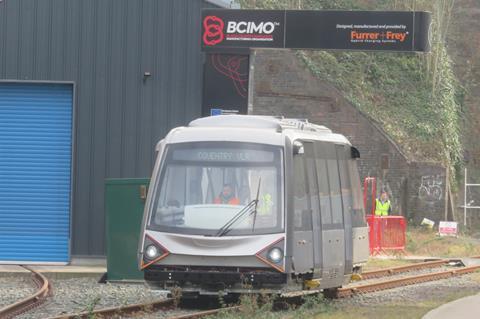
The battery can be charged from 10% to 90% in 12 min using a 450 kW Furrer+Frey opportunity charger. This was originally designed for use with buses, and has a pantograph that lowers from above, rather than one fitted on the roof of the vehicle. The battery has a range of 50 km per charge. It is not charged to 100%, to leave capacity for regenerative braking.
The focus on the VLR project is on reducing the overall costs of light rail, so as well as looking low cost track and rolling stock the project aims to reduce operating costs.
The CVLR has a capacity of 56 passengers including 20 seated. Brummitt-Brown says this ‘is not too small’ but is the optimal size because ‘we don’t want to be transporting empty seats around’.
When more capacity is needed extra vehicles would run, with the possibility of platoon-style operation with a driver in the lead vehicle controlling other vehicles following along behind without a physical link in the ‘train’.
Autonomous operation is envisaged for the longer term, however there are unresolved questions about the legal environment and public acceptance. Brummitt-Brown says that in purely technical terms the vehicle ‘could be driverless in a couple of weeks. But there is no advantage to this at present’, and so production vehicles would have a driver, at least at first.
Demonstration runs
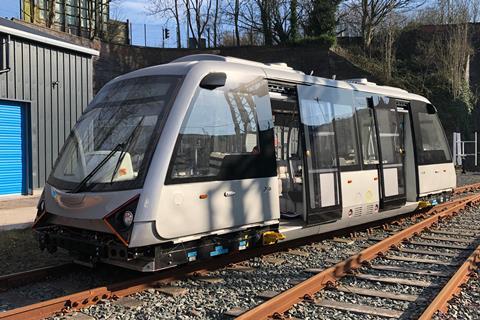
Demonstration runs in Coventry are planned for May and June, with the prototype vehicle to be driven by a father and son team from the UK arm of German special train operator RailAdventure.
‘This project is a perfect fit for RailAdventure: it’s local, innovative, and uses our operational expertise and passion for bringing new ideas to life’, said Kevin Walker, Managing Director of RailAdventure UK.
Councillor Jim O’Boyle, Cabinet Member for Jobs, Regeneration & Climate Change at Coventry City Council, said ‘residents will have the opportunity to experience this one-of-a-kind vehicle and track system and provide feedback on the experience’.
Details of how to apply to take part will be made available on the council website.
A game changer?
The project partners believe VLR has the potential make urban transport significantly more affordable for medium-sized cities and larger towns; Stoke-on-Trent has already expressed interest.
O’Boyle said ‘we think it will be a real game changer in terms of how people move around, especially in towns and cities and it will save cash, cut carbon and eventually provide a driverless hop on and hop off option.’
He said ‘there is lots of interest from across the UK and further afield so we are really looking forward to showing everyone how quickly the track can be laid — that really is the clever bit of our system.’
Mayor of the West Midlands Richard Parker said ’this revolutionary Very Light Rail technology, in which the West Midlands is leading the way, will slash costs and accelerate construction times for tram networks — allowing us to better deliver on my vision to connect communities with more affordable and accessible public transport.
‘We are investing millions in this project, and the start of work on this test track shows how close we are to making this a reality.’
- The background to the VLR project was described in the Spring 2020 issue of Metro Report International magazine.