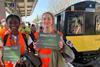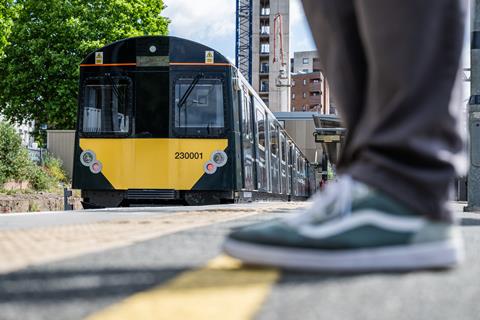
UK: Great Western Railway has announced that its Class 230 prototype battery trainset is to enter passenger service on the Greenford branch in west London on January 31.
The first passenger service is scheduled to be the 05.30 from West Ealing to Greenford. Unit 230 001 will initially carry passengers on Saturdays, with GWR planning to increase services as it learns more about the BEMU’s performance.
The battery trainset was converted from former London Underground D78 metro cars by Vivarail. After Vivarail went into administration in December 2022, GWR bought the intellectual property, rolling stock and battery fast-charging technology to ensure that a planned trial on the 4 km non-electrified Greenford branch could go ahead. The 22-month trial used a lineside battery bank and short charging rails installed at a station.
Diesel replacement ambitions
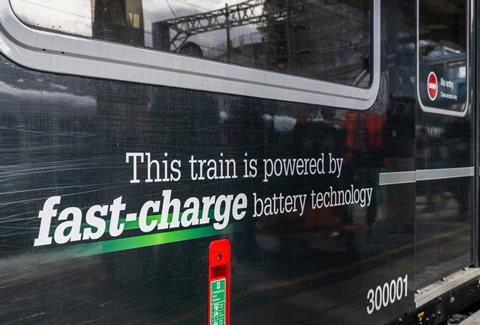
The start of passenger-carrying services ‘is a significant moment for all those involved in this innovative project and comes at a crucial time as we focus on plans to replace our ageing diesel fleet’, GWR Engineering Director Dr Simon Green said on January 29. ‘Our fast-charge trial has successfully demonstrated that battery technology offers a reliable and efficient alternative to power electric trains, in cases where overhead lines aren’t possible or desirable. Delivering the train into passenger service will enable us to gain further insight which can be fed into our own decarbonisation plans, as well as those of the wider rail industry.’
In July 2025 GWR published a white paper outlining the findings of the trial, saying ‘if you take one fact away from this report, it’s this: fast-charge battery train technology works’.
In August the Class 230 set a world record for the furthest distance travelled by a battery train on a single charge, covering 320 km to beat the previous record of 224 km set by Stadler using a new-build Flirt Akku BEMU in Berlin in 2021.
Branch line plans
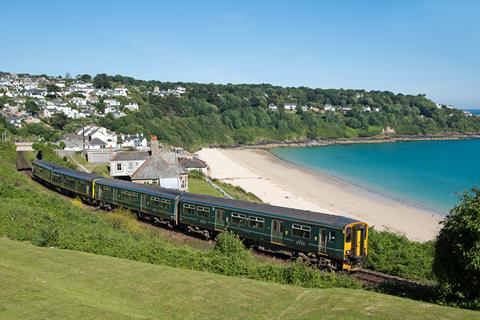
GWR is looking to replace diesel multiple-units on branch lines in the Thames Valley, Devon and Cornwall, which are unlikely to priorities for electrification in the forseeable future. It has calculated that battery trains would need to routinely cover more than 95 km between charges, and says the record showed that the technology is a viable option.
In the white paper, GWR Managing Director Mark Hopwood said the trial was undertaken ‘not because we think 45-year-old Underground trains are the answer, they’re not’, but because the technology used is ’at the forefront of cutting edge research, delivering evidence for the benefit of the wider rail industry’.
GWR is now working ‘closely’ with the Department for Transport and other train operators to build the best financial case for investment in battery-powered trains.
Supporting documents
Click link to download and view these filesGWR Fast Charge White Paper - July 2025
PDF, Size 3.43 mb