UK: Completion of the elevated alignment that will carry High Speed 2 into central Birmingham from the east has moved a step forward with the completion of a six-day bridge rotation and slide over a busy road in the city.
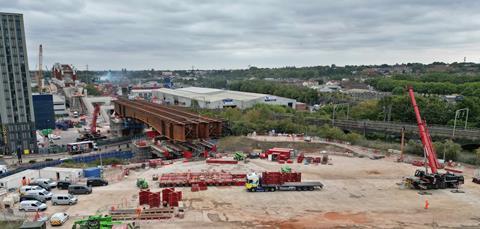
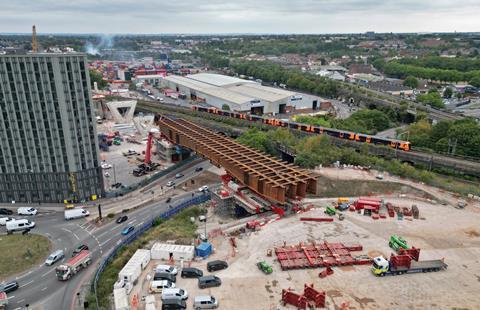
On August 15, a 1 631 tonne bridge assembly was rotated 90° in preparation for pushing it out over Lawley Middleway, a major road artery.
Lawley Middleway connects the northeast and southeast areas of the city, and it is sufficiently busy that HS2 contractor Balfour Beatty-Vinci joint venture, which is constructing the West Midlands section of HS2, was unable to close the road for any significant amount of time.
Instead, the bridge was moved into position during the evening, which required a number of night road closures from August 16. The method employed to move the bridge had not been used by BBV before, nor had it been used often in the UK.
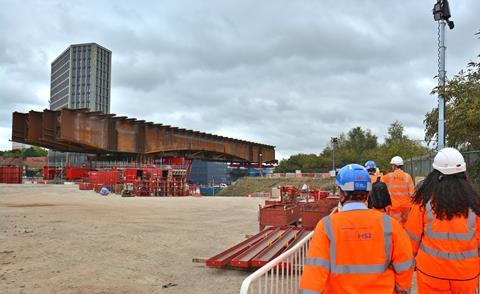
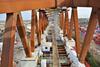
This ‘skidding system’ approach involved first using self-propelled modular transporters to manoeuvre the bridge into position; once correctly aligned, the bridge elements rested on the vehicles themselves. The SPMTs then worked in concert with a set of guide rails and hydraulic rams to push the bridge over the road.
Once a guide beam connected to the eastern end of the bridge had reached the opposite side of the road and was resting on a second skidding assembly, the SPMTs were moved out from under the bridge and the move was completed solely by the guiderails and rams.
The operation had to be carefully choreographed, as the SPMTs needed to move forward at the exact same rate as the hydraulic rams. One end of hydraulic rams pushed against a ratchet system and the other against a set of ‘shoes’ upon which the bridge was resting. The rams pushed the bridge gradually for 700 m over the road. After each stroke, they were reset to begin the process again.
The bridge progressed by approximately 12 m each evening, and by the morning of August 21, it had been fully moved into position.
A two-year process
Over the previous 24 months, the arch structure had been assembled on site in Birmingham from weathering steel sections which were manufactured in Bolton by Severfield. Assembly took place between Lawler Middleway and the Digbeth branch of the Birmingham & Fazeley Canal. The constrained nature of the site meant that it was not possible to assemble the bridge in the correct orientation, which is why it had to be rotated using two sets of SPMTs before being slid into place.
Now that the bridge has been moved into position, BBV can begin the process of lowering the bridge from the ‘shoe’ supports used during the move onto permanent bearings located on top of the precast concrete piers. The bridge will be lowered in stages until it is resting approximately 3 m lower than its current position.
At that point, the process of connecting it to Curzon No 3 Viaduct will begin. The section between Lawley Middleway and the canal to the west will be erected from steel beams which will be lifted into position using cranes. The section crossing the canal itself will be built in situ using a scaffold and formwork structure, a similar method to that used to build the No 3 viaduct.
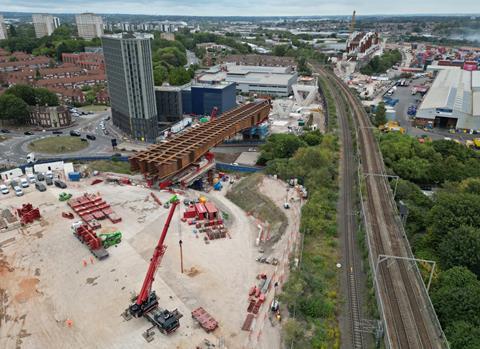
At the eastern end of the bridge, a further section will be needed to connect Lawley Middleway Bridge to Curzon No 2 Viaduct. But this cannot happen until that viaduct has been moved into position, which is scheduled to take place next year.
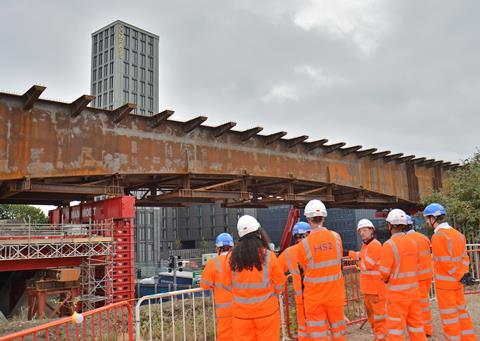
This complex series of structures will, once finished, effectively create a single 1∙8 km-long elevated guideway carrying HS2 into Curzon Street station from the east. To form the deck and support the ballastless trackform, BBV will install precast concrete panels, over which will be poured a layer of in-situ concrete mix to ‘stitch’ the panels together.