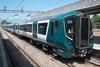
UK: West Midlands Trains has confirmed that the much-delayed entry into service of its Class 730/2 Alstom Aventra EMUs is now expected to begin on June 9.
The five-car sets have been specifically designed for the London Northwestern-branded longer distance services, offering improved spacing between the 2+2 seats. Fewer cabs and longer vehicles mean a pair of 730/2 units will offer 812 seats, 112 more than 12-car Class 350 formations which they will replace.
‘It’s a real increase in capacity, and that’s not been achieved by just squashing people in, it’s done in a comfortable way with the longer coaches’, explains Engineering Director John Doughty.

Other features include wide gangways, at-seat power, improved heating and ‘intelligent’ air-conditioning.

One end vehicle has slightly higher specification seats with leather headrests and sculpted cushions, as the operator’s decision to move away from offering first class came late in the production process.
Entry into service has been delayed because of a high level of noise inside the cabs when running at speed. ‘Over 90 mile/h it started to become a problem’, according to Doughty. ‘We are the first operator of an Aventra that does 110 mile/h [178 km/h] and we’re the only operator of an Aventra that has got a through gangway at the end.’
Changes to address this include perforated panels which absorb noise within the cab. ‘Alstom are working really hard on the modifications that are required, we’ve got a substantial number of the units completed and that is what allowed us to commence the driver training just after Easter’, Doughty said. During this time EMUs have continued to be accepted by the operator with modifications completed via a commercial deal between the businesses.
Introduction into service is a complex process; Doughty notes that current Class 350 diagrams go ‘hopping around our network’ and ‘you can’t change one diagram out without changing five or six; that’s really complicated in terms of logistics’.

The first use will be on the West Coast South section, where three-car Class 730/0 sets destined for the West Midlands have been drafted in on a temporary basis to enable early release of Class 350/2 EMUs. This means that the new trains can stay close to their home depot of Bletchley.
‘Later on into the summer, we’ll be rolling them out on a temporary basis on Liverpool to Birmingham and then onto Crewe to London services later on in the year’, Doughty explains. ‘The train crews in the West Midlands and northwest have already been trained in the Class 730 three-car fleet, so it’s a relatively short one-day conversion for them.’ Fewer drivers on West Coast South are qualified on the type, so there will be a logical sequence of introduction as crews and depots complete their training.
The plan is driven in part by the need to complete the hand-back of the Class 350/2 sets, ‘which from a customer perspective is good because they haven’t had the same level of refurbishment that we had for the /1, /3 and /4s.’ Seven of the 37-strong fleet have been handed back to leasing company Porterbrook and the aim is to complete the process by the end of the year. From that point, almost all West Midlands local services will be in the hands of Class 730/0 sets, the exception being services on the Birmingham – Northampton route which will stay with eight-car Class 350 formations due to platform length constraints.
Doughty notes that until Birmingham Cross-City line services return to six trains per hour, the company will have a surfeit of EMUs. ‘We’ve got slightly too many trains for four trains per hour, but this has all been specified with a view to bringing six trains per hour back, which we know there’s a really good case to do; the trains are very busy. It’s the busiest main line metro service outside of London, so it’s a really important commuter route; you should have a train every 10 min and it’s very much our intention to put that back as soon as we possibly can.’
Ultimately, many Birmingham – Liverpool services will return to Class 350 operation in order to provide maximum capacity; platform lengths again rule out 10-car 730/2 formations but eight-car 350s on peak services can be accommodated. This move is also a result of a lack of stabling space for trains across the West Midlands, a challenge which must be resolved before the Cross-City service frequency can be improved.

‘We’ve spent a lot of money developing the facilities’, Doughty notes, ‘but we do still need a West Midlands stabling location, that’s one of the enablers for six trains per hour. We are working on that with Network Rail looking at alternatives as well as long term plans around Bescot.’
Once all 730/2 sets are in service, the aim is to diagram between 32 and 33 every day with all of the five-car sets fully deployed on the West Coast services. Doughty comments that ‘we see significant demand even today; our 12-car 350s on the Trent Valley can be full and so the vast majority of services (on that route) will be pairs of units. In fact a lot of our services on the West Coast seem to be getting extremely busy, which is great, so we want to be able to match capacity and demand as much as possible.’
WMT continues with its application to extend services from Stafford to Manchester Airport. ‘Obviously, we don’t know what the outcome of the application will be, but we’re very keen on that because, as anyone who’s travelled from Birmingham to Manchester and worked in Manchester knows, the journey is awful whether you’re on the train or driving; it’s not the easiest journey’, said Doughty. ‘I think any improvements in public transport between the Midlands and Manchester would be very much welcome and we’re very keen on our plan for Manchester Airport.’ Services would be operated by Class 350 units due to platform length constraints at the airport.
An extension of the Trent Valley line services beyond Crewe to Manchester Victoria is also an aspiration. ‘There’s significant demand for that, and we know that we can do it in a cost efficient way. We’re very keen to grow our services.’