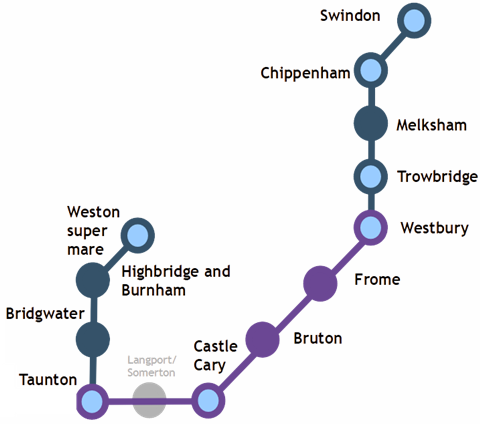
UK: Open access passenger train start-up Go-op Co-operative says ‘a hostile investment environment’ has so far prevented it from raising the funding it needs to launch services between Swindon, Taunton and Weston-Super-Mare, and there is ’now one last chance’ to for investors to step in before its track access rights expire.
May deadline
In November 2024 the Office of Rail & Road agreed to Go-op’s application for track access, but to reflect the would-be operator’s novel co-operative structure the regulator required it to secure £2·6m of funding by May 2026 and then launch by December 2026, otherwise the access rights running to December 2030 will lapse.
The funding requirement comprises £1·1m to launch the business and begin operations, and £1·5m for upgrades at eight level crossings. Go-op raised around £600 000 for development, and signed a track access contract with Network Rail in June 2025, but it has yet to raise the full amount required.
Time running out
On February 23 Go-op said its initial share offer at the end of 2024 had been ‘rushed and poorly resourced’ and ‘fell far short of its target’, as many investors ‘either didn’t hear about it or viewed the target as unachievable’. It changed its approach towards working with a small number of specialist larger investors, but negotiations foundered ‘when it became clear that there was too much uncertainty for any to commit funds’.
Go-op remains keen to hear from investors, but said ‘this opportunity is available for only a matter of weeks’ before ORR withdraws support.
It said ‘industry standard’ demand forecasts show there would be trading losses to begin with, but it ‘would rapidly move into profit, sufficient to easily repay the initial investment’.
Operations Director Alex Lawrie said ‘the business case is as strong as ever, and we’ve not held back from offering strong returns on investment — keystone investors have the opportunity to double their money. But the fact of the matter is that with time running out for delivery of the new services, we’re hearing from investors large and small that factors outside Go-op’s control are making it impossible for them to commit to the investment that is required.’
Reasons for investor hesitancy
Go-op said a number of factors have contributed to investor hesitancy, with Lawrie saying ‘people have a right to know why this such a struggle’.
It said an ‘impression of government hostility to future open access rail’ has ‘drowned out the actual support from the Department for Transport for this particular service’. It said that while there is a clear target for increasing freight under the future Great British Railways, there is no target for increasing passenger numbers and ‘that means there are many reasons to limit capacity for new passenger services, and none to increase it — the wrong signal to send potential investors’.
Go-op says ORR’s approach to calculating funding requirements made the initial funding hurdle higher than needed, with a ‘particularly pessimistic’ estimate for the cost of level crossing works.
It also says ‘longstanding underinvestment’ in the railway, coupled with pandemic impacts and industrial disputes, have ‘severely damaged’ rail’s reputation, and the ‘uneven and hesitant progress’ of combined authorities and the ‘weakened and demoralised state’ of local government have removed a source of reassurance for private sector investors.
Meanwhile ‘hidden structural biases’ in business funding infrastructure have created ‘unnecessary obstacles’ for a co-operative society, and the co-operative movement lacks the capabilities to support a co-op entering an entirely new business sector.
Lawrie said ‘investors that recognise the inherent strengths of rail as mode of transport, and respond to the specific strengths of this proposal rather than historic impressions of the whole industry, will find a fundamentally sound proposition. Regardless of the outcome of this particular contract, Go-op will continue to work towards public transport that is accountable to its users; and will explore more innovative approaches to mobilising investment in the Taunton – Swindon corridor.’