
UK: Stakeholders from across the rail sector have welcomed the government’s committment to developing the Northern Powerhouse Rail programme as well as a new line between Birmingham and Manchester. However, they have called for more details on scope, governance and timescales as well as decisive action to begin delivery.
Supply industry comment
‘Today’s announcement is a significant declaration of intent from the government on future rail investment in the north’, said RIA Chief Executive Darren Caplan on January 14. ‘RIA and our members now ask to see detailed plans, timescales and committed budgets to all three phases of the government’s plans, in order to ensure that this statement of intent announced today becomes a reality well within its 2040s deadline.’
The High Speed Rail Group said a new line from Birmingham to Manchester was ‘essential’ to avoid ‘locking in Britain’s biggest bottleneck to the north of Birmingham and ensuring the investment already made into HS2 Phase 1 is not wasted’. However, the industry group is concerned about a lack of clarity on the plan and timescales potentially decades away, as well as the government’s decision not to extend legal powers to purchase land between Birmingham and Crewe which expire in February.
Ben Brittain, Director of Public Affairs at the Association for Consultancy & Engineering, said ‘our members will work hand in glove with government to move quickly from announcement to delivery, starting with clarity on delivery timelines and scope. The economic transformational effect of these infrastructure projects need to be felt quickly, so speed of delivery is mission critical. By bringing commercial discipline, engineering expertise and a clear focus on outcomes, we can remove obstacles, control risk and ensure these projects are delivered efficiently and deliver real value for taxpayers and businesses alike.’
Sam Gould, Director of Policy & External Affairs at the Institution of Civil Engineers, said stakeholders must learn the lessons from HS2, and ‘the purpose of the project must be clear, who is in charge must be clear, the right capability and understanding must be present in government departments, and the project must be sufficiently developed before ground is broken’. He said the programme could be transformative for the whole of the UK, and ‘ICE is ready to work with government to ensure the right pieces are in place to stay the course and deliver this vision successfully’.
Amish Patel, Transport Leader at PwC UK, said ‘the strategic intent is right’ and ‘the focus must now shift decisively from ambition to delivery. That means sequencing investment carefully, securing early and visible benefits, and ensuring the right delivery capabilities are in place in the right locations at the right time. Major programmes of this scale succeed not just through funding, but through strong governance, commercial discipline, and a realistic approach to skills and supply-chain capacity.’
Jerome Frost OBE, CEO of Arup, said ‘our analysis shows that properly delivered, NPR will do far more than move people faster between cities. It will generate tens of billions in economic benefits and provide the sustainable transport choices essential for future communities.’
Paul Hirst, Chair of the Transport Committee of the Northern Powerhouse Partnership of business and civic leaders and Head of Transport at Addleshaw Goddard, said ‘time is critical — we cannot afford another decade of delay’. The law firm produced a report backing NPR in 2019, and participated in the 2024 Opportunity Through Connectivity report into a new line for the Greater Manchester and the West Midlands.
Michael Toher, Head of Rail UK & Ireland, Ramboll, said ‘with investment at this scale, there is a genuine opportunity to set new benchmarks for the standard of rail and connectivity in the north. What’s now critical is confident, swift delivery. Infrastructure improvements often spark a ripple effect of investment and growth, but we need assurance that plans are well-backed and can move forward quickly. Mixed messages and delays, as seen with NPR, can be damaging to attracting essential private investment.’
Political response
Mayor of Greater Manchester Andy Burnham said ‘finally, we have a government with an ambitious vision for the north, firm commitment to Northern Powerhouse Rail and an openness to an underground station in Manchester city centre. A modernised Manchester Piccadilly could become the [London] King’s Cross of the north, acting as a catalyst for major growth in our city region and beyond.’
Lord Blunkett, author of the Yorkshire Plan for Rail, said ‘Yorkshire, with a population greater than Scotland, has long been neglected and this announcement starts the process of putting right years of neglect’.
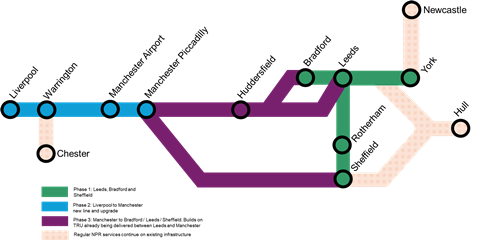
In a joint statement, the mayors of South Yorkshire Oliver Coppard, West Yorkshire Tracy Brabin and York & North Yorkshire David Skaith said ’decades of underinvestment have left Yorkshire’s transport network overcrowded and outdated. The first phase of Northern Powerhouse Rail will tackle this head on, with a clear national focus on connecting Sheffield, Leeds, Bradford and York with a frequent, electrified service.
‘As set out in Yorkshire’s Plan for Rail, we will work to deliver up to four fast trains an hour between Sheffield and Leeds, with a 30 min connection which will help unlock over a million extra journeys a year and boost the economy. A commitment to upgrade the infrastructure at Leeds, York and Sheffield stations, as well as the vital new station for Bradford and onward connection to Manchester, will be crucial to realising this vision, enabling more direct services and longer trains to run across the region.’
The mayors added that ‘today’s announcement is just the beginning. Alongside Northern Powerhouse Rail, we will keep working with the government to push for the delivery of all the schemes included in Yorkshire’s Plan for Rail to make sure all our cities and towns benefit from this unparalleled investment. Mass transit in West Yorkshire and tram-train expansion in South Yorkshire; two trains/h between Sheffield, Barnsley and Huddersfield, and from York to Scarborough; fixing the bottlenecks on the East Coast Main Line at York and Doncaster; and more — these are the ambitions of our communities and they remain our priorities.’
Travel sector comment
Managing Director of Manchester Airport Chris Woodroofe said ‘by placing Manchester Airport at the heart of a full Northern Powerhouse Rail Network, people and businesses across the region will have the direct access they deserve to the world. That will help high-value industries to thrive and attract investors and visitors to all parts of the North - maximising the region’s contribution to national growth.’
Henri Murison, Chief Executive of the Northern Powerhouse Partnership, said NPR ‘will enable a single labour market more like that of London and the southeast, so a young person in Bradford could aspire to work in Sheffield or Manchester, or a business there attract talent from further afield than they can today’.
Jason Geall, EVP SME at American Express Global Business Travel, said ‘better connectivity between the UK’s major economic hubs outside of London is essential to unlocking balanced, sustainable economic growth. Business travellers want to choose rail where they can because it allows them to be more productive while on the move. To make it a credible alternative and capitalise on that demand, UK rail travel must be more reliable, affordable and connected.’
Freight operators
The Rail Freight Group said improving rail connectivity across the north is not only a passenger priority, but also a critical enabler for goods movement, industrial investment and decarbonisation. Although freight is not expected to run on new high speed lines, released capacity across the existing network would provide a transformative opportunity for businesses across the region.
‘It is essential that the plans support the growth of rail freight, supporting new industries, infrastructure and consumers across the region’, said RFG Director General Maggie Simpson. ‘NPR must, however, not delay the successful completion of the Transpennine Route Upgrade, which will provide transformative capacity and gauge capability for rail freight.’