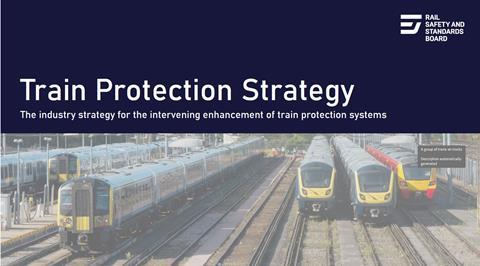
UK: Following extensive cross-industry consultation, the Rail Safety & Standards Board has updated its Train Protection Strategy, which is designed to help train operators and infrastructure managers understand and mitigate the risks of signals passed at danger and overspeeding.
Recognising that these ‘rare but potentially high-consequence events continue to pose challenges’, RSSB said the refreshed TPS was intended to enhance safety across Britain’s main line network ‘during the interim period before comprehensive fitment of the European Train Control System’.
The first TPS was published in 2017, in response to industry concerns that there was no clear strategy for the long-term future of the Train Protection & Warning System. This is now installed across approximately 40% of network, largely at high-risk locations such as signals protecting junctions. It has reduced the risk from SPADs, overspeeding and buffer stop collisions by 60%, but it does not provide continuous speed monitoring.
The TPS was revised in 2018, but had not changed since then. It has now been ‘refreshed’ in the light of ongoing work to deploy ETCS and several significant overspeed incidents. These included the collisions at Salisbury Tunnel Junction in October 2021 and Talerddig in October 2024, where low adhesion was a causal factor.
RSSB notes that network-wide deployment of ETCS is expected to take at least 30 years, adding that ‘this plan is not fully funded nor comprehensive in scope, and the transition is gradual. Therefore, SPADs and overspeed risks are not wholly mitigated in the intervening period before comprehensive train protection is in place.’
Strategic objectives
The refreshed strategy covers a range of organisational and technical workstreams, with RSSB emphasising that ‘it is vital that the industry collaborates with a unified vision.’
- Mitigating Risk: The strategy aims to understand what ‘as low as reasonably practicable’ means in the context of train protection systems, including targeted enhancements to existing systems to reduce derailment and collision risk.
- Interim Enhancements: Pending the rollout of ETCS, the strategy proposes embracing interim technological and operational improvements.
- Shared Responsibility: Recognising the joint accountability between train operators and infrastructure managers, the strategy aims to promote cross-industry leadership and collaboration.
- Cost-Effective Solutions: RSSB recommends a prioritisation matrix and life-cycle cost analysis to guide investment in enhancements that deliver maximum safety and performance benefits.
- Data-Driven Decisions: Recognising that proactive safety management needs to be based on data, the strategy calls for improved incident reporting, risk assessment, and real-time data integration.
- Future-Ready: The strategy supports the investigation of ways to optimise technology, including the automation of certain operational processes. It emphasises that ‘digital signalling remains the long-term vision for a safer, more efficient railway’.
Monitoring against the delivery of the strategy will be co-ordinated by the RSSB-facilitated Train Protection Strategy Group, with cross-industry support.
Facilitating migration to ETCS
The strategy provides a high-level summary of the train protection technologies currently in use and those being explored. It does not specify which systems should be used in each location, but sets a framework for industry players to determine which system best mitigates risks to ALARP and are proportionate in cost and time to realise.
RSSB points out that there are challenges to implementation of technological solutions, ‘including potential barriers from a rolling stock, infrastructure or operational perspective, for example’. It emphasises that ‘co-operation on the chosen technology is imperative’.
Recognising that initiatives cannot progress without the appropriate funding, and that there are often competing projects, RSSB notes that ‘it is important that any funding assigned to alternative train protection workstreams does not adversely impact other agreed schemes, such as the rollout of ETCS.
‘It is vital that projects undertaken to analyse and develop intervening enhancements to train protection do not result in funding being diverted from agreed ETCS fitment programmes. This does not preclude reprioritisation of funding for safety interventions subject to a robust, evidence-led case being made in line with safety decision-making principles’
Meanwhile, work is continuing under the ‘Target 190’ programme to reduce the cost of ETCS fitment, so that it becomes the cost-effective alternative to the like-for-like replacement of existing train protection systems.
Funding has been allocated in Network Rail’s budget for Control Period 7 for various Speed Management Programme workstreams and various ETCS activities. Nevertheless, RSSB emphasises that ‘further cross-industry saving opportunities need to be exploited, particularly on the fleet fitment and roll out of ETCS. New vehicles are fitted with some of the equipment required for ETCS at the point of manufacture. However, for legacy rolling stock, this fitment can often be complicated and costly, so every opportunity to reduce this needs to be pursued.
‘It is vital that funding already allocated for workstreams related to the enhancement of train protection is not diverted for other activities.’
Delivery roadmap
The seven objectives in the strategy set out 13 key deliverables, each with measurable outputs. RSSB emphasises that ‘the deliverables need to be monitored to ensure their successful delivery and that the outputs lead to a constructive outcome’.
The UK rail sector has committed to a phased implementation of the strategy by 2028, based on evidence-based decision-making. An industry implementation plan is to be finalised by 2027.
Phase 1 focuses on gaining a better understanding of ‘the level of risk posed by too far and too fast events’. RSSB says the data gathered and analysed in this phase will allow ;informed discussions around the determination of what is ALARP, which will drive the later phase of the strategy’.
Ongoing workstreams include the development of a Junction Overspeed Risk Assessment Tool, work on the feasibility of identifying overspeed events using Train Describer train movement data, and the first phase of the Speed Management Programme.
Next year should see the publication of a new Rail Industry Standard for Speed Restriction Management, while work is underway on a second version of the Red Aspect Approach to Signals toolkit (RAATS2). Planned work for 2026 includes a project on proactive speed data gathering and an analysis of sample data to determine the scale of overspeeding.
At the conclusion of Phase 1, the industry will review the outputs and develop an implementation plan for the delivery of Phase 2, commencing in 2027/28. This will be accompanied by a timeline and targets for the rail sector to meet, ‘based on factors such as the industry’s fiscal position’.
‘This strategy is about bridging the gap between where we are and where we need to be’, explained RSSB’s Director of Standards Tom Lee. ‘ETCS is the long-term goal, but its rollout could take decades. This strategy provides a practical, risk-based framework to manage the residual risks of SPADs and overspeeding trains in the intervening period.’
Supporting documents
Click link to download and view these filesTrain Protection Strategy
PDF, Size 3.53 mb