UK: The Rail Accident Investigation Branch has issued urgent advice asking Network Rail to consider the risk of remote monitoring sensors on earthworks being overwhelmed during extreme weather, and being unable to send safety-critical alerts to control staff.
Independent rail accident investigation body RAIB issued urgent safety advice on December 19 about the use of remote monitoring technology to verify the safety and integrity of railway earthworks.
The advice states that lineside monitoring equipment used on Network Rail infrastructure may not be able to detect the failure of slopes in some circumstances. As a result, this equipment may not provide data as expected to support safety decision-making, particularly during extreme weather conditions.
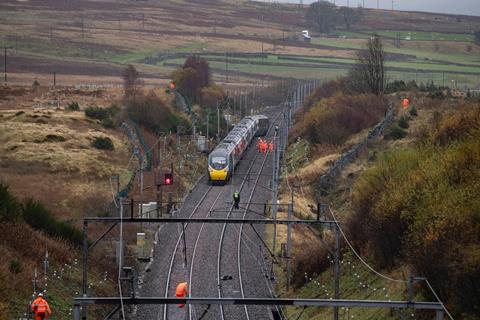
The advice has been issued as part of RAIB’s ongoing investigation into the derailment of an Avanti West Coast inter-city passenger train at Shap in Cumbria on November 3 2025. The train, formed of a Class 390 Pendolino tilting EMU, was travelling at around 134 km/h when it struck landslip debris that had been washed onto the track. This material lifted the first bogie off the rails and to the right, where it ran derailed for around 560 m.
There were nine staff and 86 passengers onboard the train at the time of the collision. Four people were treated for minor injuries as a result of the accident, and damage was caused to the train and to railway infrastructure.
RAIB said its investigation work so far had found the landslip was caused by a period of heavy and sustained rainfall. RAIB’s preliminary examination found that a drainage channel, which runs across the cutting slope above the washed-out material, was unable to accommodate the volume of water which was present. This led to the slope material below becoming saturated, initiating the landslip.
The cutting slope was fitted with remote monitoring equipment, which was designed to detect ground movement. At the time of the accident, the monitoring equipment at Shap was recording data and reporting to its online monitoring service. However, it had not been formally entered into operational use, so was not sending alerts to the Network Rail control centre. Similar equipment is operational on other parts of the railway infrastructure.
This type of equipment, when configured for Network Rail slope monitoring applications, is mounted on steel spikes every 2 m along the base of the slope. The position of the sensors is recorded at intervals.
Movement of the sensors is recorded by the monitoring system as four colour-coded levels of alert, of which the highest two are considered to represent significant movement:
1. Green (information): movement of between 10 and 30 mm;
2. Amber (major): movement of between 30 and 60 mm;
3. Red (severe): movement of between 60 and 90 mm;
4. Black (critical): movement of more than 90 mm.
Around 4 h before the accident, the sensors nearest to the landslip began to show minor movement of the earthwork, below the threshold needed to trigger a green alert. This movement continued for the next 2 h, remaining below the green alert threshold.
The RAIB advice explains that at around 04.30, when the evidence available suggests that the landslip occurred, the two sensors in the path of the debris were tipped over and subsumed by the material sliding down the slope. It would appear that this occurred too quickly for them to determine and transmit their movement and to generate an alert.
RAIB concluded that the sensors’ wireless signal was also unable to pass through the layer of material which covered them. This is based on them being able to re-establish a connection and report a variety of alert levels as the site was cleared.
The investgation body is advising Network Rail and other parties involved in UK railway infrastructure managment to ‘consider and, if necessary, mitigate’ this risk.
Remote condition monitoring equipment has emerged over recent years as an increasingly common means of verifying the health of railway assets, and it is widely used on the UK network and internationally. Concomitantly, concern has grown over the threat to railway structures posed by increasing incidence of extreme weather largely driven by climate change.
- Learn more: The derailment at Shap was cited during Railway Gazette’s webinar on IoT in rail infrastructure on November 24, which is available to watch on demand.
Supporting documents
Click link to download and view these filesRAIB's Urgent Safety Advice - December 19 2025
PDF, Size 0.14 mb