








Business news from the world rail freight market.
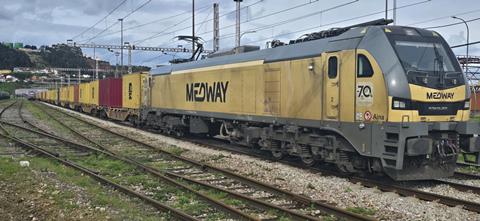
On February 10 Swiss shipping company MSC’s Medlog subsidiary ran its first freight train from El Musel (Gijón port) to León. The train hauled by a Medway Euro6000 locomotive carried 36 TEU of imported food. A twice-weekly service is planned.
Entreprise Générale du Cobalt and Trafigura have agreed the first delivery of copper and cobalt from DR Congo to global markets via the 1 300 km Lobito Atlantic Railway. ‘LAR is a true regional asset, open to all users, and a catalyst for positioning Angola and the DRC as key players in providing the metals and minerals needed for decarbonisation, digitisation, and industrialisation’, said LAR CEO Nicholas Fournier on February 9.
More than 372 000 TEUs were handled at the Korgas Gateway special economic zone on the Kazakhstan-China border in 2025, a 2% increase on 2024. During the year 10 broad-gauge sidings were built at the dry port, along with intelligent infrastructure upgrades which have reduced container handling time from 5 h to 1 h.
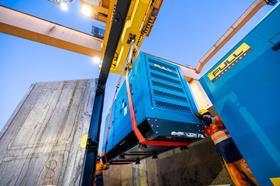
Generators donated by Lithuania were delivered to Ukraine by rail by LTG Cargo and LTG Cargo Polska in less than five days from the initial request. ‘We took advantage of LTG Cargo’s experience in Poland and in project transportation — we selected routes, ensured that rolling stock suitable for transporting such cargo was available, and worked closely with our partners in Poland and Ukraine’, said LTG Cargo CEO Eglė Šimė.
KfW IPEX-Bank has arranged a €340m seven-year loan which leasing company VTG will use to purchase new wagons. A promotional loan based on KfW programme 269 (investment loan for sustainable mobility, individual variant) is being used for the first time as syndicated financing for a German company active internationally in the rail industry. ‘The financing contributes to the shift of freight transport from road to rail and strengthens the decarbonisation of the transport sector in Germany and Europe’, said Aida Welker, Member of the Management Board of KfW IPEX-Bank.
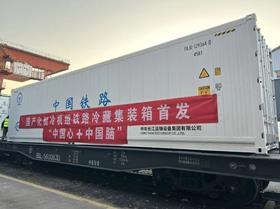
Domestically developed refrigeration units developed by CRRC for railway containers have been deployed on cold chain trains in China. CRRC said they are designed to provided stable and reliable performance, enhanced information security and short lead times for spare parts procurement and service response within the ‘complex’ operating conditions of China’s rail network.
Kazakhstan’s KTZ Express and Georgian Railway have integrated digital systems to support the joint monitoring of transit trains and the digitalisation of cargo documents, waybills and transit declarations. The customs inspection time for container trains in Georgian territory has been reduced from 8 to 9 h to 40 min.
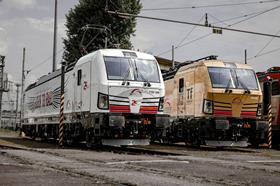
TX Logistik has put into service the last of 40 Siemens Mobility Vectron locomotives ordered in 2023 and delivered from September 2024 to enable it to replace leased locos with its own fleet. They will primarily be used on the north-south routes via the Brenner Pass and through Switzerland, which the company said were heavily trafficked corridors with high demands on the locomotives used.
BTT Multimodal Group has acquired the Rail Terminal Chemelot at Geleen, north of Maastricht in the southern Netherlands. It said the terminal with three 670 m tracks, two straddle cranes, 60 000 m² of land and a capacity of up to 100 000 containers per year would strengthen its activities on corridors from the ports of Rotterdam and Antwerpen to the European hinterland.
Railinc’s TransmetriQ has launched VIN Tracking which allows automotive manufacturers and dealers to track finished vehicles by Vehicle Identification Number as they move by rail from manufacturing plants to distribution terminals and dealers across North America. It said this addresses a longstanding challenge in automotive logistics, with manufacturers and dealers previouly have relying on wagon-level tracking, requiring teams to collect location data from multiple railway and manually associate that information with the VINs. ‘Automotive logistics teams think in VINs, not railcars’, said Andy Adams, Senior Solutions Engineer at TransmetriQ. ‘By making VINs searchable and traceable across the rail network, we’re removing a major source of friction and giving shippers faster, clearer insight into where vehicles are and when they’ll arrive.’
Chairman of Kazakhstan’s KTZ Talgat Aldybergenov recently met Kaido Zimmermann, Chairman of Estonia’s Eesti Raudtee, to discuss bilateral co-operation to optimise freight flows between Central Asia and Europe as part of the Trans-Caspian International Transport Route. Traffic between Kazakhstan and Estonia reached 382 400 tonnes in 2025, up by 197 400 tonnes from 2024.