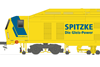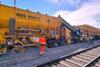








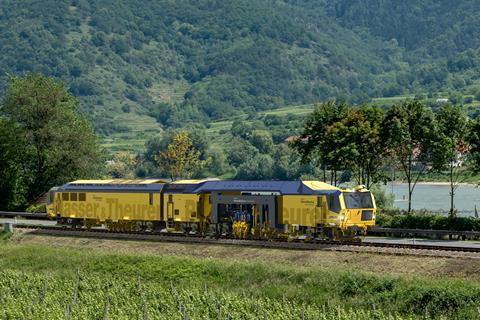
GERMANY: Plasser & Theurer has announced an ‘impressive’ large order to supply the national railway’s DB Bahnbau Gruppe construction business with 18 UnimatExpress 2X-4x4 Dynamic high-capacity tamping machines equipped with ETCS and digital assistance systems.
‘The new tamping machines are an investment in the future and are replacing several outdated machines’, said DB Bahnbau Gruppe Chairman Markus Egerer on November 26. ‘Acquiring 18 identical, universally deployable types reduces the variety that is now dominant in our fleet. This allows us to design our maintenance strategy and spare parts management even more efficiently. These modern machines run on HVO fuels, allowing us to make an important contribution to sustainability.’
Tamper technology

The 2X-4x4 tamping unit is made up of two halves, one flexible for the complex geometries of turnouts, and the other optimised for efficient and low-wear operation on plain line. It will be possible to work in two-sleeper mode over large parts of a turnout, increasing productivity.
Integrating dynamic track stabilisation onto tamping machines avoids the need to use additional machines, and means fewer speed restrictions need to be imposed after maintenance.
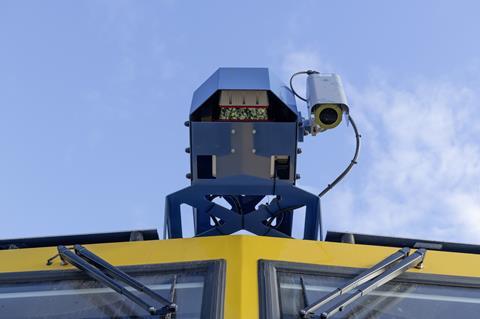
Digital assistance systems will optimise work processes, reduce the burden on operating staff, speed up staff familiarisation and reduce the potential for human error.
The Plasser TampingAssistant offers end-to-end digitalisation from pre-measuring to documentation, with AI and a wide range of sensors used to generate recommendations to simplify work processes.
Plasser TampingControl will provide the basis for automating the tamping process to ensure precise long-lasting track geometry.
The non-contact Plasser InertialTrackGeometry measuring system records the existing track geometry using relative 3D space curves, making deviations immediately visible. It can be used for pre and post-measuring from a standstill to the maximum speed of the tamping machine.
The Plasser ReferencedTrackGeometry fixed-point measuring system makes it possible to verify the absolute track geometry in space. This data is used to calculate the necessary lifting and lining values, and the tamping machine can work according to the precision method, guided by fixed points. It generates a reference to the original geometry using external reference points, allowing measurements to be taken without line closures.