





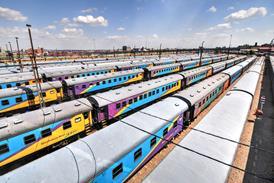
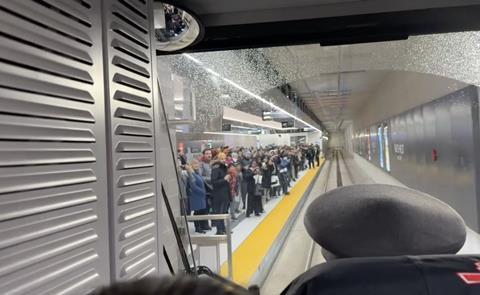
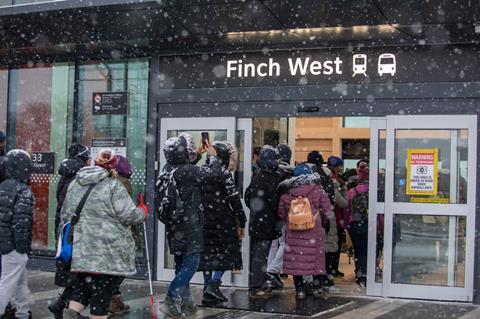
CANADA: Toronto’s light rail Line 6 Finch West opened on December 7, running east-west from Finch West to Humber College in the northern suburbs of the city with two underground and 16 surface stops.
Passengers on the first day could ride free of charge and collect souvenirs including and commemorative coins and badges.
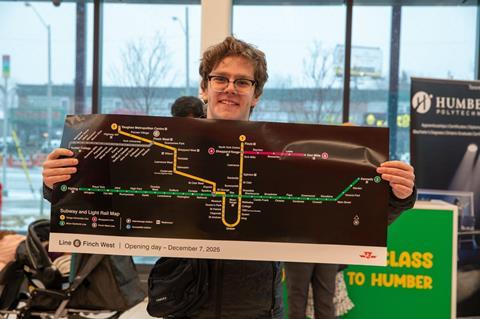
The 10·3 km fully segregated Line 6 runs west along Finch Avenue West from Keele Street to Highway 27, before turning south towards Humber Polytechnic’s North Campus. It is intended to provide faster and more reliable transport along one of Toronto’s busiest corridors, serving destinations including Humber Polytechnic and Etobicoke General hospital.
There are more than 230 000 people within walking distance of the stops, and connections to around 30 bus routes as well as metro Line 1 Yonge-University at Finch West station. Ridership is predicted to reach 12 million people/year by 2031.
Following the recommendations of the public inquiry into problems with the Ottawa LRT project, Line 6 is initially operating under what Toronto Transit Commission calls ‘soft opening’ conditions, with services running from 06.00 to 22.00 Monday to Saturday and 07.30 to 22.00 on Sundays. The early end of services will provide an extended overnight maintenance window.
Line 6 Finch West project
The line was developed and is owned by Greater Toronto & Hamilton Area transport agency Metrolinx, with Toronto Transit Commission responsible for operations.
The federal and Ontario governments announced funding for the project in Toronto in June 2017.
In 2018, the Mosaic Transit Group private sector joint venture of ACS-FlatironDragados Canada, Aecon Concessions and CRH Canada was selected to build the line (Mosaic Transit Constructors), and maintain it over a 30-year period (Mosaic Transit Partners Maintenance).
Arup was primary subcontractor for the project’s lead design. London Trackwork Inc supplied turnouts, crossovers and point machines, and TÜV Rheinland provided safety assessment services. Zedas software is being used to track all assets down to component level.
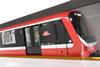
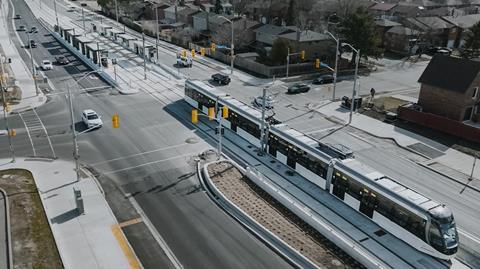
Alstom, as successor to Bombardier Transportation, supplied the rolling stock and is responsible for the maintenance of the vehicles, track and the overhead electrification for the next 30 years. The 18 Canadian-built Citadis Spirit light rail vehicles were manufactured at its Brampton site and tested in Kingston. The 48 m long, 100% low-floor LRVs have a capacity of up to 292 passengers, including 120 seated, and are fully accessible for people with mobility needs.
They are designed for the Canadian market, with reinforced insulation, powerful HVAC and snow and ice management systems for operating in winter temperatures down to -38°C.
Line 6 is the first deployment of the latest generation of Hitachi Rail’s SelTrac communications-based train control system, which was developed at its Global CBTC Competence Centre in Toronto. The latest version is requires less trackside infrastructure and cables, and features modular equipment that can be swapped out in minutes to simplify maintenance and upgrades.