






ITALY: A 3 km extension of Roma metro Line C was formally inaugurated on December 16, along with two new stations at Porta Metroni and Colosseo/Fori Imperiali.
The opening ceremonies were attended by the capital’s Mayor Roberto Gualtieri, Minister of Transport & Infrastructure Matteo Salvini and Minister of Culture Alessandro Giuli, along with Alfonsina Russo, Head of the Department for the Enhancement of Cultural Heritage. Following the events in the morning, the stations were opened to passengers from 16.00.
Work on Section T3 of Line C, extending the route from San Giovanni toward the historic city centre, began in March 2013. The line has been built by the Metro C Scpa consortium which includes Webuild, Vianini Lavori, Astaldi and Ansaldo STS (now Hitachi Rail). Work has taken 12 years due to the significant archaeological discoveries along the route, and the complex civil engineering required in the central area.
Archaeological heritage
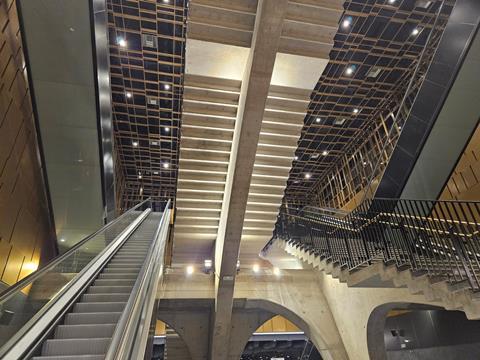
In order to manage the complexities of the capital’s archaeology and geology, the Line C project adopted an ‘archaeological top-down’ approach, according to Webuild. This technique was developed specifically for the stations in the city centre and initially applied to those at Colosseo/Fori Imperiali and Porta Metronia. Intermediate slabs are installed progressively as the excavation advances from top to bottom, ensuring structural stability and continuity for the archaeological digs while construction work proceeds.
Both of the new stations are among the six ‘archeo-stations’ planned for Line C, together with San Giovanni (already operational), Venezia (under construction), and Chiesa Nuova and San Pietro (at the design phase). Developed under the guidance of the Ministry of Culture, these stations will showcase the numerous artifacts uncovered during the metro construction.
Porta Metronia station is located in Piazzale Ipponio, next to the Aurelian Walls. it has a rectangular structure with five underground levels reaching a maximum depth of 30 m below street level. Excavations revealed a vast military compound, dating from the first half of the 2nd century AD, including a Commander’s House featuring frescoes and mosaic floors. The design of the station had to be revised in order to preserve the remains, although some elements including the bath house had to be relocated, according to Francesca Gherardi, restoration officer at the Colosseum Archaeological Park. Opening of the museum itself has been delayed, but it is expected to be ready in the next few months.
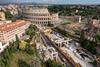
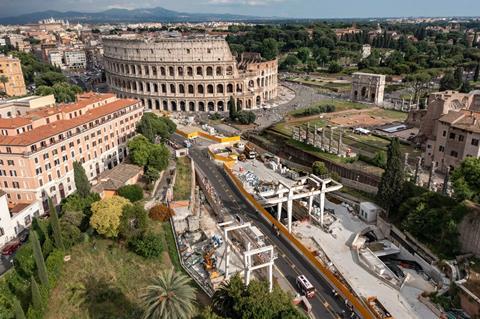
Colosseo/Fori Imperiali station is located beneath Via dei Fori Imperiali, between the Colosseum and the Basilica of Maxentius. This station box is 32 m deep, with four underground levels. It provides a direct interchange to the existing Colosseo station on Line B. Historical exhibits inside the station have been curated by the Colosseum Archaeological Park, along with the Department of Architecture & Design at Sapienza University of Roma.
’The delivery of the Colosseo/Fori Imperiali and Porta Metronia stations represents — for Roma and for Italy — a strategic milestone that combines in an exemplary way progress in infrastructure with the conservation of our heritage’, said Webuild Chief Executive Pietro Salini. ’It is all thanks to a vision of the city’s future shared by businesses, institutions, and communities.’
Next phase underway
When completed, Line C will run for 26 km from Monte Compatri/Pantano in the east to Farnesina in the northwest, with 31 stations; of this, there will be 9 km above ground and 17 km in tunnel. Services currently operate between Pantano and Colosseo/Fori Imperiale, serving 24 stations.
The next section will run from Colosseo to Clodio/Mazzini, passing under the River Tiber. Construction work is underway, although Construction Director Marco Cervone anticipated that this section would also take around 11 years to build, given the complexity of the project. The next station at Piazza Venezia is already well advanced.
This section is also being built by the Metro C consortium, and Webuild reported that the so-called ’macro-phase 2’ had started at Venezia. Detailed design work is in progress for the stations at Chiesa Nuova, San Pietro, Ottaviano and Clodio/Mazzini, while final design is proceeding for the final two stations at Auditorium and Farnesina.