






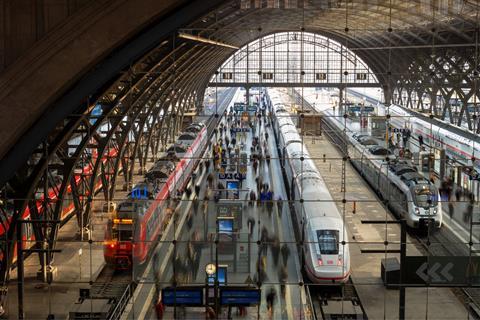
GERMANY: Federal Minister of Transport Patrick Schnieder has announced a ‘new start’ for national railway group Deutsche Bahn, which is to be reformed with a simplified structure and a greater separation between its train operating business and infrastructure arm DB InfraGO.
The plans set out on September 22 aim to make the state-owned railway more financially sustainable and to improve punctuality: DB made a loss after tax of €760m during the first six months of 2025, while long-distance punctuality in August was just 59·6%, down from 78·9% in 2016.
Next CEO named

Schnieder confirmed that Evelyn Palla would be taking over as Chief Executive of DB with effect from October 1, and she has been tasked with taking forward the reform plans. The government had announced in August that current CEO Dr Richard Lutz would step down as soon as a successor could be found, rather than continuing until the end of his contract in 2027 as had been expected.
Palla is currently the head of regional passenger division DB Regio. She was previously Chief Financial Officer of the long-distance passenger business DB Fernverkehr, and before that worked at Austrian Federal Railways.
DB reform plans
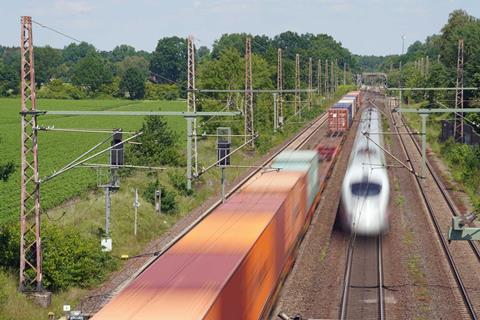
The government’s reform plans will see DB concentrate on its core activities, which are defined as the successful operation of its three train operating divisions: DB Fernverkehr, DB Regio and DB Cargo.
Although the target date for DB Fernverkehr to achieve 70% punctuality has been put back from 2026 to 2029, an eventual goal of achieving 90% has been established; in June and July, long-distance punctuality fell below 40% for three days in a row. A 90% punctuality target has also been set for DB Regio.
An internal restructuring will see the number of divisions within DB and DB InfraGO reduced from eight to six each. DB AG is to present a concept for the new structure by the end of Q1 2026. Amongst the anticipated changes will be the abolition of the separate Technology department headed up by Daniela Gerd tom Markotten. The group-level post of Chief Infrastructure Officer, currently held by Berthold Huber, is also to be abolished.
DB Cargo is required to become ‘economically viable’ by 2026 to meet EU rules, and this is expected to drive further restructuring. Among the options being investigated is a reshaping of its loss-making wagonload operations using a hub-and-spoke model.
The sale of stakes in non-core activities is also envisaged, and DB has been tasked with providing a concept for this during 2026. The move builds on the sale of the DB Schenker non-rail logistics business to Denmark’s DSV earlier this year and the recent divestment of DB’s stake in Transfesa.
Infrastructure priorities
Infrastructure manager DB InfraGO is being tasked with delivering sustainable improvements to Germany’s national rail network, enabling all train operators to run their services more smoothly. A reform of track access charges is planned, and DB InfraGO’s finances will be made ’more transparent’, in order to demonstrate that its income is being used purely for infrastructure purposes, with no cross-subsidy within the DB group.
The government has proposed the appointment of Dirk Rompf as CEO of DB InfraGO, replacing the incumbent Philipp Nagl. Rompf is currently Managing Director of Ifok, but served as Board Member for Network Planning & Major Projects at DB Netz AG in 2014-19.
An initial infrastructure plan is to be agreed by DB InfraGO and the Ministry of Transport next year; the government has called for all 42 of DB’s designated high-capacity corridors to be modernised by 2036. Other targets include the refurbishment of 500 stations by 2030 and a further 500 by 2035.
A decision on which routes are to be fitted with ETCS will be made by the end of 2025, and this will be followed by a federal government decision on the railway’s wider digitalisation strategy during 2027.
Earlier this year Germany changed its constitution, enabling the government to raise up to €500bn through extra borrowing to fund infrastructure, defence and climate protection initiatives. The national budget for 2025-29 already envisages spending €106·5bn on railway infrastructure. Projects currently underway include a blockade of the Berlin – Hamburg line which began in August and is scheduled to run until April 2026.
Sector engagement
In order to involve the entire rail sector, Schnieder announced that he planned to convene a ‘Reliable Rail Task Force’.
This would include representatives from the federal government, the Länder, the Federal Railway Office and Federal Network Agency, other train operators, public transport authorities and trade unions, as well as DB InfraGO.
Among various topics, he highlighted the need for ‘optimising services at highly congested junctions’, which has been suggested as potentially requiring the thinning out of some services, and a need for more efficient organisation of infrastructure maintenance and construction sites. The task force is due to start work by the end of October and report by the end of March 2026.