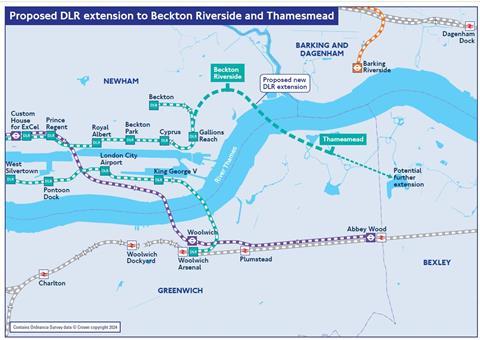
UK: Negotiations between the Greater London Authority, Transport for London and the government are to be held over the next three months to finalise the funding arrangements for the planned Thamesmead extension of the Docklands Light Railway.
Government support for the project was widely trailed before being confirmed by Chancellor Rachel Reeves in the budget presented on November 26.
The government said that the project would be funded through TfL and Greater London Authority borrowing, saying ‘the majority of the costs will be met by TfL and GLA, with the government also contributing over the long term’. The government would ‘continue to work with London to finalise funding details and will continue to work with the GLA to look at options for innovative financing to support the delivery of infrastructure projects in the capital’.
The cost of the Thamesmead Extension Programme is estimated at £1·62bn including VAT.
Following the budget TfL told Rail Business UK the government would underwrite the borrowing needed for the TEX Programme. ‘We know it is going ahead’, a TfL spokesperson said. ‘We just need to fine tune how the funding will work.’
TEX Programme scope
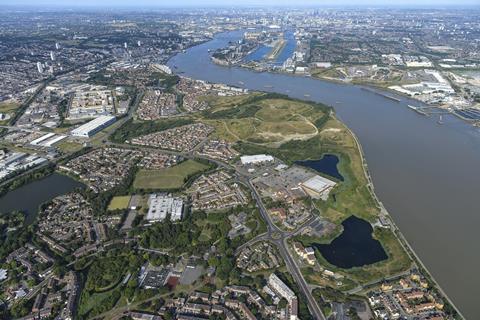
TfL says the 3 km extension of the automated light metro has the potential to deliver 25 000 homes and 10 000 new jobs in areas of high deprivation with ‘huge’ housing need.
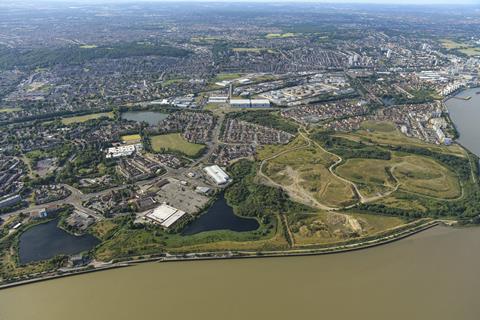
It would start on viaduct at a grade separated junction with the existing DLR’s East Route to Beckton, and drop down to ground level to serve a new station in the centre of the Beckton Riverside development. It would then run in a 1·5 km twin-bore tunnel under the River Thames to a station at Thamesmead. A new turnback siding to the west of the extension would facilitate a future increase in services on the Thamesmead branch and East Route.
New delivery model planned
TfL plans to use a new delivery model intended to drive improvements, capture construction efficiencies and reduce costs, and is seeking innovative techniques to reduce carbon and improve whole life costs.
It has begun market engagement to help develop its approach, seeking industry feedback and information on alternative approaches that are being developed in the marketplace for similar schemes. TfL is also defining the scope of requirements for the goods, services and construction works under the TEX programme.
TfL hopes to call tenders in June 2026, with work to begin 2028 for completion by 2033.
Suppliers welcome government backing
Mayor of London Sadiq Khan said ‘the project is a win-win and a massive vote of confidence in London’ and he looks forward to ’working hand-in-hand with ministers to deliver this vital project as we continue building a more prosperous London for everyone’.
Mott MacDonald is supporting the project through land referencing for the Transport & Works Act Order and environmental surveys. Commenting on the budget, the company’s Managing Director for Transport in UK & Europe Ken Norbury said the extension would ‘unlock thousands of homes and jobs and create public transport connectivity for one of London’s most underserved areas’.
Alistair Geddes, Sector Director, Rail at Costain, said ‘projects such as the Elizabeth Line have been transformational for communities in London and the surrounding areas’, and the DLR extension would ‘boost prosperity, support employment prospects and encourage investment in skills and education’.
Darren Caplan, Chief Executive of the Railway Industry Association said ‘RIA has long called for the government to use private investment to support publicly funded rail projects. The plan is also an important reminder of how new rail schemes can be a catalyst for the creation of new housing and jobs.’