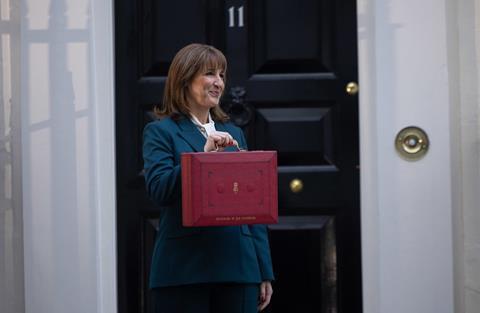
UK: ‘Today’s budget contained limited new measures affecting the railway industry and rail businesses’, Railway Industry Association Chief Executive Darren Caplan said following the budget statement from Chancellor Rachel Reeves on November 26.
Caplan said RIA ‘would like to have seen in this budget more of the government’s plans to encourage innovative funding models in rail — whether private or third party investment, more direction on its long term strategy for rail, and an update announcement on Northern Powerhouse Rail, a major scheme which up until recently had general cross-party political support. We urge the government to give more clarity on these issues, to both boost jobs, GVA and Treasury revenues to the benefit of UK plc, and also to ensure the rail supply sector can play its part to efficiently and cost-effectively deliver world-class UK transport infrastructure in the future.’
This was echoed by Darren Fodey, partner in Stephenson Harwood’s Transportation & Trade team, who said ‘investment in rail has repeatedly shown to drive growth, with the benefits of investment being felt across the supply chain and across the UK. The commitment to rail today will give some confidence to the industry, but it forms only part of the wider long-term rail strategy under development as part of the government’s rail reform programme. The supply chain has been calling for more visibility for some time and we now need to see that next level of detail.’
Andy Steel, Managing Director of contractor QTS Group, said ‘the Chancellor’s commitment to progressing key rail schemes, including the Docklands Light Railway extension and Northern Powerhouse Rail, are a welcome signal that the government recognises the critical role rail infrastructure plays in driving long-term economic productivity’. He said ‘to maximise the benefit of this funding, we now need collective action. That means early contractor involvement, clarity of pipeline and genuine public-private sector collaboration. This will ensure these schemes are delivered efficiently, with minimal disruption to the operational network.’
Alistair Geddes, Sector Director for Rail at Costain, said ‘the industry will welcome the Chancellor’s commitment to rail infrastructure improvements across the UK, including the extension of the Docklands Light Railway, which will boost prosperity, support employment prospects and encourage investment in skills and education. For any large or complex infrastructure project, collaboration is key to success. Enduring relationships can be formed through alliances to build momentum and ensure schemes are delivered safely, on time and on budget.’
Rachel Ellison, Managing Director for Advisory & Programme Delivery for UK & Europe at Mott MacDonald, said ’the Chancellor has shown continued support for infrastructure in her budget. The certainty that this creates is essential to enable businesses to confidently invest in order to realise the ambitions set out earlier this year in the 10-Year Infrastructure Strategy.’
The Association for Consultancy & Engineering said ‘what is now needed is concrete information to give industry confidence. Expanded devolved transport settlements and renewed support for Northern Powerhouse Rail, alongside not proceeding with plans to equalise the rates of Landfill Tax, show that the government understand the role of infrastructure in driving regional growth.’
Resonate Group CEO Blake Richmond said ‘we welcome further investment in data technologies and AI, which are key to modernising rail industry processes. By adopting smarter, data-driven systems, creates more opportunities to develop AI to optimise these flows across an increasingly connected transport system, supporting long-term economic growth and regional development.’
Amish Patel, transport leader at PwC, said ‘freezing rail fares provides immediate, visible support to passengers at a time when affordability remains a barrier to public transport use. From a network perspective, however, fare revenue is still a key pillar of rail’s funding model. To make this sustainable, and to give Great British Railways the best possible start, the sector will need clarity on how the Treasury intends to bridge the funding gap while also modernising infrastructure, improving punctuality and accelerating digital transformation.’
Andrew Dean, Partner in the Infrastructure, Projects & Procurement Group at law firm Bird & Bird, said ‘freezing fares may grab headlines, but it doesn’t change the fundamentals’, and rail projects ‘must be backed by realistic timetables and clearly defined funding mechanisms. Communities will be watching to see whether these pledges turn into trains on track, not just plans on paper.’
Bus industry group the Confederation of Passenger Transport said ‘the big news for the long-term future of transport is the introduction of a new pay-per-mile road user charge on electric cars. Road user charging which reflects usage can be fairer and can help accelerate the shift towards more sustainable public transport by encouraging people to think twice before making unnecessary car trips.’