UK: A 30-day blockade of the line between Stalybridge and Heaton Lodge Junction to the east of Huddersfield will begin on August 30 as part of the Transpennine Route Upgrade programme.
The blockade will be used to create an interim reduced track layout at Huddersfield station, with two through platforms plus the Penistone line bay which will be extended to allow four-car trains to be operated to Barnsley and Sheffield. The three platforms will be renumbered 1 to 3, with the bay becoming 1.
The remainder of the station will be barricaded off to allow the construction of an island platform in the area previously occupied by stabling sidings and the extension of the passenger subway. The sidings will be replaced with a new facility at Hillhouse along the line to Leeds.
The blockade will also see the closure of Diggle Junction signal box and its adjacent loop, with signalling recontrolled to York ROC.
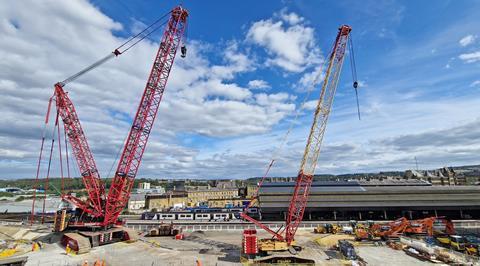
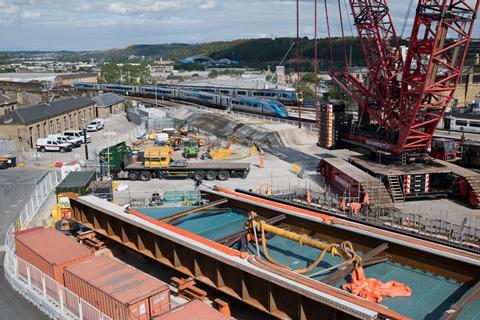
The 47-span viaduct at the northeast end of Huddersfield station will be strengthened, with the replacement of all but one of the decks of Span 1, the John William Street Bridge; the deck which carries the fast lines will be replaced later in the programme. This work will use a Mammoet crane capable of lifting 1 250 tonnes.
Keeping people on trains
Operators are aiming to keep as many passengers on trains as possible during the blockade, with 3 000 diverted services planned.
TransPennine Express trains will operate via the Calder Valley line, and the local service between Leeds and Huddersfield will be diverted to serve Bradford Interchange.
All diverted services will call at Brighouse, which was extensively upgraded as part of a £100m investment to provide diversionary routes for the TRU programme. Brighouse will be linked to Huddersfield by a regular bus service with a journey time of around 15 min, and Huddersfield will also be linked to a range of destinations by a total of 13 500 rail replacement bus services designed to handle 5 000 people a day at Huddersfield and 3 000 at Brighouse.
Reduced capacity
The reduced capacity at Huddersfield will remain from the end of the blockade on September 28 until early 2027, when four 200 m through platforms and a 200 m bay at the northwestern side will be opened.
Until then, the loss of platform capacity will see the joining up of some local stopping services which normally operate separately west and east of the station. Local stations between Huddersfield and Leeds, including Mirfield, Dewsbury and Batley, will be served by trains operating to/from Bradford. The exceptions to this will be Deighton and Ravensthorpe stations, which will be closed for rebuilding until 2027.
Keeping services flowing
Chris Nutton, Major Projects & TRU Director at TransPennine Express, said ’it is absolutely critical that we keep the rail service flowing locally here in Kirklees, but more so right across the north of England, during the closures. So at the height of the works, we will have 18 rail replacement services per hour operating in and out of Huddersfield station, nearly 2 000 buses required to support that operation on the roads.
‘Until we come back in January 2027 to finish the work off, Deighton and Ravensthorpe will unfortunately be closed for an interim period, but when they reopen they will be brand new stations with doubling of their train service.’
- Learn more: read our in-depth explainer from August 2024 setting out the scope and aims of the Transpennine Route Upgrade.