UK: FirstGroup’s open access operator Lumo hopes to order new-build battery-electric units to replace the Class 222 diesel multiple-units it is leasing for the launch of its London to Stirling services, Managing Director of First Rail Open Access Stuart Jones has told Rail Business UK.
However, any future order is dependent on Lumo being granted an extension to its track access rights of sufficient duration to justify the investment, and its other open access applications also being approved.
Trains
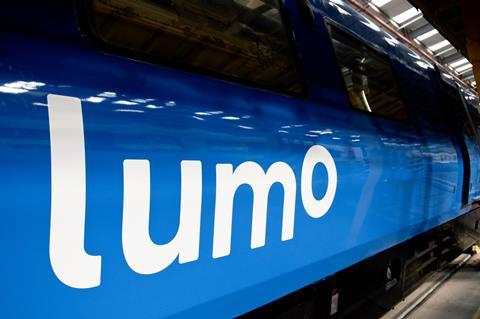
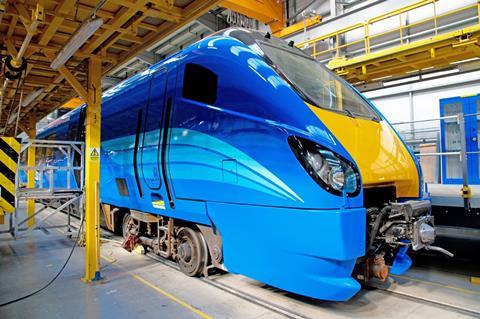
The £10m ‘refresh’ of the Class 222s which were previously used by East Midlands Railway under the Meridian fleet name is being undertaken at Alstom’s Widnes site, in association with leasing company Beacon Rail.
A £40m train services agreement will see Alstom’s Central Rivers depot in Burton-upon-Trent maintain, overhaul, service and clean the fleet over the next five years.
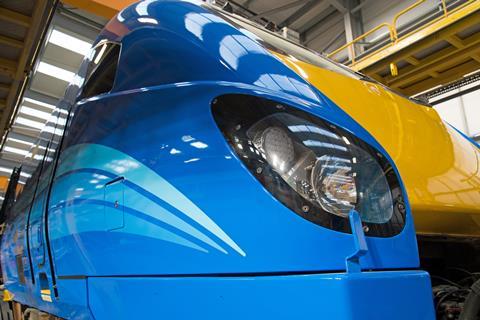
Speaking when images of the first Class 222 to be repainted in Lumo livery were unveiled as part of the official opening of Lumo’s West Coast headquarters at Preston on March 20, Jones said ‘we haven’t gone and done a full refurb, simply because our long-term aspiration is to bring in new trains. We’ve got an application out to the Office of Rail & Road for an extension with new battery electric trains, so we’re looking to bring those in at the earliest opportunity.’
The existing seats are being refreshed, and as Lumo will operate a single-class service new seats are being fitted in what was previously the first class area.
tickets
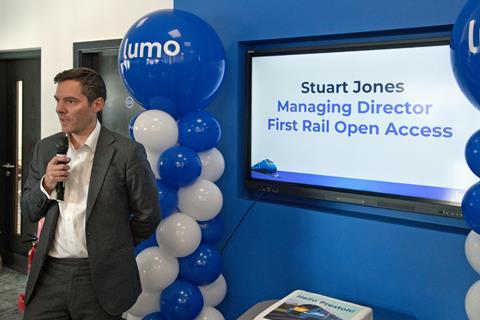
Jones said Lumo aims to offer ‘simple, low-cost tickets’. A launch date for the London to Sterling service is still to be confirmed, but tickets for travel from July 10 are now on sale. The actual launch date is expected to be earlier.
Lumo will start with a limited number of services, with its full timetable coming in once all five six-car Class 222s have been refurbished.
‘We went for tickets for July, so we’ve got real confidence in having that level of service ready’, said Jones. ‘Where we are now is just working back from there to understand exactly when we can go live for the first service and also how that phased ramp-up works, which obviously is absolutely linked to when the rolling stock becomes available.’
The full service will see four daily return services between London Euston and Stirling, calling at Milton Keynes, Nuneaton, Crewe, Preston, Carlisle, Lockerbie, Motherwell, Whifflet, Greenfaulds and Larbert. There will be an additional fifth return service between Preston and London.
As with its East Coast Main Line services, Lumo expects the majority of passengers to use train-specific Advance tickets. However, the company acknowledges that passengers with open tickets may board, and so some seats will be left available. ‘We’ll work it through as we understand the demand’, said Jones. ‘Typically on a long-distance market, we would look at predominantly reserved seats and then have a small number open for walk-up, but we’ll evolve that model once we are running.’
Tickets will be sold up to 24 weeks ahead. ‘We typically work to a 24-week window because for us it’s important to be able to give customers that choice early on; we recognise that rail’s not the only option’, said Jones.
This will be a challenge given that many operators, particularly on the West Coast Main Line, have been working to shorter sales horizons owing to uncertainties around access and engineering work. Jones said Lumo will probably have to be ‘less than consistent’ in offering 24 weeks, ‘but that’s certainly the model which we try to work to’.
Drivers
Jones said ‘we’re excited to be investing in our new base in Preston, which is creating jobs and supporting the local economy’.
Lumo says it is creating around 100 jobs as it prepares to launch the London to Stirling service. This includes a mix of drivers who are new to rail and some who have transferred from other train operators. ‘We are proud of the apprenticeship and the levels we’ve got; on the East Coast for example, circa 75% of that workforce has come through apprenticeships’, said Jones. ‘So we are doing a very similar model over here on the West Coast.’
As services ramp up, drivers will be trained over diversionary routes to add resilience during route closures. This is likely to make use of empty stock movements which can be sent over different routes without impacting passenger services.
Expansion plans

Jones confirmed that FirstGroup continues to look for further open access opportunities, and an application to extend the Preston service to serve Blackpool North has been lodged.
‘We’ve also got an application to run between Rochdale and London Euston’, he said. ‘We put an application in previously which got pushed back on capacity grounds. It passed the Not Primary Abstractive test, but the concerns are around capacity. So we’ve done further work to try and identify that capacity.
‘We believe there is capacity and I think the important piece is we’re not after that capacity today, it’s for three or four years in the future when we have the new trains available.
‘Alongside that we’ve also been looking in Wales & Western territory, we have two applications open there for extensions of our South Wales to London service which starts from December 2027; one which runs between London Paddington and Hereford and a second which goes down into the southwest from London down to Paignton. Those are quite far along with regards to the application process and we hope to hear more from the regulator in the future. We’ve been working hard with Network Rail and the regulator over the past year; we think we put in a good application.’
These services would be operated using five-car Class 80x trains ordered by FirstGroup from Hitachi for its open access services. Jones noted that the battery-electric variant may offer new journey opportunities ‘The first five of the 14 that we have on order are for the Carmarthen service, principally because we have to get that operation as quick as possible. We haven’t determined the best home for the remaining nine yet, we’re working through that at the moment. It will depend partly on how our applications unfold over the coming months.’
Lumo hopes to ‘demonstrate how a battery-electric train really can help, particularly on the West Coast Main Line where we have power supply constraints. We are asking how we can navigate those constraints and I think that’s where a battery-electric train can help.’