UK: Passenger services were reinstated on the Camp Hill line on April 7, restoring a service that was withdrawn in 1941 owing to coal shortages during the Second World War. Tony Miles reports from Birmingham.
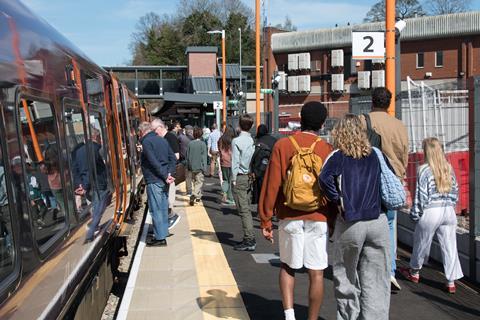
Operated by West Midlands Railway using Class 196 diesel multiple-units, the trains run between Birmingham New Street and Kings Norton, where the reversal is tightly timed to fit in between the four trains/h Cross-City service which reaches New Street via Bournville and Edgbaston. Trains run every half-hour Monday to Saturday, and hourly on Sundays.
The new stations at Moseley Village, Kings Heath and Pineapple Road have been built on the sites of former stations; all feature sheltered platforms, accessible lifts, passenger help points and secure cycle racks. Pineapple Road and Moseley Village have pick-up and drop-off areas, but the stations have no car parking; travellers will be encouraged to use other forms of public transport to access the stations if they are beyond walking distance.
‘With services as fast as 10 min from Moseley to New Street, we know this will be a real game changer for local residents, whether they’re commuting, visiting family and friends, or travelling for leisure’, said WMR Customer Service Director Jonny Wiseman.
Sandeep Shingadia, Executive Director of Transport for West Midlands, said ‘restoring passenger services to the Camp Hill line isn’t just about shorter journey times. It’s about easing congestion on our roads, cutting carbon emissions and opening up new economic opportunities across the region.’
Reopening project
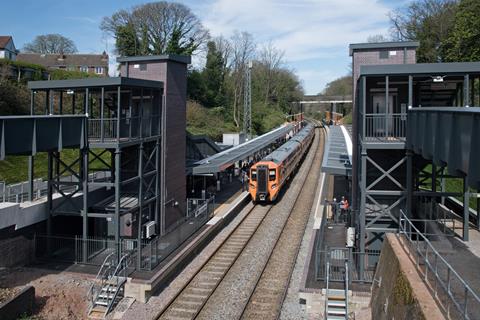
The project to reintroduce passenger trains on the freight line was led by Transport for West Midlands and the West Midlands Rail Executive, in partnership with WMR, Network Rail, Birmingham City Council and the Department for Transport. Construction works were undertaken by VolkerFitzpatrick.
Wiseman told Rail Business UK that introduction of the service, which requires two trains to maintain the timetable, had been covered from WMR’s existing staffing and rolling stock resources.
‘This is within our existing establishments for senior conductors and for drivers, but they’ve obviously had to learn the new route’, he explained. ‘In terms of rolling stock it is sweating the assets a little, we’re going through the engine half-life overhaul at the moment and there are set periods where we know we’re going to get squeezed for trains. That is a good problem to have, but we, the government, the DfT, invested an awful lot of money in new rolling stock for what was the West Midlands Trains franchise at the time, so actually it’s really good to see that return on the investment.’
Congested network
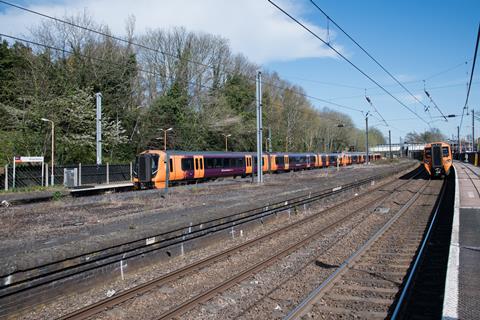
The first train to call at the new stations was the 06.27 southbound departure from Birmingham New Street to Kings Norton.
The first day saw some punctuality issues, with early trains impacted by the knock-on effects of an incident in Coventry which illustrated the challenges of the congested rail network around Birmingham. Thousands of people turned out in the beautiful spring weather to celebrate the reopening, and later in the day a significantly high number of passengers required assistance from the conductor to board or alight which meant station dwell times were prolonged.
‘We all know that New Street is congested; that’s the basis for why we’re looking at the Midlands Rail Hub, so we can increase capacity and increase performance’, said Wiseman. ‘We believe that Camp Hill line services will be able to run punctually, but like any other train service on the network, they are going to be subject to knock-on delays from other things that are happening on other parts of the network’.
The requirement to use an existing platform at Kings Norton to terminate the new service means that for the time being it will not be possible to restore a six trains/h service on the Cross-City line. West Midlands Rail Executive is discussing an interim solution with Network Rail while plans are developed to reopen the disused central island platform to provide a separate turn-back facility for the Camp Hill trains.
In the short term, electrification of around 750 m of the fast line through Kings Norton and over one crossover would enable the two extra Cross-City trains to pass through the station without stopping to pass the terminating Camp Hill services.
In the longer term, a scheme aligned with the Midlands Rail Hub programme would see the island platform reduced in width and reopened; along with additional tracks and some remodelling this could provide a dedicated platform for Camp Hill trains and allow all Cross-City services to call at the station. A new crossover would be installed to enable Camp Hill line trains to terminate in the new Platform 3, whilst a central through line between Platforms 3 and 4 would enable other trains to overtake anything in the bay. The project would also require the replacement of the existing footbridge and installation of lifts to the reopened platform.
Electrification of the full station layout would be followed by the full electrification of the fast lines between Kings Norton and Barnt Green to increase capacity on the route.