
This week’s round-up of business news from the UK railway industry.
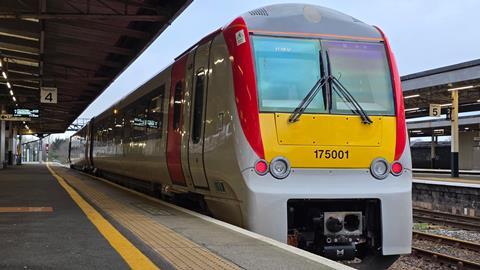
The first of Great Western Railway’s 26 Class 175 DMUs which were previously used by Transport for Wales re-entered passenger service on December 15, ahead of a phased roll-out in 2026. They will operate predominantly between Exeter St Davids and Penzance, as well as on services to Barnstaple and Okehampton.
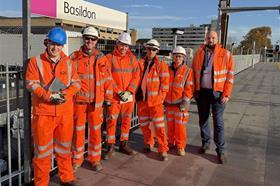
c2c has returned 10 and 12-car trains to Basildon station, following a two-year programme of works in partnership with AmcoGiffen to remove and redesign a 100 m section of platform 2. This sits on an embankment which has been restabilised with regrading and the installation of an 8 m deep sheet pile retaining wall, and replaces a platform built when the station opened in 1974. ‘The previous 50-year-old platform had reached the end of its life and was being supported by an embankment which dated back to 1888’, said Tom McGourty, Senior Contracts Manager at AmcoGiffen. ‘The new stabilised embankment now has a life span of circa 100 years, with the platform expected to last a minimum of 60 years.’
Northern Trains is undertaking market engagement for the replacement of its existing ticket retailing and validation system by December 2026, owing to incumbent supplier Fujitsu’s withdrawal from the UK rail ticketing market. The minimum term of the contract would be six years from April 2026, with the option to extend for a further five years.
A survey of 125 railway business leaders conducted between October and November by Savanta on behalf of the Railway Industry Association found that confidence in the rail market has declined significantly over the last 12 months, and most businesses are either freezing recruitment or reducing the size of their teams. Findings include: 64% of rail business leaders say the market will contract in the coming year, compared to 48% surveyed last year, and only 12% believe it will grow in the next year (26% last year); 62% of rail businesses are either freezing recruitment or reducing headcount, with 34% making redundancies; 44% of businesses think they will grow over the next year (46%) and 23% say they will contract (29%). The main measures they are likely to take in response are ‘prioritising work outside the UK’ and ‘freezing/slowing recruitment’.
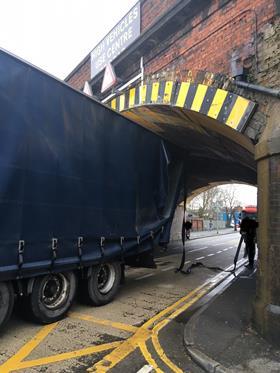
Network Rail has selected the Harlaxton Road bridge in Grantham for a three-month trial of a remote monitoring system which will use cameras and sensors to ‘massively’ speed up the process of checking that the bridge is safe to carry trains after being bashed by a road vehicle. Network Rail secured £50 000 of funding and is working with risk-management specialists BES Group. It is hoped the real-time alerts, data and video footage will allow engineers to assess the bridge remotely within seconds, reducing disruption for passengers and improving safety for staff who would otherwise need to inspect the structure on track.
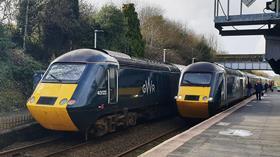
Great Western Railway withdrew its three remaining Castle Class HST sets after the final runs on December 13. The Class 43 locomotives and MkIII coaches are due to be returned to their leasing companies in the new year.
London Liverpool Street was Great Britain’s busiest station for the third year running with 98 million entries and exits from April 2024 to March 2025, according to statistics from the Office of Rail & Road. Elton & Orston in Nottinghamshire was once again the least used station with 68. Six of the top 10 most popular flows were between stations served by the Elizabeth Line, with 8·7 million journeys between London Liverpool Street and Tottenham Court Road.
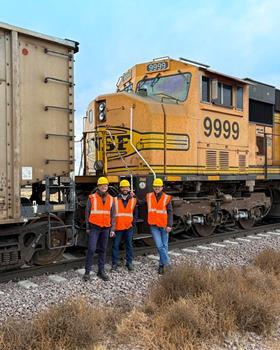
Five members of the University of Huddersfield’s Institute of Railway Research shared their expertise at the 14th World Congress on Railway Research held in Colorado Springs in the USA from November 17-21. Professor Bevan, Associate Director for Enterprise, Innovation & Knowledge Exchange at the IRR, gave a talk on the Practical Use of Wheel Impact Load Detector Data for Detecting Vehicle Defects in Freight Wagons. Dr Stow, Associate Director for Enterprise & Industrial Partnerships, spoke on Characterising the Dynamic Comfort Properties of Passenger Rail Vehicle Seats. Professor Bezin, Associate Director for Research, presented on a New Calculation Framework for Railway Track Designers and Maintainers to Better Understanding and Estimate. Dr Hawksbee, Senior Research Fellow, spoke on the topic of White Etching Layer Formation on Wheel and Rails During Braking under Changing Adhesion Conditions. Jordan Brant, Industrial Assistant, presented his research on Highly Adherent Leaf Layers.
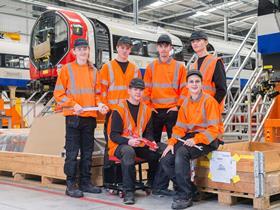
Siemens Mobility’s apprenticeship programme has welcomed the latest intake of 25 people across the UK and Ireland, contributing to the 175 apprentices currently on the programme and adding to the 150 who are already enrolled on different apprenticeship programmes. ‘The main thing that attracted me to Siemens was the opportunity to work on London Underground trains’, said Level 3 Engineering Fitter Apprentice Maisie Eastwood, 16, from Goole. ‘The idea of helping to build something which thousands of people will benefit from every day is so exciting. Being from Goole, it’s amazing to now have Siemens on my doorstep. It’s crazy to think this small town that not many people have heard about is playing such a big part in the transport network! Although I’m a female in an industry which is still quite male-dominated, I don’t feel like I’ve ever been treated differently. Everyone has been really supportive. One of my supervisors is a woman and I love seeing her briefing and leading the team — it’s really inspiring having so many women in senior positions at Siemens to look up to.’