UK: Procurement of a fleet of tilting trains and a focus on Birmingham – Manchester services are key to making the most of the descoped High Speed 2 scheme, former Virgin Trains executive Chris Gibb tells Rail Business UK.
UK: Amid the ‘reset’ of the embattled High Speed 2 programme which will see a new line built between London and the West Midlands, former Virgin Trains Chief Operating Officer Chris Gibb has reiterated and refined his recommendations for how the railway should be operated.

Having held numerous senior positions across the UK rail sector with a focus on operational delivery, Gibb made a high-profile intervention last year in the debate over how to make the most of a descoped HS2 when he advocated modification of existing Alstom Pendolino tilting trainsets for use on the new line.
However, with reports emerging that the full HS2 route from London Euston to Birmingham Curzon Street and a junction with the West Coast Main Line at Handsacre may not be ready for revenue service until 2039-40, Gibb has told Rail Business UK that a more fundamental review of the operating principles and fleet requirements is now needed.
Capacity crunch
The crux of the challenge facing planners is the decision in October 2023 by the previous government to cancel phases 2a and 2b of HS2 north of Handsacre. This means that under current plans, eight-car HS2 trains 200 m long will join the WCML there, immediately encountering a bottleneck as four tracks become two around Stafford.
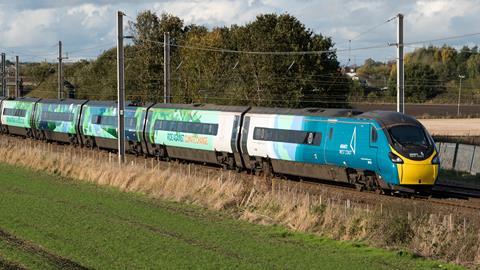
Currently, approximately two-thirds of Avanti West Coast’s inter-city trains are formed of 11-car Pendolino sets, which are 260 m long. This has in turn led to concerns about a potential loss of seating capacity when HS2 services are launched, compared to the status quo. This is compounded by ongoing questions about the maximum speed at which non-tilting rolling stock can run over WCML tracks.
‘Assured boarding’
Rail Business UK can reveal that plans are already being developed to manage access to HS2 and potentially other WCML services as a result of these issues, and because platforms at existing stations will be unable to handle pairs of HS2 trains running as 16-car sets.
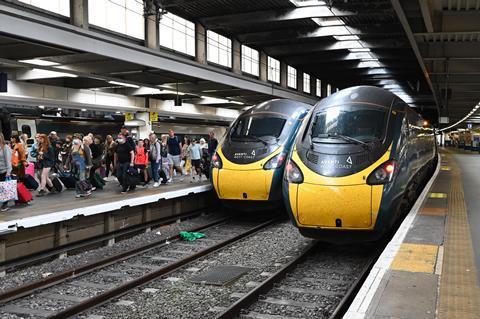
The 54 HS2 trainsets already on order from a consortium of Alstom and Hitachi Rail will have a maximum capacity of 504 seats, compared to 607 seats provided on an 11-car Pendolino set. Industry sources suggest that London – Manchester HS2 services are expected to be accessible only to holders of a seat reservation, although the term ‘assured boarding’ is being used rather than the more contentious ’compulsory reservation’. Standing passengers are generally not carried on high speed trains elsewhere in the world.
‘London – Manchester HS2 services are expected to be accessible only to holders of a seat reservation’
However, such an approach would have significant implications for other services using the WCML, as currently Avanti West Coast carries large volumes of traffic between Manchester and Macclesfield, Wilmslow, Crewe and Stoke-on-Trent. Effectively forcing these passengers onto local or regional services would create capacity problems too, especially at times of peaks in demand, such as weekends in the football season.
Pendolino plan revised
In 2024, Gibb proposed the use of refurbished and modified Pendolino sets to provide increased capacity on the Manchester/Glasgow/Edinburgh – London Euston services that would run over HS2 south of Handsacre. This would have exploited the 225 km/h design speed of the Class 390, which has never been possible on the existing upgraded WCML, despite aspirations to do so dating back many years.
Yet recent suggestions that HS2 Phase 1 between Old Oak Common and Birmingham Curzon Street may not open until 2037, with the full route to Euston not opening until as late as 2039-40, has caused Gibb to rethink his ideas. The 56-strong Class 390 fleet is due to be withdrawn between 2037 and 2043 as the trains become life expired. As a result, Gibb is now recommending the purchase of a new fleet of trains to augment HS2’s existing order for eight-car non-tilting trains.
TriLink
A further complicating factor is the TriLink programme to modernise the WCML north of Crewe, where comparatively little work was undertaken during the £9bn upgrading of the axis between 1998 and 2009.
TriLink would see ETCS Level 2 installed and overhead electrification equipment renewed between Warrington and Quintinshill in 2032-37, renewing the signalling and overhead electrification.
HS2 proposition
From 2039-40, HS2 is assumed to come on stream, including the link to Euston and the triangular Delta Junction at Water Orton east of Birmingham, where the spur to Curzon Street diverges from the north-south running line. At that point, Gibb has modelled 10 trains/h running over HS2 in each direction: three linking Birmingham with London; three to and from Manchester; two to and from Liverpool; and two serving Glasgow and other Scottish destinations as required.

He suggests that an hourly Blackpool – London service should run via HS2 by combining that train with a Liverpool – London service between Dallam, near Warrington, and Euston. No further enhancements to the existing NR infrastructure are assumed. Of the two Scottish HS2 trains per hour, one would be a fast Glasgow service calling only at Preston, giving an approximate end-to-end journey time of 3 h 40 min, which would compete well with air travel.
Delta delay
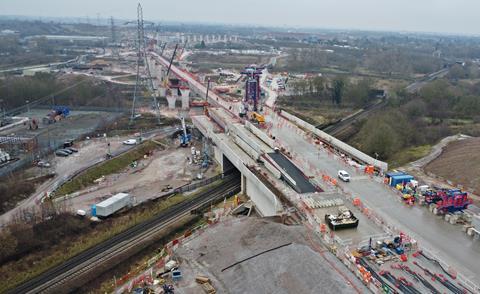
Gibb says that at present, there is no plan to fit-out the west-to-north side of the Delta at Water Orton, which would allow trains from Birmingham Curzon Street to head north to join the WCML. Under the descoped HS2 plans, the earthworks for the chord are being completed, but no track, switches or overhead line equipment is currently envisaged.
However, he feels that this link is vital, as it would allow the current CrossCountry trains between Birmingham and Manchester to be replaced with a service via the HS2 route to Handsacre that would be faster than the 1 h 35 min journey time typical today. The use of 200 m trains would also offer improved capacity compared to the current Class 220/221 fleet.
Fleet plans
In his revised scenario, Gibb envisages no changes to the order for 54 eight-car HS2 trains, nor to plans for the maintenance depot alongside the new line at Washwood Heath in Birmingham, However, he does foresee the trains being used on some WCML diagrams too. This fleet would be introduced initially on Old Oak Common – Birmingham services only.
| Fleet deployment proposal for HS2 trains already on order | |
|---|---|
| Service | Daily diagrams |
| Birmingham – London via HS2 (16 cars all trains) | 16 |
| Liverpool – London via HS2 | 10 |
| Blackpool – London via HS2 | 6 |
| Birmingham – Manchester via HS2 | 6 |
| Wolverhampton – London via WCML | 4 |
| Birmingham – London via WCML | 4 |
| ‘Hot spare’ trains at Curzon Street | 2 |
| Total diagrams | 48 |
| Maintenance quantum at Washwood Heath | 6 |
| Total fleet size | 54 |
| Total number of vehicles | 432 |
This fleet would then be supplemented by the tilting trains bought to replace the life-expired Pendolinos. These trains would be procured, delivered and commissioned in 2027-39. Gibb envisages a 12-car design 286 m long — the longest that can be accommodated at legacy stations such as Glasgow Central and Manchester Piccadilly. Selective door opening would be needed at other locations, but such a design would offer up to 786 seats per train. The trains would be fitted with ETCS from new, as well as active body tilt to permit operation at up to 300 km/h on HS2 and 225 km/h on the WCML.
These trains would be introduced onto existing Anglo-Scottish WCML services from 2037 when the TriLink ETCS goes live. This would avoid the expense of fitting Pendolinos with ETCS equipment, along with the associated driver training for a short period of use. In addition, there would be time for driver training and mileage accumulation before these services are rerouted onto HS2 and introduction on Manchester – London services from 2040. Gibb is proposing a build of 43 trains to cover 37 diagrams.
| Fleet deployment proposal for potential new tilting train fleet | |
|---|---|
| Service | Daily diagrams |
| Scotland – London via HS2 | 18 |
| Manchester – London via HS2 | 13 |
| Manchester – London via WCML | 6 |
| Total diagrams | 37 |
| Maintenance quantum (Longsight and Polmadie) | 6 |
| Total fleet size | 43 |
| Total number of vehicles | 516 |
Gibb proposes retaining the 13 Class 805 five-car bi-mode trainsets used by Avanti West Coast today to cover 10 daily diagrams between North Wales and London Euston via the WCML. The 10 seven-car Class 807 EMUs would be displaced to other routes from 2040, including possible use by open access operators.
2040 looms
‘The fleet deployment to service groups is using my draft timetables and is of course subject to further detailed train planning work’, Gibb tells Rail Business UK. ‘For Birmingham – Manchester I have assumed that an HS2 Curzon Street – Manchester electric service replaces the existing CrossCountry diesel service to provide more seats, a journey time reduction and environmental benefits. This service would be operated entirely with new Washwood Heath drivers and trains from Washwood Heath depot.’

However, he reiterates that the third side of the Delta Junction would need to be commissioned to enable this to happen. One train per hour would serve Stafford; the other would run non-stop between Stoke and Birmingham southbound via Hixon, routing northbound via Stafford to avoid flat junction conflicts at Colwich. Capacity would be released on the Stafford – Wolverhampton – Birmingham New Street route for additional local services, he adds.
Overall, Gibb says that ‘by 2040 a total fleet of 948 new vehicles will replace 684 vehicles currently in use, of which 614 will be life expired. The additional 264 vehicles will provide the additional capacity necessary on all routes to accommodate the growth generated from 2040 by reduced journey times, improved performance, population growth, modal shift from air and car, GDP growth, effective marketing, good yield management and high levels of passenger satisfaction.’
‘I’m confident train builders can come up with a new generation of tilting trains’
Gibb has also created a set of associated train maintenance depot capabilities, with the objective of minimising training and modifications to existing or designed assets. Current WCML depots would be supplemented by the Washwood Heath HS2 facility, which is being built for 200 m long trains, while recruitment of new drivers could be combined with revised working arrangements to match the demands of the new route and service groups.
Alignment of opportunity
Summarising his concept, Gibb suggests that his proposed approach allows HS2 Phase 1 ‘to deliver a significant increase in capacity and reduced journey times on all routes without further major investment on the rest of the network’.
He points out that delays to the full opening of HS2 would more closely align it with life expiry of the Pendolino fleet. This would create opportunities to bring rolling stock strategy into harmony with infrastructure renewals and enhancements on the WCML that are already at the planning stage.
‘Doing Pendolino full fleet replacement with competitive procurement in time for the full opening of HS2 Phase I presents a range of opportunities to increase capacity, reduce costs, deploy the latest technology and avoid a variation of the HS2 train order already placed. Countries such as Italy and Switzerland will be replacing their Pendolinos from 2040, so I’m confident train builders can come up with a new generation of tilting trains’, he says.
Meanwhile, economic regeneration and housing developments between Birmingham and London would also be supported. ‘The use of 400 m long, 1 008 seat trains on all Birmingham Curzon Street to Euston HS2 services from 2037 releases significant seating capacity on Birmingham – Milton Keynes – Euston and Birmingham – Bicester – Marylebone [routes], allowing that capacity to be reused to support population growth, new housing and economic development within 60 min of central London’, he concludes.