UK: Preparations are well in hand to move the striking Curzon No 2 Viaduct into position this spring, forming a stand-out element of High Speed 2’s arrival into Birmingham. Chris Howe reports from Duddeston.
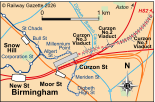
Curzon No 2 Viaduct, informally known as the ‘Bellingham Bridge’ after locally-born Real Madrid footballer Jude Bellingham, is one of five structures that will carry High Speed 2 trains into the future Curzon Street station in the centre of Birmingham.
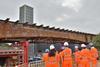
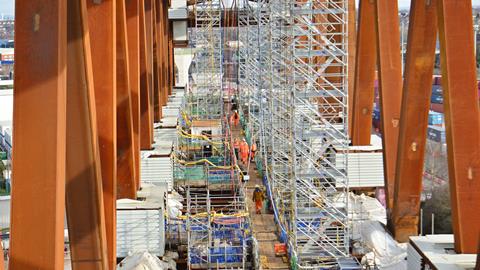
The 150 m long Warren truss viaduct will traverse the Cross-City suburban line approximately 700 m to the south of Duddeston station. For the past 12 months, the Balfour Beatty Vinci joint venture responsible for constructing the West Midlands section of HS2 has been assembling the truss frame for the viaduct within a constrained site sandwiched between the River Rea, an industrial estate and the Cross City Line.
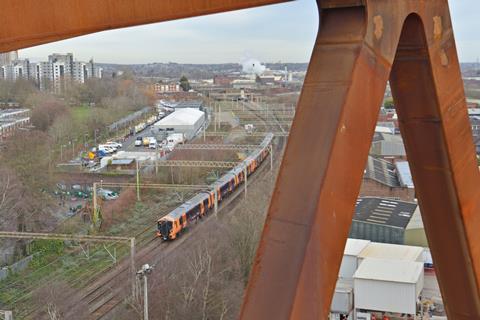
BBV says that the compact nature of the worksite has made assembly of the 4 200 tonne truss challenging, and delivery of the structural steel elements and subsequent assembly had to be carefully choreographed.
The individual elements weighing up to 85 tonnes were manufactured by Martifer in Portugal. On reaching the UK, they were transported to the site by road. A number of sections were then welded together to form a ‘diagonal’, whch was then lifted into position and welded to the diagonals installed previously.
Approximately 94% of the total welding task was undertaken at the factory in Portugal, with the remaining 6% completed on site.
BBV opted to carry out as much assembly as possible at ground level. This reduced the amount of time spent working at height, and thus the safety risks, although a team of highly specialised welders had to spend months painstakingly connecting the sections together at heights of up to 40 m.
29 km of welding
Assembly of the truss required 29 linear-km of welds, which had a combined weight of 18 tonnes. Each of the main full penetration welded joints connecting the main structural elements required 35 passes, which took up to four days to complete.
The sheer amount of welding required posed a particular challenge for BBV, as the joint venture had difficulty recruiting enough welders who had the skills required for such precise work. This led to programme delays, and saw the resulting bridge move held up by nine months.
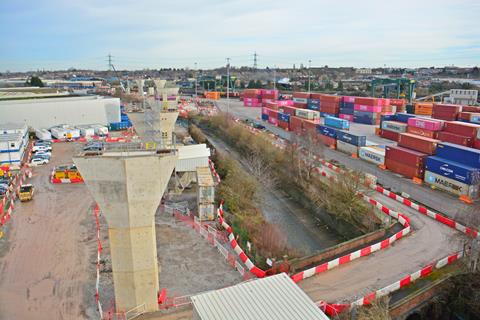
The truss frame is currently situated away from the existing railway and is resting on piers that will eventually also support the adjacent Curzon No 1 Viaduct. The ‘Bellingham Bridge’ was supposed to have been moved over the railway in August last year, but BBV opted eventually to postpone the move until May 2026.
In a process due to start on May 24, the entire truss structure will be pulled into its final position using a strand jack system. It will initially be dragged close to the railway over a number of nights between May 24 and 28, with this initial move requiring overnight possessions of the Cross-City railway as the bridge is slowly moved closer to its final position.
A three-day possession of the railway is then planned for the final shift to get the structure into place.
Four piers
The structure will rest on four piers, two on each side of the existing brick arch viaduct that carries the Cross-City Line towards Proof House junction on the edge of the city centre.
Two main V-shaped piers each resting on 16 piles 30 m deep will support most of the weight. However, because of the angle at which the bridge crosses above the viaduct two further off-centre piers have been constructed.

Although the initial move date for the bridge was pushed back, engineers are now confident that the new date at the end of May can be met. Once Curzon No 2 Viaduct is in position, the remaining section of Lawler Middleway Viaduct can be installed and connected to No 2 Viaduct. This in turn will also allow work to commence on Curzon No 1 viaduct, which will rest on the piers that are currently supporting No 2. Once in position, the concrete deck will be formed from precast concrete panels. These are being delivered by BBV itself from its Kingsbury precast site in Warwickshire, which is also manufacturing the concrete segments for HS2’s Delta Junction to the east.
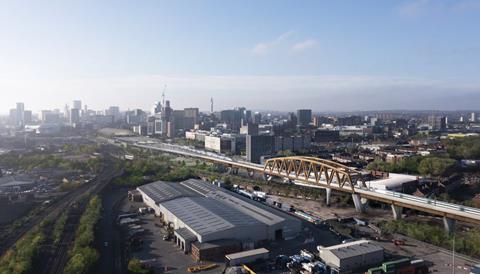
The height and scale of the No 2 Viaduct mean that it will be a significant feature on Birmingham’s skyline, being visible over a wide area during the day. At night, a distinctive lighting scheme, designed by British artist Liz West, will further help to establish the structure as a stand-out emblem of Birmingham’s HS2-inspired urban renewal.