







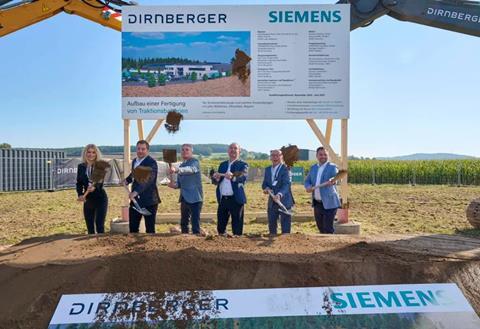
GERMANY: Siemens Mobility began construction of a rolling stock battery system factory at Luhe-Wildenau in Bayern with a groundbreaking ceremony on September 29.
The factory being developed in co-operation with Dirnberger Real Estate and construction company Dimonda Projektbau represents a total investment of around €35m, including €22m from Siemens Mobility and €2·7m from the Land of Bayern.
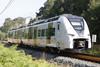
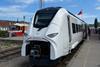
Siemens Mobility currently assembles battery systems for regional battery-electric trains at the site, which will be expanded to undertake full-scale battery system production from October 2027. The 20 000 m² facility will have up to 200 employees manufacturing complete battery packs totalling up to 120 MWh per year. These will be used for Siemens Mobility regional passenger trains and planned battery-electric freight locomotives as well as being supplied to external customers.
Siemens Mobility said rail battery systems must meet significantly higher requirements for robustness and durability than comparable automotive products, with typical storage capacities of 500 kWh for regional trains and up to 2 000 kWh for locomotives.
It uses cells sourced from external suppliers such as Toshiba, and a battery management system has been developed with München-based Stercom.
Commitment to Germany
‘We are making a clear commitment to Germany as a production and innovation hub’, said Siemens Mobility CFO Karl Blaim. ‘We are investing specifically in key technologies, creating high-quality jobs in the region and strengthening the competitiveness of the domestic rail industry. At the same time, we are making an important contribution to the mobility transition and sending a strong signal for the future viability of Germany as a business location.’
Bayern’s Minister for Economic Affairs Hubert Aiwanger said ‘Siemens Mobility is developing battery systems here that combine strong acceleration performance with high energy capacity for long-distance travel, so we can look forward to more powerful and efficient trains. At the same time, many high-quality jobs will be created in the region.’