






Poland is launching the largest railway expansion programme in its history through the Port Polska initiative, a transformative effort to reshape national mobility and strengthen connections between major cities and regional centres.
The largest rail expansion programme in Poland’s history is now underway. Developed as part of the Port Polska investment programme, it will ensure a maximum journey time of 3.5 hours between the country’s largest cities. Travel from Warsaw to major cities such as Kraków, Poznań and Wrocław will take no more than 100 minutes. Every county will gain direct or indirect access to the long-distance rail system. The programme is based on forecasting, simulation models and broad consultations.
The Integrated Railway Network (ZSK) is being delivered at the request of the Ministry of Infrastructure by Centralny Port Komunikacyjny – as part of the strategic Port Polska projects – and PKP Polskie Linie Kolejowe.
ZSK includes new rail investments to close infrastructure gaps and defines the post-2035 expansion of Poland’s rail network following completion of the “Y” line linking Warsaw, the new airport, Łódź, Poznań and Wrocław. It establishes a long-term, coherent rail investment plan developed with academic experts and agreed with local authorities, the logistics sector and the military.
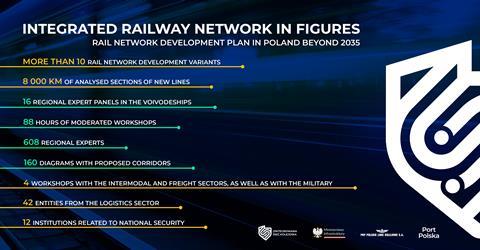
Under ZSK, 8,000 km of potential new lines have been analysed. Consultations across all 16 voivodeships involved nearly 800 representatives of more than 100 institutions, including local governments, rail operators, universities and logistics and security bodies.
Scientists and the military
Investment options were consulted with the Ministry of National Defence, the General Staff and other armed forces bodies in the context of national security and dual-use infrastructure. Cooperation also includes the Centre for Eastern Studies (OSW) and the Institute for Urban and Regional Development.
The final variant after launch of the “Y” line is overseen by the ZSK Scientific Council, comprising 19 experts from leading Polish institutions, including the Warsaw School of Economics, technical universities, the Polish Academy of Sciences and the Railway Research Institute.
What will be built after the “Y” line
Consultations considered local needs to ensure every county has direct or indirect access (via rail or regional buses) to long-distance services. Cross-border links are coordinated with the Baltic States, the Czech Republic and Germany.
Assessment uses proprietary Passenger and Freight Transport Models integrating road, rail and air transport on the basis of statistical data and forecasting. A detailed expansion plan covering several thousand kilometres of new routes will be announced this year.
A convenient, clockface timetable
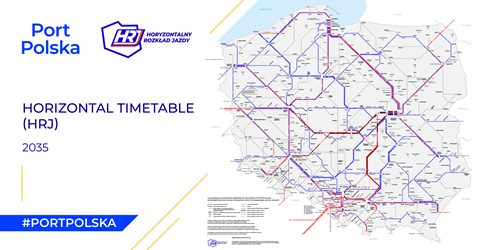
Infrastructure development is accompanied by work on the Horizontal Timetable (HRJ), a regular, passenger-friendly schedule. Alongside the fastest high-speed services on the “Y” line, regional express trains will serve medium-sized and smaller cities, including on sections of the conventional network.
Consultations across Poland
A total of 157 experts participated in HRJ workshops with regional rail organisers and national institutions. Local authorities submitted 727 comments and proposals, while public consultations generated around 1,800 additional submissions. Discussions were also held with operators and international partners.
Specialist planning tools
Port Polska relies on advanced analytical tools developed in-house to design the future rail system with precision, aligning it with European Union priorities for passenger and freight transport.
“Thanks to advanced analytical tools such as the Passenger Transport Model and the Freight Transport Model, the future rail system can be prepared with exceptional precision, with decisions based on accurate and reliable data” – says Michał Pyzik, Director of Transport Planning Projects Portfolio at Centralny Port Komunikacyjny – “The tools have been developed in-house by the company’s engineers and take into account the international context of the rail network – both for passenger and freight transport. As a result, they align closely with European Union plans to prioritise rail at both national and international level”.
New rail lines under construction
Construction is under way on the 480 km high-speed rail line from Warsaw via Łódź to Poznań and Wrocław, designed for speeds of up to 350 km/h. The government programme for other rail lines covers 12,000 km, with PLN 180 billion in expenditure planned by 2032.
Poles are switching to trains
Poles currently make just under 12 rail journeys per capita annually, compared with the EU average of 18. The target is up to 20 journeys per year per person. On key corridors, including Warsaw–Poznań and Warsaw–Wrocław after completion of the “Y” line, more than two-thirds of passengers are expected to travel by rail.
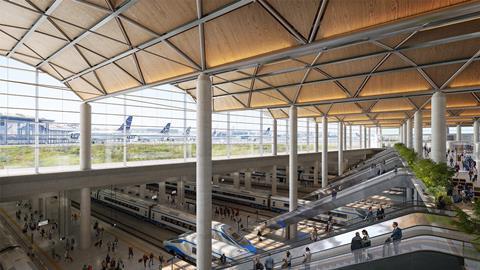
Port Polska is a strategic infrastructure programme developed by Centralny Port Komunikacyjny to create an integrated national system combining air, rail and road transport, including a new airport hub between Warsaw and Łódź and a nationwide high-speed rail network.