


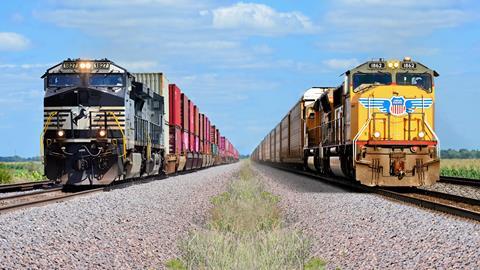
USA: Union Pacific and Norfolk Southern formally applied for Surface Transportation Board approval of their proposed merger on December 19.
The Class I railways said the application runs to nearly 7 000 pages, including 2 000 letters of support from stakeholders, joining shareholders at both companies who cast votes 99% in favour of the merger.
Norfolk Southern President & CEO Mark George said ‘this combination will bring together Union Pacific’s expansive western reach and Norfolk Southern’s unparalleled access to eastern manufacturing and population centres’, to create ‘a cohesive freight rail solution with 50 000 route-miles [80 500 route-km] that connect 43 states and more than 100 ports.’
The railways said UP’s the creation of what would be the USA’s first coast-to-coast transcontinental railway would ‘remove the artificial barrier that divides America’s rail system between east and west’. This would provide ‘faster, more efficient single-line service’, eliminating an estimated 2 400 wagon and container handlings and 96 600 car-km each day and competing more effectively with long-haul trucking resulting in the transfer of estimated 2 million lorryloads of from road to rail annually.
The companies expect $133m in annual capital synergies. They said every employee with a union job at the time of the merger would continue to have one, and they expect growth to create about 900 net new union jobs by the third year following the merger.
Union Pacific CEO Jim Vena said ‘as time and technology continue to transform how freight is delivered, our industry must keep pace and move forward, reaching underserved markets with new rail solutions and strengthening the US supply chain. Customers deserve stronger, more connected freight rail, and our merger will make that happen.’
STB process
The STB is to determine by January 18 2026 whether to accept the application for consideration or to reject it as incomplete. If the STB accepts the application, its will then undertake a review.
If the STB approves the transaction, the two railways expect the deal to be completed by early 2027.
Responses
Commenting on the application, BNSF President & CEO Katie Farmer said ‘what we have seen so far does not change BNSF’s opposition to the proposed merger. The transaction poses a significant threat to the US economy and the American consumer through its long-term competitive harms. It would leave shippers with fewer options — driving higher rates and ultimately higher prices for consumers. This didn’t begin with customers asking for this merger, and the claimed public benefits appear to accrue primarily to shareholders. Past mergers demonstrate the risk of serious service failures with destructive impacts to customers, the US rail network and the American economy.’
Farmer added that ’this is precisely why the STB strengthened its merger rules: applicants must now prove their deal will not only preserve but enhance competition; that it serves the public interest, and its purported benefits can’t be delivered through partnerships. BNSF is confident that UP has not met these requirements. UP has a long history of making promises in past mergers that they back away from once they’ve secured approval. BNSF remains focused on achieving these same benefits through partnership and collaboration which results in streamlined service, and greater operational flexibility, delivering real, immediate benefits to customers.’
Fellow Class I railroad Canadian National said the application ‘fails to demonstrate that the merger would enhance competition or generate significant public benefits that would require a merger’, and ‘falls well below’ STB rules. CN said ‘this merger would reduce rail transportation options for customers while creating a single entity that controls more than 40% of the US freight rail market. Without real railroad competition, prices go up and consumers lose.’
CPKC said the proposed merger was ‘unprecedented in scale and scope’ and the resulting ‘behemoth’ would ‘radically and permanently change the US rail network’ with ‘extraordinary and far-reaching risks to customers, rail employees and broader supply chains.’ CPKC said it would examine the application from at least two perspectives: whether it complies with STB merger rules, and whether it is consistent with the public interest.