






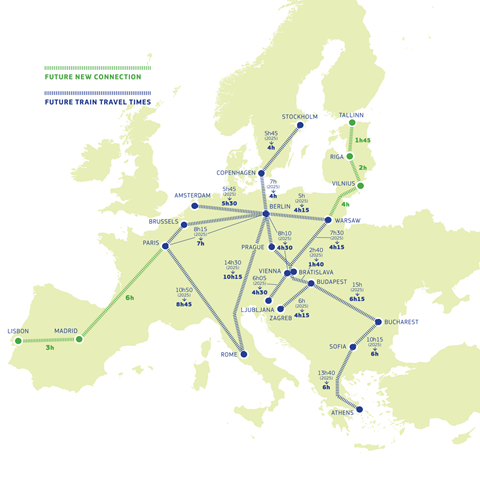
EUROPE: The European Commission has unveiled a plan to accelerate the development of high speed rail across the European Union, saying the creation of a well-functioning and faster rail network by 2040 would support the twin goals of becoming carbon-neutral by 2050 and strengthening Europe’s global competitiveness.
The plan envisages trains running at more than 200 km/h to provide significant reductions in journey times between major cities, ease congestion, increase capacity on conventional lines, improve services for regional and night trains and strengthen security by facilitating the swift movement of troops and military equipment.
The plan builds on the Trans-European Transport Network, and was developed through stakeholder dialogue to hear the views of the rail industry, passenger organisations, civil society, trade unions, private investors and related companies.
Four pillars
The plan is structured around four pillars, which aim to solve long-standing problems in the rail sector.
Accelerating investment and creating a truly interoperable high-speed rail network.
A planned High Speed Rail Deal would provide a multilateral commitment to mobilise the necessary investments for priority projects to ensure completion of the TEN-T network by 2040.
Binding timelines to remove cross-border bottlenecks are to be set by 2027, and options identified for higher speeds ‘well above 250 km/h when economically viable’.
A dedicated EU financing strategy is be prepared in the coming months, supported by a strategic dialogue with member states, industry and financial actors. This aims to strengthen the EU financing ecosystem for high speed rail projects, and better co-ordinate funding sources and private investment.

The Commission said finalising the planned TEN-T high-speed network by 2040 would cost around €345bn, while a more ambitious network operating at speeds well above 250 km/h could cost €546bn by 2050.
It said public funding alone would not be enough, and the plan will require private investment and loans and guarantees from financial institutions such as the European Investment Bank and national promotional banks and institutions.
An attractive and competitive framework for rail services
The Commission will co-operate with financial stakeholders to expand or create new innovative financing tools for new entrants to acquire or lease rolling stock.
Legislation will support the development of a second-hand market for rolling stock, with the Commission to propose measures in 2027 to ban anticompetitive scrapping of usable rolling stock. Transparent conditions for resale and operation will be applied across all member states.
Proposals to improve cross-border rail ticketing and booking systems will be announced in 2026, with better access to passenger rights protection when using multiple operators and a plan to make it easier for new operators to sell their tickets on existing platforms.
Better co-ordination of track capacity, fair track access charges, and non-discriminatory access to service facilities will make it easier for new companies to offer high speed rail services, ‘boosting competition and making high speed rail more affordable’.
Supporting a strong, innovative and harmonised European rail sector
In 2026 a Europe’s Rail research call will support the development of next-generation high speed rolling stock, funding innovation to overcome technical barriers that currently prevent trainsets from operating seamlessly across Europe.
EU rules will be revised in 2026 to simplify train driver certification making it easier for train drivers to operate cross-border services.
The 2026 European ERTMS Deployment Plan will ensure enhanced interoperability through a harmonised roll-out.
Strengthening EU-level governance to co-ordinate and deliver the vision
Infrastructure managers will be empowered and legally required to co-operate in providing predictable and attractive cross-border capacity for long-distance services, in line with the proposed regulation on the use of rail infrastructure capacity.
Barriers to establishing new services between key cities will be addressed in roundtable discussions, with progress towards solutions overseen by the European TEN-T Coordinators.
The Commission will establish a scoreboard to monitor progress on high speed rail.
The mandate of the European Union Agency for Railways will be revised in 2026, enabling ERA to remove redundant national rules and issue authorisations and certifications more efficiently, thereby supporting the implementation of innovation.
Not just about cutting travel times
Announcing the plan on November 5, Commissioner for Sustainable Transport & Tourism, Apostolos Tzitzikostas said ‘high speed rail is not just about cutting travel times — it is about uniting Europeans, strengthening our economy and leading the global race for sustainable transport.
‘With today’s plan, we are turning ambition into action: breaking down barriers, mobilising investments for modern infrastructure, and making cross-border rail the backbone of a carbon-neutral, competitive and secure Europe. Citizens across the union will benefit from faster, safer, and more affordable journeys that bring Europe closer together.’
Rail sector responses
Responding to the publication of the plan, Community of European Railway & Infrastructure Companies Executive Director Alberto Mazzola said ‘by linking cities and regions through a coherent European network, we bring people closer to opportunities, give a strong boost to the European economy and contribute to energy independence. To make this vision a reality, Europe needs stable long-term investment, fair competition with other modes and rolling stock compatibility through widespread deployment of harmonised technical enablers such as ERTMS.’
André Sobczak, Secretary General of the Eurocities network of larger cities, said ‘cities are ready to play their part, integrating long-distance rail into local mobility systems and shaping the multimodal hubs of the future’.
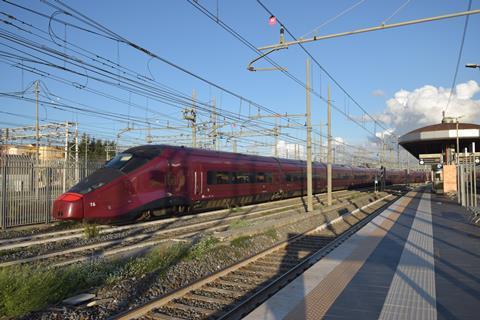
The AllRail alliance of new entrants to the passenger rail market said the plan ‘rightly recognises that the success of Europe’s high speed network depends on it being open, interoperable and competitive, so that every European can benefit’. AllRail said many of the priorities outlined in its own position paper were reflected in the Commission’s blueprint, ’from transparent rolling stock access and genuine market openness, to better ticketing and improved infrastructure governance that will allow new entrants to compete on fair terms’.
AllRail particularly welcomed the commitment to ban anti-competitive scrapping of rolling stock, saying the reforms would ‘finally open up access to trains for new entrants, unlocking innovation, affordability and dynamism across Europe’s rail market’.
Enno Wiebe, Director General of European rail supply industry association UNIFE, said the plan ‘must put member state economies, industries and communities first’. He said ‘non-European components should not be used in security-critical systems such as signalling, and the project must be put together and delivered by European-based industry as it is a strategic project’.
He added that ‘we strongly welcome the intention of the Commission to take into account risks posed by foreign state-controlled suppliers. We now need to ensure that public procurement rules are strengthened and used strategically in their upcoming review in 2026. No bidder from a country which does not have a market access agreement with the EU should be allowed to participate in such a strategic project.’
He welcomed the commitment to more joint industry research initiatives, but warned ‘we must carefully assess how to achieve an efficient harmonised European framework, avoiding national approaches, while also giving caution to over-regulation and hampering innovation’.
- Learn more: Subscribers can read an exclusive interview with Transport Commissioner Apostolos Tzitzikostas from the September issue of Railway Gazette International magazine.