






SPAIN: Construction of a 3·2 km section of the dual-gauge Bizkaia Southern Rail Bypass near Bilbao is to begin by the end of this year, the Basque regional government’s Minister for Sustainable Mobility Susana García Chueca told the autonomous community’s parliament on November 7.
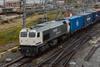
The bypass, also known as the Variante Sur Ferroviaria de Bilbao, is intended to provide a new access route to the port of Bilbao, enabling freight trains to avoid the centre of the city and freeing up capacity for suburban services.
Plans for a dedicated rail access to the port date from around 2000. Work began in 2004 with the boring of the 3 650 m Serantes tunnel, the objective being to divert freight trains to a new junction with ADIF’s single-track broad gauge line at Muskiz, avoiding Santurtzi and Portugalete. The tunnel was completed in 2008 at a cost of €47∙3m, but to date, the 4∙8 km section of new line has no physical connection with the main line.
The next segement of the bypass will extend the route from the Serantes tunnel southeast in the direction of Ortuella. It will be made up of four tunnels: a 385 m cut-and-cover excavation, a 736 m double-track bore, and two single-track tunnels 1 440 m and 620 m long.
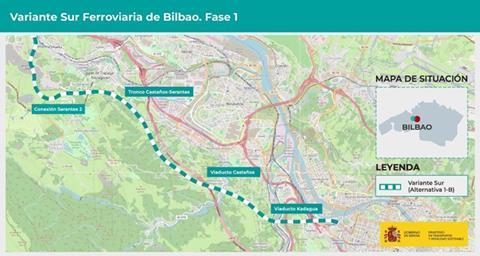
Basque infrastructure manager Euskal Trenbide Sarea awarded a €100·6m contract in April to carry out civil works on the first phase to a joint venture of construction companies Comsa, Azvi, Iza, and Campezo.
The bypass is ultimately envisaged to be 12 km long, continuing further southeast from Ortuella to meet the existing rail network near Olabeaga. The remaining six sections are still at the planning stage. It forms part of long-standing plans to create a 1 435 mm gauge link from the port of Bilbao to the French border at Hendaye, which in turn forms part of the Atlantic Corridor within the EU’s TEN-T network.
‘This [project] means that freight trains will no longer have to travel through the heart of Santurtzi, Portugalete, Sestao, and Barakaldo, where the Iberian gauge network will continue to be used exclusively by suburban trains’, García Chueca said. ‘The new infrastructure will give us a boost in economic competitiveness by connecting the port to the high speed rail network.’