





INTERNATIONAL: The complexity of the task of moving from bold vision to the reality of a truly digitalised and connected rail ecosystem was in evidence at UIC’s Future Railway Mobile Communication System conference. Nick Kingsley reports from Paris.
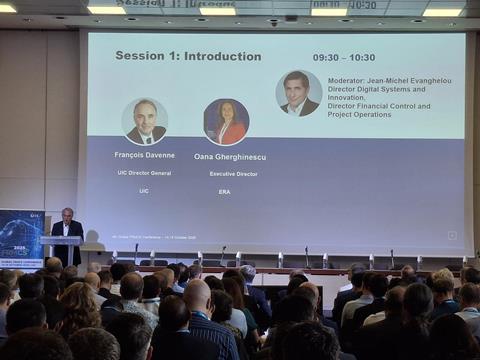
The Future Railway Mobile Communication System is no longer just an aspiration, International Union of Railways Director-General François Davenne told delegates at the opening of UIC’s FRMCS conference in Paris on October 14-15. Yet the complexity of the task of moving from bold vision to the reality of a truly digitalised and connected rail ecosystem was much discussed over the two days.
Davenne was among many speakers to emphasise the importance of the FP2-MORANE research project now gathering pace.
Finalised in December last year and being led by UIC, the project includes an array of stakeholders from the European rail sector, including the Europe’s Rail Joint Undertaking, infrastructure managers and suppliers from the telecoms sector.
‘This project will demonstrate the tangible benefits of FRMCS’, Davenne said, paving the way for a migration away from the increasingly obsolete GSM-R radio networks that form the backbone of most rail telecoms systems today. ‘FRMCS will be essential to futureproofing the rail sector and keeping rail relevant’, he insisted, noting that 5G telecoms and related technology ‘had been mentioned at every UIC meeting since 2019 for a reason — FRMCS will be a symbol of co-operation between railways across the globe.’
Focus on commercial reality, says ERA
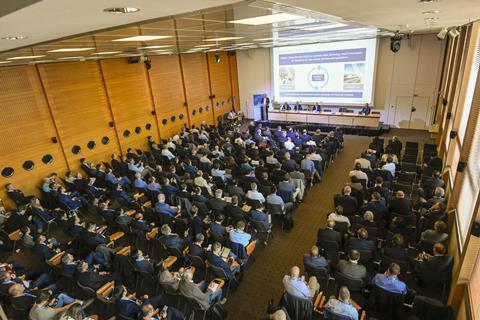
While the conference included several updates from outside Europe, the complexity of EU interoperability and technical harmonisation requirements in rail — and, to an extent, the telecoms market — made it the dominant area of focus.
In a keynote address, recently appointed Executive Director of the EU Agency for Railways Oana Gherghinescu described herself as ‘firmly part of the FRMCS family’.
Nevertheless, she urged attendees to focus on two key issues as the FP2-MORANE project takes FRMCS towards deployment over the next few years.
‘First, how do we turn a defined business need into a commercially viable market, and second, how do we ensure innovation does not stifle competitiveness?’ she asked. The next phase of the FRMCS programme in Europe needs to ensure ‘we get a radio system that can be made into clear and documented technical standards, and then those can feed into a marketable product.’
But she reiterated that ‘we all work in a sector that is not rich’, which means that ERA is keen to ensure investment in long-life assets like radio infrastructure is well directed. ‘When we push innovation, we must manage migration through a strong business case.’ In that regard, she saw ERA’s role as bringing stakeholders together to ensure, in particular, that FRMCS complements the ongoing adoption of ERTMS.
Safety and interoperability are key
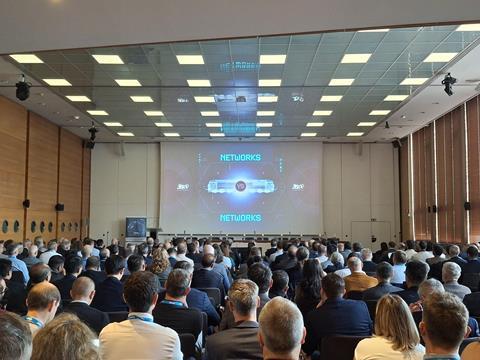
Gherghinescu acknowledged that ‘not everyone around the table’ speaks the same language on FRMCS, and she felt a need for ERA to ‘make difficult conversations happen’. On that topic, she reiterated that interoperability and safety ‘must be respected’ in the FRMCS development programme, and ’the radio component of ERTMS cannot be an exception’. Nevertheless, she was optimistic that the FP2-MORANE field and laboratory tests would complement ongoing work to finalise a Version 3 set of FRMCS specifications; these would then be used to inform a recast of the Command Control & Signalling TSI, expected in 2028.
‘We hope we’ll have a mature set of specifications soon’, she explained. ‘But that does not mean that that we will have a business-ready concept to deploy.’ Noting that she had already had 35 meetings on FRMCS this year, Gherghinescu said that much work remained to come in the months ahead to ‘identify all of the challenges’, and clarify in particular the role of the infrastructure managers and that of ERA in technical authorisations.
Concluding her address, she reminded delegates of the importance of viewing FRMCS in the context of the wider rail investment needs of Member States, ‘whose investments must be resilient and protected’. She also urged the sector to use the emergence of FRMCS as a means to maintain momentum in the roll-out of ERTMS. ‘We must go faster on that, with FRMCS as an enabler.’
GSM-R sun to set more slowly
Among several European infrastructure managers giving an update on their current views on the transition to FRMCS, DB InfraGO saw an opportunity to keep GSM-R alive on a smaller section of the network well into the 2030s. This reflected a broader consensus at the conference that aspirations for GSM-R to be ‘switched off’ by 2030 were never realistic — ‘that emperor had no clothes’, as one delegate put it.
Achim Vrielink, Head of Telecoms at the German infrastructure manager, said he foresaw a case for ‘decoupling’ ETCS and FRMCS, which would ease some of the technical hurdles railways were facing. This option would see FRMCS initially used for voice calls only, which would ease the pressure on train operators and rolling stock asset owners. ‘They can upgrade their cab radios to FRMCS for voice without having to worry about ETCS at the same time’, he said. Meanwhile, GSM-R would continue to cover the approximately 20% of the German network now being fitted with ETCS into the next decade, making use of decommissioned equipment brought in from elsewhere.
Meanwhile, Vrielink said DB was making good progress in its early preparatory works for the adoption of 5G telecoms across its network.
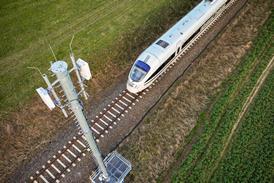
While its dedicated FRMCS trial zone in the Erzgebirg mountains in the southeast of the country will be used for field tests under the FP2-MORANE programme, masts and antennas were now being installed as part of the current total route modernisation of the Berlin – Hamburg main line as well. He reported that 300 masts 15 m high would be fitted in the corridor by April next year, initially to support enhanced mobile coverage by the public Mobile Network Operators. These will then be used for early roll-out of FRMCS as the migration proceeds. As an aside, Vrielink added that ETCS is not being fitted along the route as part of the ongoing upgrading works, with the legacy LZB train protection system being retained instead.
The densification challenge
Several speakers reiterated the importance of co-operation between mobile network operators and the rail sector to ensure cost-effective migration. This is especially important for secondary and rural railways, where the costs of installing optical fibres, masts and antennas just for FRMCS are already looking prohibitive.
But even this may not be enough to overcome some major cost effectiveness issues that are likely to emerge in the years ahead. With FRMCS expected to cost at least €50bn to deploy in Europe, attention is now turning to how railways will quantify how many assets they will need to procure, and how much legacy GSM-R equipment could be reused. One telecoms specialist told Railway Gazette International that DB InfraGO currently needs to deploy one GSM-R mast every 7 km along its network on average, but with FRMCS this could fall to as little as one every 1 km.
This is a reflection of the complex interaction between 5G spectrum and signal strength, for which mobile network operators have compensated by densifying their assets in areas of higher population to ensure better access to high bandwidth 5G connectivity. Even then, the telecoms insider added, a dense network of physical assets may not be enough to mitigate the attenuation challenge of delivering mobile signal to a moving train — sometimes referred to as the ‘Faraday cage’ effect. ‘How many billions will politicians be willing to spend on FRMCS if it doesn’t seem to benefit the end consumer?’ they asked.