








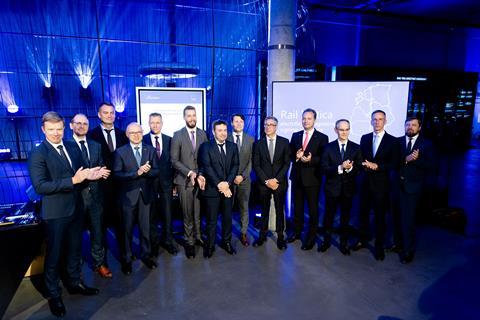
EUROPE: The COBELEC consortium and the Rail Baltica international standard gauge line’s project promoters ceremonially signed the €1·77bn design and build contract for electrification of the future corridor in Vilnius on September 15.
The procurement process was launched in May 2022. Four consortia applied, with three shortlisted in 2023. Tri-national project promoter RB Rail said the COBELEC consortium of Vinci subsidiary Cobra Instalaciones & Servicios and Elecnor Servicios & Proyectos was ultimately selected for its strong technical solution, cost efficiency and sustainability credentials.
‘By selecting a single contractor for both design and construction, we ensure efficiency, consistency and cost control. This approach allows us to cut life-cycle costs, improve energy efficiency and deliver clear environmental benefits’, said Aiga Benfelde, Senior Contract Manager at RB Rail and Chair of the procurement commission.
In a separate project, Elecnor is currently electrifying Lithuania’s 1 520 mm gauge east-west main line from Vilnius to Klaipėda.
Project scope
RB Rail said the Rail Baltica project involves electrifying 870 route-km and 2 403 track-km across Estonia, Latvia and Lithuania.
Vinci said this would be the first time that static frequency converter technology has been deployed on a large scale. It will be powered by 10 substations, and aims to ensure long-term reliability, efficiency and environmental performance.
‘We are proud to lead Europe’s largest railway electrification project’, the consortium said. ‘Drawing on our combined expertise, we have a solid history of executing complex projects to the highest standards. We are committed to supporting Rail Baltica’s strategic role in strengthening regional connectivity and EU integration.’
The first phase of the work has a budget of €949m and is to begin on October 1 for completion in 2030.
A ‘highly complex agreement’
‘Electrification is not only about powering trains — it is about enabling sustainable mobility, ensuring interoperability with the European network, and securing long-term energy efficiency for the entire region’, said Marko Kivila, CEO & Chair of the RB Rail management board. ‘This is a highly complex agreement. To ensure that every necessary step is taken and the timeline remains aligned with the overall Rail Baltica development, the electrification works will be implemented in parallel with the wider project.’
Catherine Trautmann, European Co-ordinator for the North Sea-Baltic TEN-T Corridor, said ‘signing of the electrification contract underscores the joint commitment of all project partners to build a unified and interoperable railway line across national borders. In the current geopolitical climate, strengthening the connection between the Baltic states and the rest of the European Union is more important than ever.’