













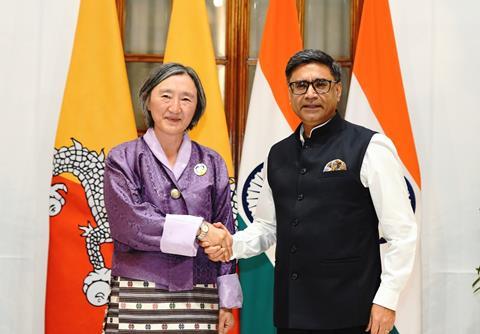
ASIA: An inter-governmental memorandum of understanding for the construction of two cross-border rail links between India and the Himalayan kingdom of Bhutan was signed during a meeting between the foreign secretaries of the two countries on September 29.
Two rail links
The plans include a railway connecting Kokrajhar in Assam with Gelephu Mindfulness City, which is being developed by the King of Bhutan as an autonomous special administrative region intended to be an ‘oasis of mindfulness and prosperity amidst increasing global uncertainties and geostrategic challenges’. The line would include 66·7 route-km in India and 2·4 km in Bhutan, with a total of six stations.
India’s Minister of Railways Ashwini Vaishnaw said linking Bhutan to the Indian rail network would mean that ‘by constructing about some 70 km, you get the advantage of 150 000 km of railway network.’
Vaishnaw said ‘a lot of homework has already gone in’ to the project, and construction could start soon and take about four years at an estimated cost of Rs34·6bn.
The second cross-border line would run from Banarhat to the industrial town of Samtse, with 17·4 km in India and 2·1 km in Bhutan. Construction is expected to cost Rs5·8bn and take about three years.
Indian funding
The two 1 676 mm gauge lines would be electrified and carry both passenger and freight traffic.
All of the funding for the two projects would come from India, with the country’s Ministry of Railways paying for the Indian sections of the routes and the Ministry of External Affairs funding the segments within Bhutanese territory as part of the government of India’s assistance for the kingdom’s 13th Five Year Plan.
Vaishnaw said India is the largest trading partner of Bhutan, and most of the landlocked country’s export and import trade is through Indian ports, and ‘therefore, it becomes very important to have a good seamless rail connectivity for the Bhutanese economy to grow, and for the people to have better ways of access to the global network’.
- Subscribers can read an in-depth article on the politics of cross-border rail links in South Asia from the August 2025 issue of Railway Gazette International magazine.