


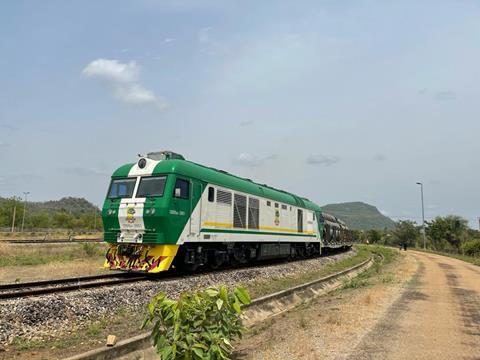
NIGERIA: Nigerian Railway Corp has moved out of the intensive care unit and is now ‘ready to fly’, Managing Director Dr Kayode Opeifa said in January when he set out ambitions to expand the network, attract private finance and use cleaner fuels.
Expansion roadmap
Opeifa said NRC would soon unveil a roadmap to expand the network from 4 000 km to 10 000 km over the next five years and then to 20 000 km in the next 20 years. This would include completion of the Lagos – Kano standard gauge line and modernisation of the 1 443 km Eastern Narrow Gauge Railway from Port Harcourt to Maiduguri corridor, as well as linking Ajaokuta to Abuja with a planned standard gauge railway extension.
Other plans include ‘aggressive’ rehabilitation of locomotives and rolling stock in order to improve on efficiency. NRC is to begin using liquefied natural gas to fuel trains, which Opeifa said would enable cleaner and more efficient operation and align with Nigeria’s gas expansion agenda, ‘significantly’ cutting operating costs while improving energy security for the rail sector.
‘We have completed the LNG proof of concept and demonstrated it for one month’, Opeifa said. ‘As soon as we get gas systems to the Lagos – Ibadan and Warri – Itakpe corridors, where gas is readily available, and resolve all regulatory issues, we will use gas to generate electricity to power the trains.’
Private sector participation
Opeifa said NRC was among the top 10 contributors to Nigeria’s gross domestic product in 2025, and it is collaborating with several state governments, including Lagos, Zamfara, Plateau, Niger and Ogun to boost the use of rail assets.
However, he admitted NRC’s plans would require substantial private sector participation, because the government alone cannot fund the scale of investment required. He said the federal government had been ‘very magnanimous’ in funding NRC, but more is needed to optimise operations and address challenges including vandalism, washouts and the need to digitalise.
‘Our doors are open to the private sector for concessioning and other partnerships’, he said. ‘The government is willing to provide sovereign guarantees for railway investments as is done globally. The rail system is open because our budget alone cannot fund it.’
He said NRC had revived investors’ interest in the rail sector, and several companies have obtained operating licences in a vote of confidence in the future of rail.
‘We now have private sector operators getting licences to run on our tracks’, he said. ’About 28 logistics companies including CCEC Nigeria Ltd are already licensed to move goods from Apapa Port either to Oyingbo or Papalanto, Kajola, Omi Adio and Moniya and Osogbo.
‘If you have the resources to bring in locomotives and rolling stock, we will give you access to our tracks at no extra charge because we know that once the tracks are in use, the economy benefits’, Opeifa said.