







SWITZERLAND: Swiss Federal Railways has signed a framework agreement with Siemens Mobility for the deployment of its Signaling X digital interlocking technology.
The agreement announced on November 5 forms part of SBB’s SFr1·4bn digital interlocking framework contract, announced on October 22, which saw work packages awarded to Hitachi Rail, Siemens and Stadler.
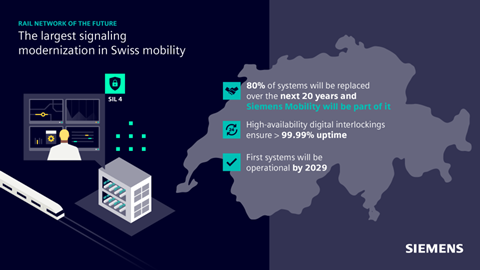
Siemens is to deploy digital interlockings, including hardware and software, to replace or modernise approximately 500 interlockingsacross the Swiss network, with around 80% of the existing equipment to be replaced over the next 20 years. The contract includes the provision of system development, training and support, as well as 25 years of maintenance.
The agreement has an initial term of 10 years and can be extended three times for periods of five years each. Siemens said that over the course of the agreement, orders for the delivery of individual interlockings will be awarded on an ongoing basis.
Commissioning of the first interlockings is planned for 2029.
‘At the heart of this transformation are virtual interlocking systems. With Signaling X, interlocking logic is intelligently shifted to central data centres, digitalising rail operations from the ground up. This groundbreaking technology not only significantly increases the network’s capacity and reliability, but also decisively contributes to SBB’s climate goals’, said Michael Peter, CEO of Siemens Mobility. ‘By providing guaranteed system availability of up to 100%, we are helping to achieve our shared goal: more trains running at shorter intervals for passenger and freight transport in Switzerland.’
Siemens launched Signaling X in September 2024. The technology is intended to allow multiple signalling, train control and related IT systems to sit in a single cloud-based data centre, offering the potential for urban and main line train control systems to be managed through a common IT architecture. According to Siemens Mobility, this will offer railways, infrastructure managers and potentially metro operators significant efficiency savings by enabling them to migrate away from individual servers, legacy IT systems and siloed working practices.