








MEXICO: Work has started on a raft of railway construction projects, with President Claudia Sheinbaum attending groundbreaking ceremonies across the country.
Two passenger projects form part of the President’s passenger rail-revival programme, which she announced in September 2024 before entering office. This aims to deliver 3 000 route-km over the first five years of her term. The first is a 57 km suburban line northeast of Mexico City, which will link Felipe Ángeles International Airport to the city of Pachuca. The second is a 226 km line from the capital to Querétaro in the centre of the country, which will form part of two long-distance passenger rail corridors.
Under the third scheme, intermodal terminals are being built on the Tren Maya network, along further freight infrastructure.
Mexico City – Pachuca
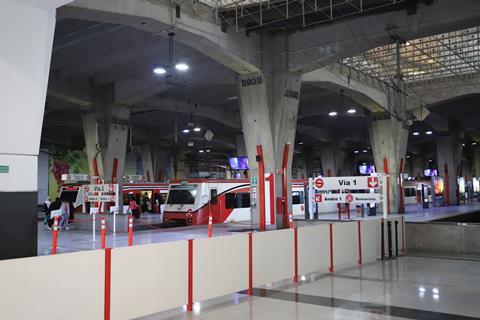
Constructions of the Mexico – Pachuca line officially got underway on March 22, as an extension of the 23 km Tren Suburbano line now being built from Lechería to the airport and sccheduled to open later this year. Designed for 120 km/h operation, the double-track electrified route will run on a new alignment next to the existing freight railway. Completion is expected in the last quarter of next year.
Services will ultimately run between the Buenavista terminus in Mexico City and Pachuca via FAIA. The completed corridor will serve a population of 1·2 million, and the line is expected to be used by 83 000 passengers a day. Journey time from Mexico City to Pachuca is estimated at 1 h 10 min.
The line is being built by the Felipe Ángeles Engineering Group, and is to be operated by the Olmeca-Maya-Mexica Airport, Railway, Auxiliary Services and Connections Group (Gafsacomm), both being under the management of the Ministry of Defense (Sedena). The ministry officially took over the concession for construction and operation of the Mexico City – FAIA line from the Ferrocarriles Suburbanos subsidiary of CAF on March 18.
Mexico City – Querétaro
Construction of the double-track railway between Mexico City and Querétaro started on April 27. This non-electrified line is intended to form part of two future passenger rail corridors, one linking the capital with Nuevo Laredo on the US border via San Luis Potosi and Monterrey, and the other running to Irapuato and Guadalajara.
Works are to be carried out over 12 construction sites simultaneously, and will start with those sections where the new tracks will parallel the existing double-track freight railway. Other parts of the route will be built on new alignments to avoid sharp curves, requiring the construction of 11 viaducts and several tunnels. Work is underway to obtain the necessary environmental permits for the civil engineering works.
The new line is being laid out for operating speeds of 160 to 200 km/h, and the project will enable the elimination of 117 level crossings from the existing route.
Completion is scheduled by November 2027 at an estimated cost of 167bn pesos. The journey time between Mexico City and Querétaro is expected to be around 2 h, compared with 4 to 6 h by road in times of heavy traffic.
The passenger services will also use the Buenavista terminus in Mexico City, while major stations are planned at Huehuetoca, Tula, San Juan del Río, and Santiago de Querétaro. Locally sourced materials are to be used for the construction of these stations. The main station in Querétaro is to be named La Corregidora in honour of Mexican independence figure Josefa Ortiz de Domínguez.
Civil engineering is being carried out by the Sedena-controlled Felipe Ángeles Engineering Group, while the line is to be operated by Gafsacomm, which is under the management of the Mexican Army.
Tenders have been called for the supply of rolling stock to operate on this line, which and a contract is expected to be awarded later this year.
‘Querétaro will become a hub for the northern railway because it runs from there to the Gulf and the Pacific’ explained Sheinbaum. ’From there, it will go to Irapuato and then to Guadalajara. On the Querétaro – Irapuato section, construction will begin around June or July, and this year we’ll also begin work from Saltillo to Nuevo Laredo. We’ll do it in stages.’
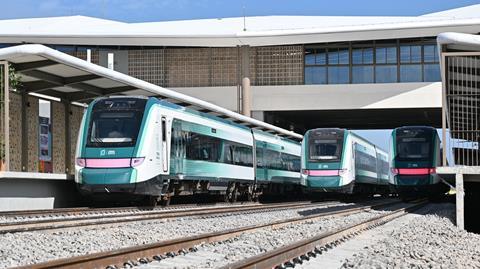
Tren Maya freight terminals
April 26 saw the start of work on the planned enhancements to accommodate rail freight on the Tren Maya network, beginning with the construction of intermodal freight terminals at Cancún and Chetumal.
The programme includes the construction of further freight terminals at Poxilá, Progreso and Palenque, as part of a strategy that envisages a total of 10 facilities in the longer term.The 25bn pesos scheme is scheduled for completion by November 2027.
Additional enhancements required to support the introduction of freight services on the Tren Maya network include the provision of a freight connection with the Interoceanic Railway corridor crossing the Isthmus of Tehuantepec, which was inaugurated in December 2023.