





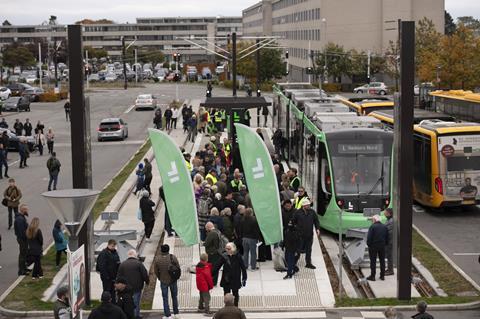
DENMARK: Trams have returned to København after 53 years, with music, family entertainment and a day of free travel marking the opening of the first phase of the Hovedstadens Letbane line on October 26.
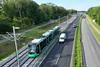
The Hovedstadens Letbane (capital city light rail) line runs 13·1 km around the capital’s western suburbs, following the O3 ring road from Ishøj north to Rødovre Nord with 12 stops. Services operate via a 400 m branch to Glostrup station with a reversal.
The second phase running north from Rødovre to Lyngby and Lundtofte is still under construction and is expected to open in mid-2026. This will take the line to 28 km with 29 stops and provide connections between five S-bane corridors while avoiding the city centre.
Faster and more comfortable to get around the capital
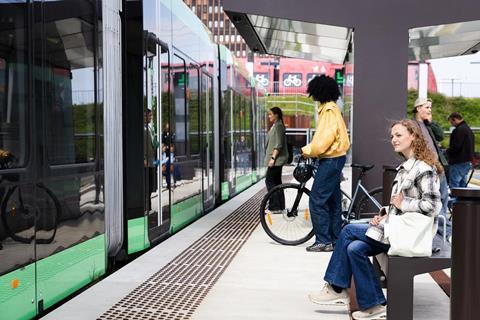
Services currently run every 10 min. When the second phase opens this will increase to every 5 min during the daytime on weekdays.
Ridership is predicted to reach 14 million passengers/year in 2030.
The line ‘will be an important part of everyday transport for many thousands of people‘, said Jakob Thomasen, Chair of project promoter Hovedstadens Letbane. ‘It makes it faster and more comfortable to get around the capital‘, and bicycles can be carried to enable multimodal trips.
It is the third modern light rail system in Denmark, after the opening of lines in Aarhus in 2017 and Odense in 2022.
Construction
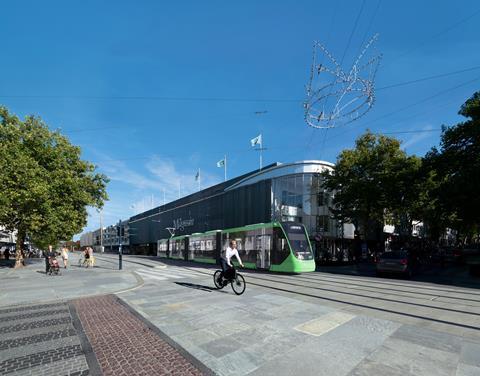
Following studies which rejected bus rapid transit in favour of a more expensive but higher quality light rail option, a framework agreement for the project was signed in June 2011. Signatories included the ministry of transport, the capital region and Lyngby-Taarbæk, Gladsaxe, Herlev, Rødovre, Glostrup, Vallensbæk, Albertslund, Brøndby, Hvidovre, Høje-Taastrup and Ishøj local councils – not all of these areas will be directly served by the line, but all expect to benefit.
The project is now expected to cost DKr9·6bn, costs having risen because of global supply issues resulting from the pandemic and Russia’s war against Ukraine. The national government is contributing 40%, the municipalities 34% and the capital region 26%.
Preparatory works began in 2018, and main construction in 2019. The decision to open in two phases was made in 2024.
Civils works were divided into five works packages, with Per Aarsleff and CG Jensen selected in 2018 for two each, and MJ Eriksson for one. CG Jensen built the operations and control centre.
The rolling stock and railway systems contract was awarded to a consortium of Siemens Mobility and Aarsleff Rail. Rhomberg Sersa Rail Group installed track as sub-contractor to Aarsleff Rail
Avansim was selected to delivered driver training simulators. Zagro supplied an E-Maxi M electric shunting vehicle.
Rolling stock
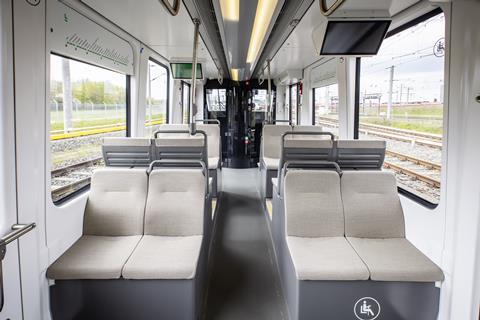
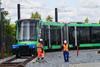
Siemens Mobility has supplied 29 Avenio light rail vehicles, which are based at Rødovre Nord depot.
The 100% low-floor, four-section steel bodied trams are 36·9 m long and 2 650 mm wide with six double leaf doors per side and a capacity of 258 passengers including 64 seated.
There is step-free boarding and level access throughout, with four areas for bicycles, pushchairs and wheelchair users.
The trams have a maximum speed of 70 km/h, and will have an average operating speed of 30 km/h.
Operations and maintenance
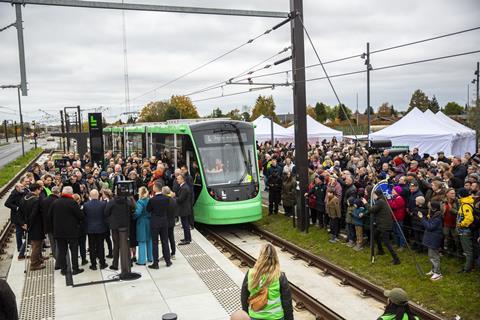
A 15-year operations and maintaince contract was awarded to Metro Services, the subsidiary of Milano transport operator ATM which also operates the København metro.
’The opening marks the culmination of long and thorough preparation, and it is a great pleasure to finally see the new trams roll out on the rails with happy passengers onboard‘, said Thomas Gram Rasmussen, tram business unit director at Metro Service.
’Now we are up and running – and it is a fantastic feeling.’
The first tram from Ishøj was driven by Camilla Pedersen, who said ‘we have been preparing for the opening day for a long time, and it is super exciting that we are finally up and running‘.