

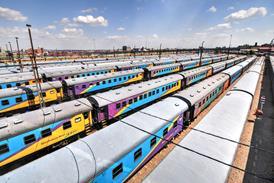
This week’s round-up of news from the urban transport sector.
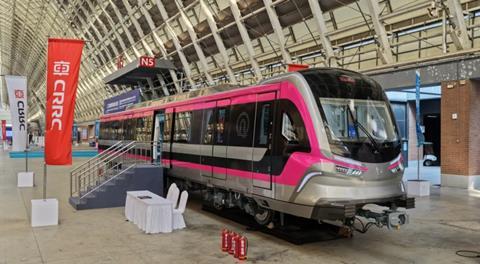
CRRC Sifang has unveiled its 120 km/h Type B trainset at the MetroTrans 2025 urban rail fair held in Qingdao on September 18-20. It is to run on the metro Line 8 branch line in Qingdao, currently under construction between Dajian and Jiazhou in the northwest of the conurbation. The vehicle features an air quality monitoring system and a stainless steel body, with increased corrosion resistance for the coastal environment. It has an expected 30-year service life. According to the manufacturer, the permanent magnet synchronous traction motors, high-frequency inverters, aluminium brake discs and lithium titanate batteries reduce the vehicle weight by about 5%, and lower the energy consumption by 22% compared to standard metro trainsets.
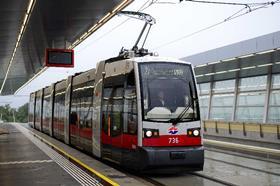
Wien tram Route 27 was launched on October 6, sharing track with Route 26 tracks from Strebersdorf to Prinzgasse and then using 2·4 km of new line to reach Aspern Nord station on metro line U2. The 13·5 km route has 28 stops, six of which are newly built. Wiener Linien said Route 27 would provided a high-performance connection between two fast-growing districts, taking around 20 000 people to their destinations in a climate-friendly way every day.
Operator RATP has completed the deployment of the final version of Octys CBTC on the 19·6 km Paris metro Line 9.
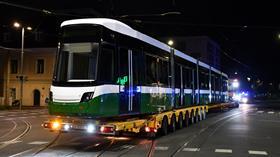
The first of 15 Alstom Flexity trams ordered by Graz Linien in January 2024 was delivered to the city in the early hours of October 6. The 33·8 m long five-section tram is 6 m longer than Graz’s existing Stadler Variobahn and Bombardier Transportation Cityrunner trams, with a higher capacity at 140 standing and 60 seated passengers and two spaces for wheelchair users. Features include a lowest entry height of 215 mm, mobile phone charging points and a driver assistance system including obstacle detection.
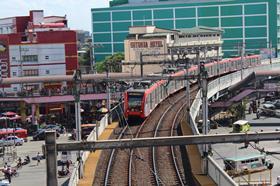
Mitsubishi Electric Corp and Hankyu Corp are co-operating with the Japan International Co-operation Agency on a project to promote energy saving on Manila LRT Line 1. Mitsubishi Electric will use its Serendie digital data analysis platform to assess current power consumption, verify the feasibility and effectiveness of various energy saving measures and then propose optimal solutions. These could include installing auxiliary power supply equipment to enable station buildings to manage energy consumption, and installing separate equipment to store surplus power for later use.
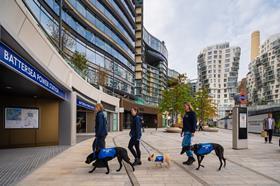
Residents from Battersea Dogs & Cats Home joined the opening of a second step-free entrance to London Underground’s Battersea Power Station station on October 6. More than 42 million journeys have been made on the Northern Line Extension since it opened on September 20 2021, and Transport for London said that in the past year it has seen 13·4 million journeys which is ‘at the top end’ of its previous modelling estimates.
In November 2026 voters in five counties of the San Francisco Bay Area will be asked to approve a 14-year sales tax measure to preserve and improve public transport. This is predicted to generate about $1bn/year for Muni, BART, AC Transit, Caltrain and other transport agencies. BART said ‘remote work has caused a decline in operating revenue for various operators and deficits are too large to solve through cuts alone. Since the Covid-19 pandemic, it has been clear that BART’s outdated funding model no longer works. BART is facing annual operating deficits of $350m-400m once the emergency assistance we have been provided runs out at the end of fiscal year 2026.’
Singapore‘s Land Transport Authority has formed a Rail Reliability Taskforce to develop and implement ’immediate solutions’ to improve rail reliability and joint responses to service disruption. The taskforce is chaired by LTA Chief Executive Ng Lang and includes SMRT Group CEO Ngien Hoon Ping, SBST Group CEO Jeffrey Sim and technical specialists drawn from across the rail sector, with a five-member Independent Advisory Panel providing strategic guidance and technical expertise. The taskforce will submit its final recommendations to the Acting Minister for Transport by the end of the year.
The Greater Cleveland Regional Transit Authority board has approved the exercise of an option for Siemens Mobility to supply a further six S200 LRVs. The high floor cars will have two door heights for high and low-level platforms, enabling them to operate across the full network.
The Novosibirsk metro is taking delivery of five five-car 81-725.3/726.3/727.3 trainsets manufactured by TMH Metrowagonmash with all major components being of domestic origin, including those that were previously imported such as the compressor, brake unit, asynchronous traction drives, passenger doors, dampers, gearboxes, driver’s controller, speed sensors and traction motors. Two of the trainsets have been bought outright, and three are being supplied under financial lease terms with the participation of Sberbank Leasing.
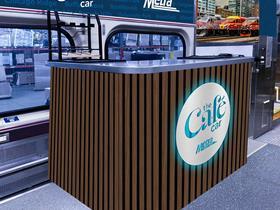
Chicago commuter operator Metra is trialling a prototype Café Car converted from a commuter rail coach, to see whether passengers like the concept and find out about what features they would like to see. People who complete a survey will receive free snacks and beverages. ‘We created this special car in an attempt to improve the riding experience and maybe attract new riders’, said CEO & Executive Director Jim Derwinski. ‘This is your chance to check it out and tell us what you think. Would you use it? What amenities would you like to see? What other thoughts do you have?’