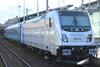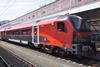



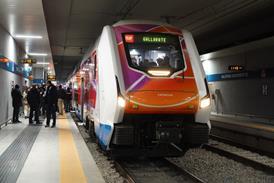










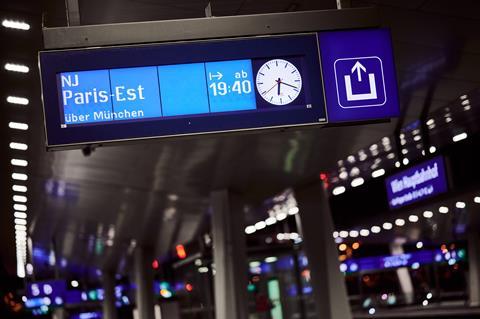
EUROPE: The Paris – Wien and Paris – Berlin Nightjet sleeper train services are to end with the December 14 2025 timetable change, following the French Ministry of Transport’s decision to withdraw funding for their operation.
The Wien service launched in December 2021 is operated by Austrian Federal Railways in partnership with French national operator SNCF Voyageurs, and the Berlin service which began in December 2023 is operated by ÖBB with SNCF Voyageurs and Germany’s Deutsche Bahn.
Economic challenge
On September 29 SNCF Voyageurs said its participation was conditional on state subsidy, as the operation of night trains is a ‘huge economic challenge’. It said the services had an average occupancy rate of 70% in 2024, and economic equilibrium would not be achievable even with higher ridership because of the high operating costs.
SNCF Voyageurs explained that domestic night trains in France are also run because of the provision of government subsidy. It said a seat on an aircraft can be sold up to five times a day and a seat on a day train up to four times, but a seat on a night train can only be sold once a day. In addition, night trains need for more staff than day trains, there are high energy costs and costs for access to infrastructure in multiple countries, with border crossings requiring changes of locomotives and crew.
Commenting on the decision, ÖBB said it ‘regrets that after the withdrawal of the French partners, the two night train connections can no longer be offered’. The thrice-weekly Wien – Brussels service will continue to run, and ÖBB said it remains the largest provider of night trains in Europe, with 24 modern Nightjet trainsets being delivered.
Commitment questioned
French campaign group Oui au Train de Nuit (‘Yes to the night train’) has launched a petition calling on the government to reverse the decision, ‘even if it means renegotiating the subsidy agreement with SNCF Voyageurs, in exchange for a commitment to run the train daily’.
It said the night trains to Wien and Berlin have proved popular, carrying 66 000 people in 2024, despite only running three days a week, down from initial plans for a daily service.
‘SNCF does not sell the tickets on its platform, nor does it even provide information about the existence of these trains, even though it operates them. This raises questions about the company’s true commitment to making these two night train routes a success’, the campaign group said.
It added that EU rules make it complicated to finance international rail routes, while aviation ‘enjoys tax exemptions that amount to a hidden subsidy of €30–40 per plane ticket’.
It said ‘as a result, international night trains in 2025 face the same situation as domestic night trains in France did in 2015: SNCF lets the service decline, encouraging the state to shut them down — against a backdrop of poorly adapted regulations’.
SNCF Voyageurs said engineering works in France and Germany meant the transition to a daily service was no longer possible.
It explained that the Nightjet trains have been ‘temporarily’ unavailable on its distribution channels since May 2024, because of changes to its reservation system which impact all products from foreign railway companies. It said Nightjet services are available on the nightjet.com/fr website and the DB website.
A new reservation system is expected to make it possible to gradually offer trains sold by non-French entities again from 2026.