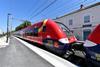











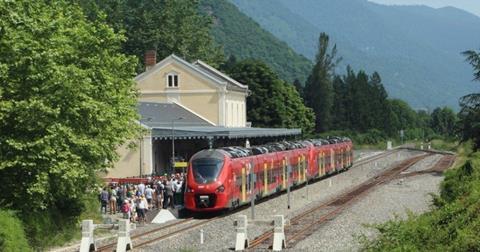
FRANCE: Large crowds turned out for the reopening of the line from Montréjeau-Gourdan-Polignan to the Pyrénéan resort of Bagnères-de-Luchon, which was celebrated with music, equestrian demonstrations and special menus at local restaurants.
The first train left Montréjeau at 10.15. on June 22 carrying Carole Delga, President of the Occitanie région which has taken over responsibility for the branch as part of its strategy to reopen closed lines.
Reopening
The 36 km single-track line to the spa and winter sports town known as the ‘Queen of the Pyrénées’ was closed in 2014 because the national government was unwilling to fund rehabilitation after the ageing infrastructure was damaged by bad weather.
The région was keen to see services restart, and took over responsibility for the infrastructure.
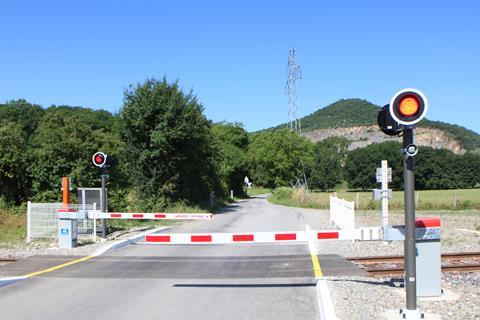
Reopening has cost €67m, fully funded by the regional authority. The infrastructure works were undertaken by a consortium of TSO, TSO Signalisation, Egenie, Guintoli, NGE GC and NGE Fondations, with Systra and Setec providing management support. The line is now suitable for a maximum speed of 90 km/h, and the KVB safety system has been fitted. Schweizer Electronic supplied its PN Flex level crossing equipment, adapted to French requirements, in its first major contract for its recently launched French subsidiary.
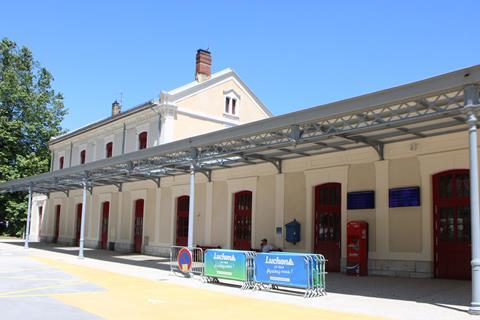
The stations at Marignac-Saint-Béat, Loures-Barbazan and Luchon have been modernised, and Saléchan-Siradan station relocated by 500 m in accordance with local requests.
The région has awarded TSO and Leyfa Measurement contracts to maintain the line, and national infrastructure manager SNCF Réseau has been appointed to manage traffic.
Operations
The regional authority has appointed SNCF Voyageurs to provide the passenger service, initially six return trains daily, and the operator has trained almost 100 drivers for the line, according to Gaël Barbier, Managing Director for SNCF Voyageurs’ TER operations in Occitanie.
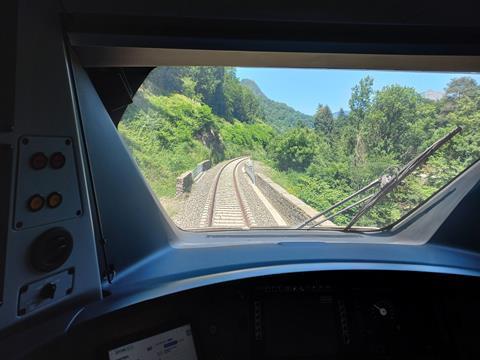
The previous overhead electrification has not been reinstated, and it is planned to use the line to trial the région’s three hydrogen-powered trainsets being built by Alstom, using hydrogen produced with power from a local hydro-electric station. For the moment, services are operated using Alstom Régiolis electro-diesel multiple-units, which in a first for France are fuelled with HVO.
The line is operated as shuttle with only one trainset and occupation verified by axlecounters at Montréjeau. In exceptional circumstances, a second train such as an excursion can be locked into the short loop at Luchon. The journey time from end to end is 35 min.
One train on weekdays and two at weekends run through to Toulouse-Matabiau, enabling the rolling stock to be changed. At other times there is a 10 min connection into trains towards the city.
The seven daily buses on the route will continue to run until at least the beginning of 2026; the train fare is €6·40, while the bus is €2. There are plans to provide local transport in Luchon to take rail passengers the last kilometre to the town centre or to their hotels.
Further reopening plans
The Montréjeau - Luchon line is the second in Occitanie to reopen for passengers. On the previously freight-only 82 km route along the right bank of the River Rhône between Avignon and Pont-Saint-Esprit passenger services restarted in 2022.
Other reopening projects supported by the région include the Alès – Bessèges line, where responsibility for the infrastructure has also been transferred; although revival has been postponed by four years to 2028.
Plans to revive the Limoux – Quillan and Rodez – Sévérac-le-Château lines were paused last year because of a lack of funding.
Delga has said that 4 000 km of French rural lines are threatened with closure, including 1 000 km in Occitanie. She has proposed that the national government funds the necessary renewal works using revenue from motorways (estimated at €2bn), taxes on lorries in transit (estimated to be €1bn) and emissions quota credits (€2bn).