



EUROPE: The European Commission has selected 94 transport projects to receive nearly €2∙8bn in Connecting Europe Facility grants, with the rail sector being the leading beneficiary.
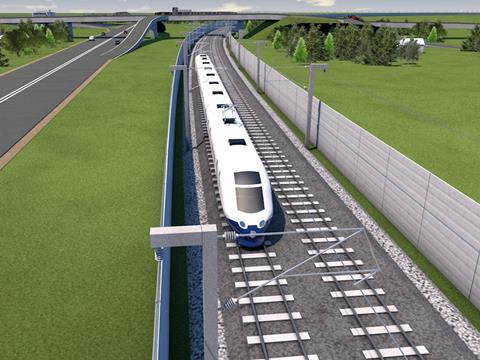
The grant awards announced on July 3 remain subject to formal ratification by the Commission’s infrastructure and networks agency, CINEA, with confirmation of the final awards to come in October. Nevertheless, rail transport will receive the largest share of the funding, 77% of the total, with investment directed towards enhancements across the TEN-T core and extended networks, particularly in cohesion countries. These include the construction of Rail Baltica in the Baltic region and Poland, and improvements in Greece and Slovakia. High speed rail projects in the Czech Republic and the CPK programme in Poland will also benefit.
A further 32 projects in 11 member states including Austria, Germany, Italy and Poland will receive allocations to support the roll-out of ERTMS, with investment in onboard equipment and wayside ETCS equipment both supported.
The 94 projects have been selected from a pool of 258 applications submitted under a call for proposals which closed on January 21 2025.
CEF future in doubt
The funding awards come amid an increasingly high-profile debate over the future of CEF, which since its establishment in 2014 has disbursed €47bn in grants for the transport sector covering 1 861 projects, with rail a major beneficiary.
With Denmark taking over the rotating presidency of the EU Council from Poland on July 1, rail supply trade association UNIFE wrote an open letter to the Danish government at the end of June asking it to ‘ensure vital and required funding [for] programmes such as the successors of Connecting Europe Facility, Horizon Europe, and the new Competitiveness Fund, which can be used to modernise the EU rail network, and to implement modern signalling technologies as demand for rail increases’.
The Danish presidency will lead budget negotiations for the next six months after the draft EU Multiannual Financial Framework is released by the European Commission, due by the end of July. Railway Gazette International understands that CEF may not continue in its current form, and there are clear concerns among rail advocates in Brussels about transport funding suffering as pressure mounts to boost defence spending across member states in response to the current geopolitical challenges.
‘Public budgets are about choice. By choosing investment in rail in these upcoming negotiations, the EU institutions can take a big step forward in cutting transport emissions, boosting commerce and protecting Europe’, says UNIFE Director-General Enno Wiebe.
Cross-border priority
The CEF funding stream plays a particularly important role in supporting cross-border links, and fears over its future prompted the leaders of four of Europe’s largest infrastructure projects — Rail Baltica, Tunnel Euralpin Lyon–Turin, the Brenner Base Tunnel and the Canal Seine–Nord Europe — to issue a joint statement on June 26. This called on the EU institutions and member states to maintain a strong, centrally managed approach to infrastructure funding under a third round of the facility, termed CEF III.
They warned against redirecting EU transport funding towards fragmented national plans could delay the timely completion of key TEN-T corridors. ‘Europe’s cross-border infrastructure projects are not just investments in concrete and steel, they are the physical manifestation of European unity, strategic mobility, and sustainable growth’, said Marko Kivila, CEO of RB Rail AS, the project promoter for Rail Baltica. ‘With construction now underway across all three Baltic states, we are moving from design to delivery – but we need continued, coordinated EU support.’
Worries have been growing
Concerns about how the EU’s ambitious goals for rail investment could be realised have been mounting since February, when the heads of government of Estonia, Greece, Hungary, Italy, Latvia, Lithuania, Portugal, Romania, Slovakia, Spain and the Czech Republic wrote to Ursula von der Leyen, President of the European Commission, to press for secure funding to develop a high-quality and high speed pan-European rail network.
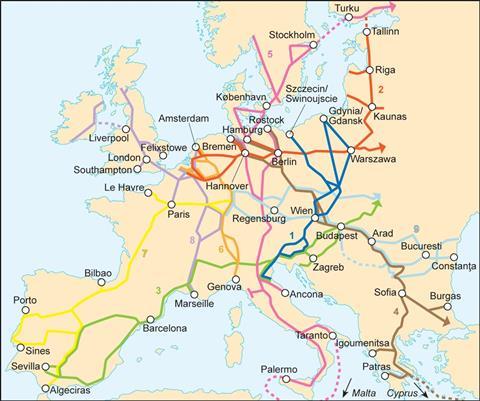
‘To implement our shared goals and to turn plans into large-scale construction phase, with significant participation of European industry, sufficient financial resources and development of new instruments, such as bridge financing, are needed’, the letter published on February 11 said. ‘Many of our projects are already in the construction phase or in the final stage of preparation to be implemented in coming years, early [in] the upcoming Multiannual Financial Framework, in order to contribute to the 2030 targets defined in the TEN-T regulation.’
Noting the challenges facing public finances across Europe, the leaders added that ‘we do explore alternative ways of financing, and we count on strong support of the European Investment Bank policy to accomplish our objectives. However, and without pre-empting the next Multiannual Financial Framework, we would like to underline, that EU co-financing of those connections in the next financial period is absolutely essential and indispensable.
‘We strongly advocate a robust, centrally managed CEF III of increased financial ambition which would be a catalyst for the development of a fully-fledged TEN-T Network, including the missing high speed rail connections and the completion of major cross-border projects. At the same, we should keep the synergies of transport, energy, digital and defence sector’, they added.