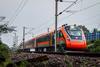






INDIA: Proposals for seven more high speed lines and another dedicated freight corridor were announced on February 1, when the government’s 2026-27 budget allocated record support for capital investment across the national rail network.
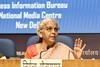
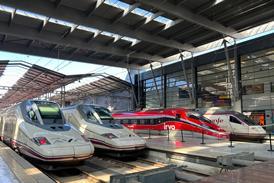
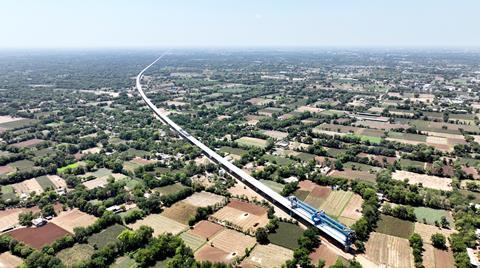
‘In order to promote environmentally sustainable passenger systems, we will develop seven high speed rail corridors between cities as “growth connectors”’, explained Finance Minister Nirmala Sitharaman. The seven routes are: Mumbai – Pune, Pune – Hyderabad, Hyderabad – Bengaluru, Hyderabad – Chennai, Chennai – Bengaluru, Delhi – Varanasi and Varanasi – Siliguri.
The minister also announced the go-ahead for a third Dedicated Freight Corridor, ‘connecting Dankuni in the east with Surat in the west’, as part of a wider policy ‘to promote the environmentally sustainable movement of cargo’. This programme included the development of 20 National Waterways over next five years; and a scheme to incentivise modal shift from road, which she anticipated would increase the market share of inland waterways and coastal shipping from 6% to 12% by 2047.
Noting that public spending on capital projects had ‘increased manifold’ from Rs2tr in FY2014-15 to Rs11·2tr 2025-26, Sitharaman said she was proposing a further 8·83% increase to Rs12·2tr in the 2026-27 financial year which begins on April 1, ‘to continue the momentum’.
The Ministry of Railways has been allocated Rs2·93tr for capital expenditure in FY 2026-27. Of this, Rs2·77tr will come from the general budget, up from Rs2·52tr in FY 2025-26. The balance will come from internal resources and the Nirbhaya Fund covering safety and security initiatives. The allocation will fund the development of new lines and upgrading of the existing network, including further double-tracking and gauge conversion, as well as the procurement of rolling stock.
Global competitiveness
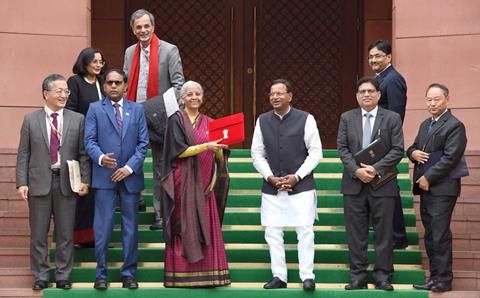
‘India’s economic trajectory has been marked by stability, fiscal discipline, sustained growth and moderate inflation’, Sitharaman said in her budget speech. ‘Our government is decisively and consistently choosing action over ambivalence, reform over rhetoric and people over populism.’
However, the minister warned that India faced ‘an external environment in which trade and multilateralism are imperilled and access to resources and supply chains are disrupted. As a growing economy with expanding trade and capital needs, India must also remain deeply integrated with global markets, exporting more and attracting stable long-term investment.’
To that end, Sitharaman spelled out three primary tasks, or kartavyas:
- to accelerate and sustain economic growth, by enhancing productivity and competitiveness, and building resilience to volatile global dynamics;
- to fulfil the aspirations of Indian people and build their capacity, making them strong partners in India’s path to prosperity; and
- to ensure that every family, community, region and sector has access to resources, amenities and opportunities for meaningful participation.
This threefold approach required a ‘supportive ecosystem’, she explained. That included a ‘robust and resilient financial sector’, efficient allocation of capital and the use of cutting-edge technologies, including AI applications, ‘as force multipliers’.
Railway projects to ‘move fast’
Following the budget statement, Railways Minister Ashwini Vaishnaw explained that the seven high speed corridors would total about 4 000 km and would require an investment of nearly Rs1·6tr. ‘India has to be developed by 2047, so work on these seven corridors will have to be [done] simultaneously’, he added. However, ‘the capacity of the industry and the team has increased; there is a lot of learning. We have already climbed the learning curve, so we will move fast’, he promised.
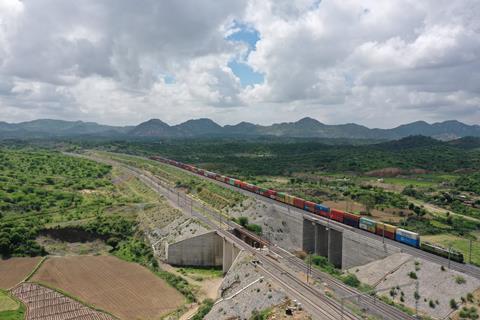
The minister said work on the 2 052 km east-west DFC would be completed during the term of the current government. It would complement the 1 337 km Eastern DFC which is already fully operational and the 1 506 km Western DFC now nearing completion. He reported that the final 102 km section of that route from Vaitarna in Maharashtra to the Jawaharlal Nehru Port Trust in Navi Mumbai was ‘scheduled to be commissioned soon’. Connections between the western DFC and the new east-west route would provide ‘seamless movement of freight to all parts of the country’, he added.
Indian Railways has been developing proposals for three more DFCs to extend its high performance freight network deeper into southern, eastern, and central India; according to railway insiders this would ‘create a continuous nationwide logistics loop’. The other two corridors under consideration are a 1 115 km East Coast DFC from Kharagpur to Vijayawada; and a 975 km North–South DFC linking Vijayawada, Nagpur and Itarsi.
Insisting that ‘safety will remain a focus, Vaishnaw confirmed that ‘Rs120bn will be invested in safety’ in the coming financial year. Suggesting that ‘95% of accidents have been reduced’, he said there would be more focus on the maintenance of track, locomotives, coaches and wagons, as well as a rapid roll-out of the Kavach train protection system and CCTV monitoring. Funding would also be provided for upgrading the overhead electric traction system, and the construction or reconstruction of stations to improve customer facilities.
Container initiatives
In a bid to create a globally competitive container ecosystem, the finance minister announced plans in her budget to develop a Scheme for Container Manufacturing, with an initial allocation of Rs100bn over a five-year period. This is expected to leverage private investment of close to Rs1·1tr, and would develop the capacity to manufacture 1 million TEUs per year. Noting that India currently imports around 2 million empty TEUs per year, finance ministry insiders said the government was looking at ‘bridging a cost differential’ of nearly $400 per TEU. The ministry reported that major global players such as MSC, Maersk/Artsons, Tata, Adani and JM Baxi had expressed interest in either participating in the project or procuring Indian-made containers.
Shipping Secretary Vijay Kumar said the government was poised sign an agreement in early February to ‘operationalise’ the Bharat Container Shipping Line as India’s new national container carrier. The project was launched by Prime Minister Narendra Modi in October 2025, with backing from Shipping Corp of India and Container Corp of India. BCSL is expected to start operations with around 51 vessels, and will need an installed base of around 1 million TEUs.
Lacklustre performance
Despite the generous government support for capital expenditure, figures reported in the budget documents revealed that Indian Railways’ operational performance remained lacklustre, with a deteriorating operating ratio and a continued fall in its share of the national freight market.
Revised estimates for the year to March 31 anticipate that IR’s revenues for 2025-26 will total Rs3·86tr. Expenditure is expected to reach Rs3·82tr, which would leave a surplus of just Rs3·5bn, against a budget of Rs30bn. IR’s operating ratio has been hovering at around 98 for the last few years and the target for 2026-27 is 98·4 compared with a latest estimate for FY26 of 98·8. However, railway insiders consider that a proper assessment including realistic amortisation allocations would give a ‘true’ operating ratio of ‘well over 125’, suggesting that the railway is no longer able to cover its operating and renewal costs from revenues.
Targets for passenger and freight revenue in 2026-27 have been scaled back slightly, after the latest estimates indicated that IR would not achieve the budgeted out-turns for 2025-26.
Freight loadings are forecast to increase from 1·7 billion tonnes to 1·765 billion in FY27, with freight revenues increasing by no less than 35% from Rs1 957bn to Rs3tr. However, industry insiders point out that the expected increase in traffic is well below the levels needed to achieve a rail market share of 45% to 50% and a total volume of 3 billion tonnes by 2030.