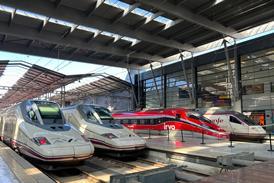

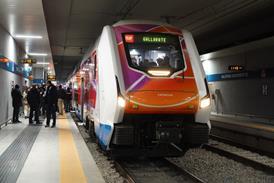





EUROPE: Rail and aviation policymakers have met in Brussels as part of efforts to push a multimodal approach to ticketing and journey planning.
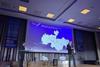
Members of the European Parliament joined passenger representatives and research specialists met on November 12 for a policy lunch debate entitled Unlocking Seamless Multimodality in Europe: Enabling Passenger-Centric Air–Rail Integration through Policy, Data and Collaboration.
Hosted by MEP Sophia Kircher, who is Vice-Chair of the European Parliament’s TRAN Committee, the event was co-organised by three multimodal research initiatives: Sign-Air, MultiModX and Travelwise. Sign-Air and MultiModX are supported by the aviation sector’s SESAR Joint Undertaking, while Travelwise is jointly funded by Europe’s Rail and SESAR.
‘Europe grows together through its transport networks — by rail, by road, and by air. But true connectivity can only succeed when ticketing, systems and standards are aligned. That’s the way forward’, Kircher said in her opening address.
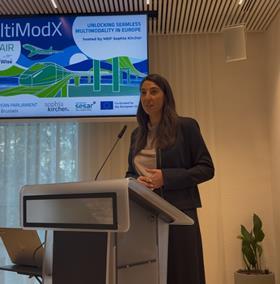
‘Air transport does not exist in isolation. Making journeys seamless means aviation must connect effectively with the wider mobility system’, said SESAR Executive Director Andreas Boschen. ‘We are working to make multimodal travel a reality, so passengers can move smoothly between air, rail and other modes with reliable information and minimal hassle.’
‘Self-assembled’ journeys
Delegates were told that despite long-standing ambitions to improve the booking experience, 90% of air–rail multimodal trips today are ‘self-assembled’ by passengers. Travellers must juggle separate tickets, price systems and disruption responses, often with little guidance.
‘Passengers shouldn’t need to be detectives to plan a simple journey’, said Delphine Grandsart from the European Passengers’ Federation. ‘If Europe wants people to choose sustainable travel, it must offer seamless information, fair prices and real protection across the entire journey.’
‘Europe needs holistic, data-driven regulation that evaluates door-to-door performance. Only then will passengers experience seamless travel’, added Prof Andrew Cook of the University of Westminster.
The event highlighted five urgent policy needs:
- EU-wide integrated ticketing with transparent and real-time data access;
- stronger multimodal passenger rights, including cross-mode journey continuation;
- incentives for timetable synchronisation and co-operation at major hubs;
- a European framework for co-ordinated multimodal disruption management;
- investment in open mobility data and modelling to support performance-driven policymaking.
MultiModX concludes
On November 13, the Airport Regions Council hosted the final conference for MultiModX, a research project backed by UIC on the rail side which brought together stakeholders from the rail, aviation and regional mobility sectors.
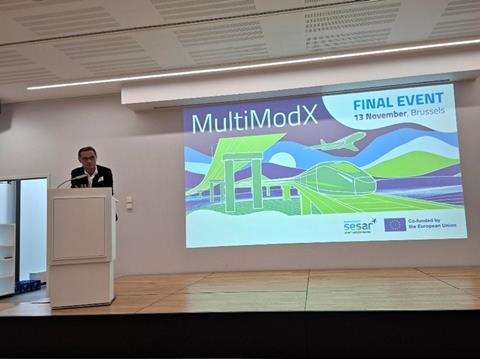
The final event highlighted three technology proposals seeking to address barriers to multimodality.
Lucía Menéndez-Pidal de Cristina of Spanish data company Nommon showcased a Schedule Design Solution aimed at optimising integrated air–rail timetables, while Luis Delgado of the University of Westminster introduced methodologies to evaluate environmental and passenger impacts through robust performance indicators.
UIC said on November 27 that the MultiModX consortium, comprising Bauhaus Luftfahrt, Nommon, Airport Regions Council, TU Dresden, UIC and the University of Westminster, would leave behind ‘a strong legacy of validated solutions and policy recommendations that will support Europe’s transition toward a fully integrated mobility ecosystem’.