



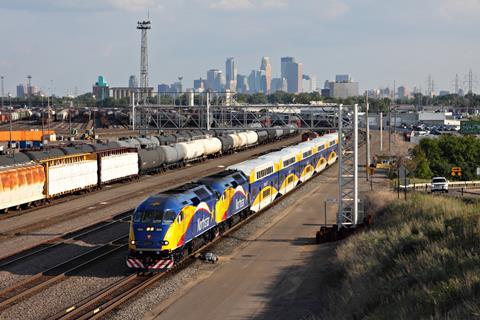
USA: The Northstar commuter rail service from Big Lake into Minneapolis is to be replaced by buses after riders failed to return following the pandemic.
The decision has been approved by the transport committee of the Metropolitan Council covering the seven-county Twin Cities metro area, and will go the council for approval on August 27.
The council’s operating division Metro Transit said the use of buses would enable it to provide more frequent and flexible services to better match post-pandemic travel patterns.
Low ridership
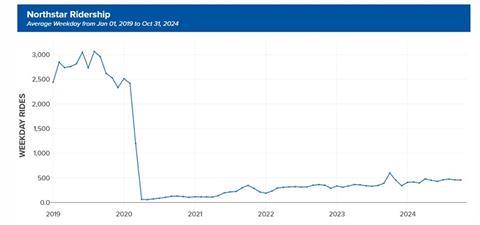
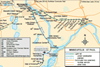
The 65 km Northstar service from Big Lake, Elk River, Ramsey, Anoka, Coon Rapids and Fridley into central Minneapolis was launched in November 2009. Before the pandemic it carried a maximum of 2 660 average weekday passengers, less than half the projected 2025 figure of 5 590. Ridership fell during the pandemic, and by 2024 the average weekday ridership was 430.
There are currently eight trains a day: three inbound in the morning and three outbound in the evening, plus a morning and evening train against the main flow. This is down from 12 trips pre-pandemic. Weekend trains now only run for special events. The contract with line owner BNSF prevents the operation of off-peak daytime services.
According to a report by Metro Transit, rising costs mean it costs more to provide the 40 weekly services in 2025 than it did to provide 72 in 2019. Subsidy has risen from $16 per passenger in 2017 to $116 in 2023, compared to $16 for commuter bus services, and of 29 other US commuter rail lines only one had a higher subsidy per journey in 2023.
Bus services
An hourly replacement bus service between Minneapolis and Ramsey is planned, increasing to every 30 min in the peaks. Metro Transit currently does not have the authority to operate buses to Big Lake or Elk River stations.
The last weekday train service is planned for January 2 2026, with the final train to be a special event service on January 3 or 4 after the last Minnesota Vikings match of the season.