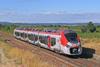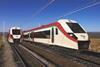
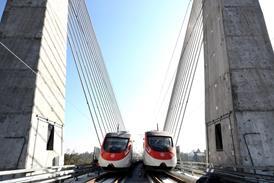
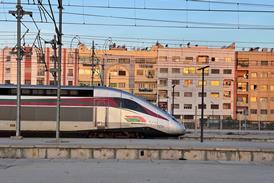








FRANCE: The Oxygène inter-city trainset is ‘probably one of the most beautiful trains built by CAF’, CEO for France, Alain Picard, said when the first trainset was officially unveiled by the manufacturer, operator SNCF Voyageurs and the French government.
Speaking at the Villeneuve-St-Georges maintenance centre on April 24, Pierre-Christophe Soncarrieu, the transport ministry’s Deputy Director for TET services, said the aim has been to design the ’Intercité train of the 21st century’, offering the same level of comfort and better performance than the Corail coaches hauled by Class BB26000 locomotives that they will replace.
The project to procure a new fleet for 200 km/h services on conventional lines began in 2016, and in October 2019 CAF was awarded a €715m contract to supply 28 sets. Of these, 12 are needed for the Paris – Clermont-Ferrand service and 16 for the Paris – Limoges – Toulouse route.
A €650m order for a further 22 sets to operate on the Bordeaux – Marseille route was placed in December 2024. Separately, Morocco’s ONCF has also ordered similar trainsets.
10-car set
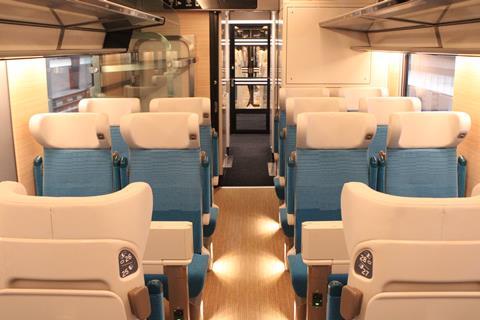
Designated Class Z26700, an articulated Oxygène set with 10 aluminium-bodied coaches is 188 m long.
There are 420 seats, which is 24 more than a rake of seven Corail coaches. The three first class coaches have red seats arranged 2+1, and the five second class coaches with 2+2 blue seats.
Coach 4 has features for passengers with reduced mobility, including barrier-free access, dedicated seats and an and accessible toilet; a train will not run if the accessible toilet is out of service. Coach 5 has catering and staff facilities.
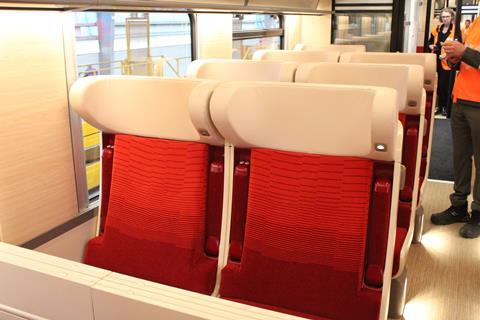
Tables are designed for laptop computers and smartphones, and all seats have two armrests and electric and USB sockets. The lighting adjusts to the time of day, and there is CCTV, air-conditioning, wi-fi and a passenger information system. There is space for 10 bikes.
The trains can operate under 1·5 kV DC or 25 kV 50 Hz overhead, with the two end cars and two centre cars each having two axles driven by asynchronous traction motors, giving a continuous rating of 4 MW.

The trains are fitted with ETCS and the KVB train protection systems. The cab has forward-facing CCTV, a fridge and alcohol test equipment.
The doors on the Corail stock are opened and closed by the train manager, but on the Oxygène fleet the doors will be controlled by the driver, with the train manager having more of a focus on customer service.
Technicentre Oxygène
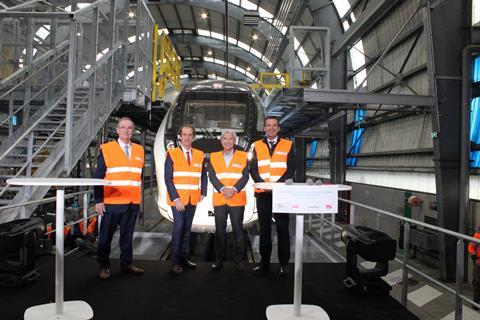
The government is investing a further €100m in the four Technicentre Oxygène maintenance facilities.
The Villeneuve-St-Georges depot for the Paris – Clermont-Ferrand line has three tracks for maintenance and preparation of Oxygène sets plus two tracks for a wheel lathe and jacks. The Paris-Masséna depot for the Toulouse route will have two tracks for maintenance and 12 for train preparation.
There will also be servicing sites in Clermont-Ferrand and Brive, with train washing plants, controlled emission toilet emptying facilities and the ability to undertake minor repairs, informed by onboard monitoring systems which will support direct discussions with drivers and train managers.
Manuel Canamela, director of Technicentre Oxgène at SNCF Voyageurs which will operate the facilities, said maintenance would be undertaken overnight, with the number of staff at the sites expected to increase from 22 now to 130 in 2027. The operator will have access to all technical documentation, which will be adapted to its working practices.
Entry into service

The first seven trainsets are being assembled at CAF’s Beasain plant in Spain, and the rest at Reichshoffen. CAF is responsible for design, production and type approval, which will be followed by intensive testing by SNCF Voyageurs prior to the start of revenue service.

Two trainsets are currently at the Velim test centre in the Czech Republic, and a third is at Villeneuve-St-Georges to support the maintenance planning process. A fourth trainset to be delivered this summer will enable the start of dynamic testing on the two routes, with approval for operation expected by the end of 2026.
Entry into service on the Toulouse and Clermont-Ferrand routes is currently envisaged for March 2027, by which time an initial 18 trainsets should be available. All 28 sets from the first order are expected to be delivered by the end of 2027, when infrastructure modernisation will be completed to reduce journey times and an additional daily return service will be added to the timetable.
Delivery of the 22 trainsets for Bordeaux – Marseille services would then follow.