









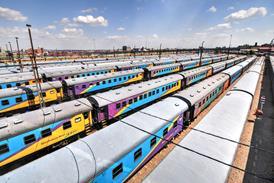
UKRAINE: National railway Ukrzaliznytsia has awarded Kryukovsky Railway Car Building Works a contract to supply 100 coaches, including five new-generation vehicles intended as a pilot for future orders.
Minister of Community & Territorial Development Oleksiy Kuleba said the renewal of passenger rolling stock is important to ensure the provision of stable transport services within the country, and the coaches ‘give the railway additional reliability and resources, and people have better conditions for daily travel’.
Pilot batch of next-generation design
The stainless-steel bodied pilot cars are expected to have a service life of 50 years, 20 years longer than legacy designs from the 1970s, with lower maintenance requirements and extended overhaul intervals. One of the coaches is expected to cost about 95m hryvnias, or 98·3m hryvnias for a wheelchair accessible car — this is a higher first cost than a conventional design but more economical over the full life-cycle.
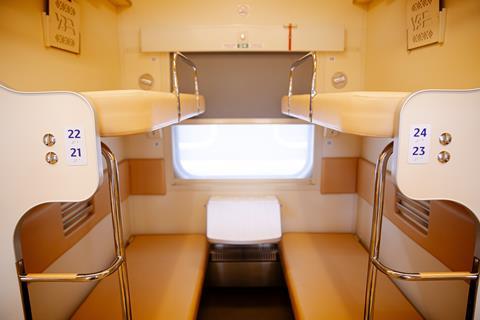
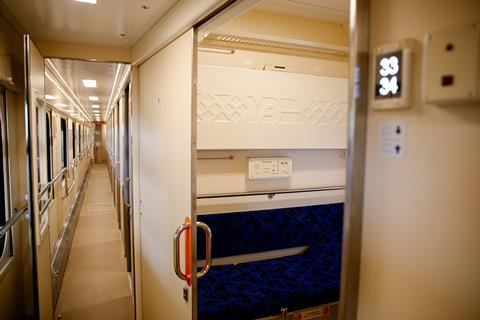
The modern compartment coaches will have a capacity of 44 passengers, a 10% increase on standard designs, with an increased body width enabling berths to be 2 200 mm long. There will be automatic doors and sealed gangways, and traditional coal-fired heating will be replaced with all-electric heating with individual temperature control in each compartment which functions even during long stops and at low speeds.
One of the cars will have a large compartment for passengers with reduced mobility, an electric wheelchair lift and a ramp for use at high platforms.
‘Made in Ukraine’ policy
‘This is the third major purchase of coaches by Ukrzaliznytsia since 2021 funded by the state budget’, Prime Minister Yulia Svyrydenko said on July 22. The cumulative total of 266 coaches marks ‘a significant renewal of its rolling stock.’
Svyrydenko said state-owned companies are expected to co-operate with domestic manufacturers under the ‘Made in Ukraine’ policy, and Kryukovsky Railway Car Building Works sources components from 166 sub-suppliers including companies that have moved from Russian-occupied territories and those that continue to work near the frontline.