UK: The first of four Department for Transport sponsored trials of digital pay-as-you-go ticketing using smart phones rather than dedicated smartcards or contactless bank cards began on September 1.
The trials aim to offer passenger easier payment options and enable the roll-out of PAYG ticketing without the cost of station validators. The results of the trials will be presented to ministers to inform future decisions about the long-term ticketing plans for Great British Railways.
DfT said the technology has already been tested widely in Switzerland, Denmark and Scotland.
DfT undertook procurement for the English trials, is providing £1m of funding and has worked with the train operators to identify suitable locations which do not have currently have PAYG options.
| Digtal pay-as-you-go ticketing trial routes | ||
|---|---|---|
| Route | Lead train operator | Technology supplier |
| Leicester – Derby – Nottingham | East Midlands Railway | Trainline |
| Harrogate – Leeds | Northern | Tracsis |
| Sheffield – Doncaster | Northern | Fairtiq |
| Sheffield – Barnsley | Northern | ECR Solutions (HopOn Group) |
East Midlands Railway trial
The first of the four trials is with East Midlands Railway, and uses technology developed by Trainline.
It encompasses an area bounded by Leicester, Derby and Nottingham, which was selected by the operator because it has significant levels of commuter and student travel. The trial covers all stations in the area, and includes both EMR and CrossCountry trains.
Each of the four trials is open to 1 000 people. By the time it launched EMR had received 550 expressions of interest and had around 80 people signed up. The operator is keen to recruit more participants, who can apply to join through its website. It is particularly targeting students, and the trial will be promoted at freshers’ fairs in the area’s universities.
Oli Cox, Head of Commercial Strategy & Business Planning at EMR, said simplicity is a key focus, with the aim of encouraging people to travel more often by making it simple to pay. He said 95% of the population have a smart phone, including almost all EMR passengers.
Using the app
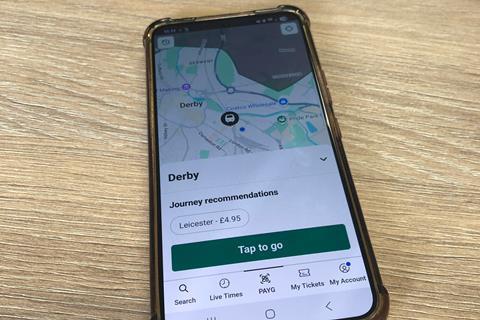
The DPAYG functionality has been fully integrated into the existing EMR app, which was also supplied by Trainline. EMR said this means onboarding is easy for passengers, taking less than 2 min. A payment method needs to be added, but there would be no need for separate registration to use a future DPAYG service.
Steve Gooder, Vice-President of Product at suplier Trainline, said DPAYG enables users ‘to simply tap in the app to travel, ensuring they always get the best on-the-day price with zero friction and real-time journey support’.
Passengers open the app and tap a button on the screen before boarding. The app then generates an in-app bar code which can be scanned at ticket barriers or shown to onboard staff. The passenger taps again at the end of their journey.
The system uses GPS to track the journey made and calculates the lowest fare, with the EMR implementation having a daily cap of £23 and a weekly cap of £73.
It supports railcard discounts, unlike current contactless bank card systems, but as each traveller needs a separate app, it does not currently support Two Together or Family & Friends railcards. DPAYG is only available for standard class travel, but it does support breaks of journey.
As part of the trial EMR has introduced single-leg pricing for DPAYG fares. Tickets bought using traditional payment methods remain at the usual prices.
To increase transparency, and an in effort to encourage more travel, the app shows the user a selection of fares from their nearest station.
The app has a journey history function, and EMR said data will be deleted after the trial.
EMR Commercial Director Simon Pready told Rail Business UK that the operator is confident in the technology, which has had lots of internal testing, ‘but there is no substitute for a large-scale trial’.
Cox said that the principle behind the system is simple, but ‘the real complexity comes with the edge cases’ such as passengers who decided to double back or who abandon a journey.
Experience in London and elsewhere has found that trust is a key factor in the adoption of digital ticketing, with potential users wanting to know that they can always rely on the system to charge the best fare.
Cox said ‘we know that complex fares can be a real barrier to travel, but this trial removes that uncertainty, making it easy to simply tap in and out on your phone, safe in the knowledge you’re always getting the best-value fare on the day’.
EMR expects the trial to be revenue neutral overall, with a potential lower payment per journey from the fare adjustments and the capping being balanced by a hoped-for increase in travel if passengers find DPAYG removes perceived complexity from ticketing.
Further plans
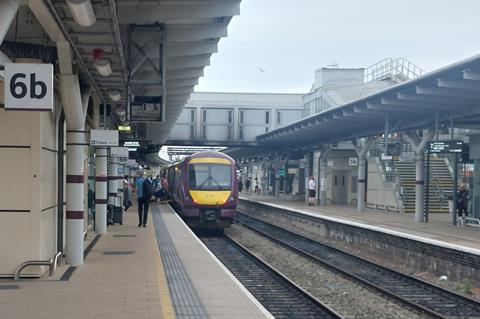
Similar trials with technology from other suppliers are scheduled to begin on Northern services at the end of September.
The four trials will run for nine months, with up to 1 000 participants able to take part in each trial.
EMR said the technology would be ready for rapid deployment if given the go-ahead.
Cox said a major benefit of the app is that it enables PAYG to be rolled out cheaply, without the cost of installing the validators required for smart card or contactless bank payment.
Trainline’s Gooder said DPAYG ‘lowers the cost and complexity of rolling out the many benefits of PAYG beyond London as it is infrastructure-light and ready to scale‘.
Separately, DfT is working with local authorities in Greater Manchester and the West Midlands to further develop local proposals for contactless ticketing.
Commenting on the start of the DPAYG trials, Rail Minister Lord Peter Hendy said ‘the railway ticketing system is far too complicated and long overdue an upgrade to bring it into the 21st century. Through these trials we’re doing just that, and making buying tickets more convenient, more accessible and more flexible.‘