UK: The Welsh government has announced a multi-year vision to create a Network North Wales integrated public transport system with frequent rail services at its heart. This would include ‘metro style’ train services on the North Wales line and the Marches line from Chester to Wrexham, and a through service between Wrexham and Liverpool.
The plans were unveiled by Cabinet Secretary for Transport & North Wales Ken Skates at Wales’ first Public Transport Summit in Wrexham on May 21.
The rail elements of the proposals which look ahead for one year, three years and to 2035 include:
- doubling train services between Wrexham and Chester in May 2026;
- bringing forward the introduction of 50% more services across the North Wales line from December 2026 to May 2026, with a new service from Llandudno to Liverpool and extending the Manchester Airport service to Holyhead in place of Llandudno;
- works to enable the provision of through services between Wrexham and Liverpool;
- increasing train services between Wrexham and Bidston to two trains per hour within the next three years, ahead of the introduction of four trains per hour between Wrexham and Liverpool by 2035;
- the Borderlands Line will be renamed the Wrexham – Liverpool line to better reflect ambitions for through services, with its key stations to be improved in the next 12 months and trains branded to reflect ‘the communities and football clubs they serve’;
- pay-as-you-go ticketing is to be introduced between Gobowen and Rhyl, and along the full length of the Wrexham – Liverpool line;
- working with Network Rail to determine the feasibility of a rapid delivery of a ‘test’ station at Deeside Industrial Park to gauge demand for permanent services;
- match funding for step-free access at Shotton and Ruabon stations;
- working with local authorities to develop plans for multi-modal interchanges at Holyhead, Bangor, Caernarfon and Wrexham;
- examining options to re-open stations and build new stations to serve employment growth areas;
- launching an electrification innovation fund to support the development of plans to decarbonise the railway and enable more frequent metro services and additional stations; this could include innovative approaches to lowering the cost of wiring to enable the line to Holyhead to be completed by 2035;
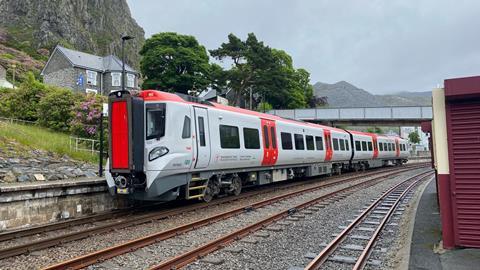
- the procurement of further new trains is planned over the next five years — Rail Business UK understands that there is high-level interest in battery or hydrogen technology;
- exploring the role of modes such as tram-trains.
The multi-billion pound programme is currently mostly unfunded, but the Welsh government has committed £13m to begin delivery. It hopes that it can successfully make the case for funding from multiple sources by setting out firm proposals and timescales in a plan that Skates said would ‘outlast any single minister, government or economic and political circumstances’. This is based on the model used for the South Wales Metro, where funding followed the development of plans.
The plans have been draw up with an understanding that North Wales has long had close ties to northwest England, and the Welsh government is in contact with mayors and devolved bodies across the border to co-ordinate efforts.
‘We now have the best possible partnership in place to deliver Network North Wales’, said Skates. ’UK government, local government, Transport for Wales and English local authorities are working with us to deliver this bold programme of work to better connect communities, with more rail and bus services and greater integration, new stations, new transport routes, new trains, new buses, new technology. A network of public transport services that will include cross-border turn-up and go bus and rail services, extending the Northern Arc from Hull to Holyhead.
‘With unprecedented partnership across governments, across borders and across the north, we have the opportunity to turn dreams into reality, to deliver on an enduring vision for what our a public transport network should look like.’
He said ‘we have already delivered significantly for South Wales with the South Wales Metro. Building on the £800m investment in new trains, the majority of which are already serving the North Wales region, now is the right time for North Wales to get the same level of ambition.’