UK: Secretary of State for Transport Heidi Alexander has told high speed line project promoter HS2 Ltd to look at lowering the maximum speed of future train services from 360 to 320 or 300 km/h, with the aim of reducing costs and delays to the overall programme.
This will form part of an ongoing ‘reset’ of the London to the West Midlands high speed line project which is being undertaken by HS2 Ltd CEO Mark Wild, who is to report back to the Secretary of State this summer.
In a sixth-monthly written update to parliament about HS2 which was published on March 23, Alexander said ‘I am determined to explore every opportunity to remove the over-specification and complexity from this project to bring down costs and delivery timelines. This will ensure the updated cost and schedule estimates are robust, rather than rush the process and risk publishing figures that we do not trust.’
A more detailed update on the progress of the HS2 reset is to follow ‘shortly’, with new cost and schedule estimates to be published once they have been ‘fully assured and approved’. According to the BBC, Wild’s announcement has been put back until after the local elections to be held in May.
Not so high speed
Alexander said Wild had now been asked to ‘assess how much money and time could be saved by adopting a specification for HS2 that is more in line with the high speed railways successfully delivered by the rest of the world. This could involve relying on proven technology and reducing the top operating speed of the railway in line with HS1 and other European counterparts.’
HS2 was originally designed for a maximum operating speed of 360 km/h, although the working assumption since the early stages of the programme have been that trains would not need to exceed around 320 km/h to keep to time. In addition, the large proportion of tunnelled and sub-surface alignment on the sections of HS2 now being built mean that operating speeds are already likely to be lower than was initially envisaged. A further complicating factor is that many HS2 services linking London with Manchester, Liverpool and Glasgow will need to cover long sections on the sinuous West Coast Main Line, where the maximum speed is 200 km/h but is at many locations substantially lower, especially north of Crewe. This puts pressure on the section of new infrastructure to deliver any journey time reductions.
Nevertheless, Alexander insisted ‘no railway in the UK, or globally, is currently engineered for 360 km/h. This means that the project would have to wait for HS2 tracks to be built before testing any trains – an approach which could increase costs and delay the completion of the project. The alternative would have been to send trains abroad to test on an existing track running at that speed.’
She said Wild’s ‘initial and provisional estimate’ is that a reduced speed could save ‘in the low billions and bring the railway into service sooner, by reducing risk in the delivery of the programme and its testing’. However, ‘in learning the lessons of the past’, Alexander is ‘eager not to make this decision prematurely’ and would consider Wild’s future advice ‘carefully’.
International comparisons
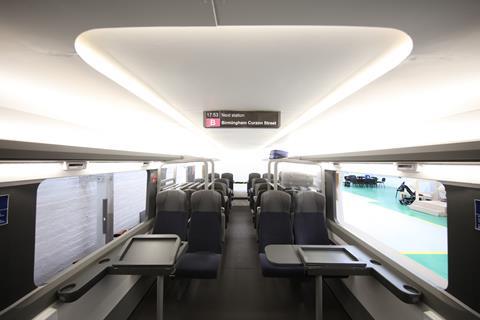
While HS2 aims to provide more capacity to relieve the WCML, described by infrastructure manager Network Rail as the busiest mixed-use railway in Europe, much of the public debate since the project was launched has focused purely on speed. Commenting on Alexander’s announcement, Wild said ‘speed has never been the primary objective. This railway will deliver better journeys, more capacity on the network, and economic growth — all of which are vital to the country’s future prosperity.’
DfT said lowering the maximum speed to 300 or 320 km/h would bring HS2 into line with HS1 from London to the Channel Tunnel (300 km/h) and high speed lines in Japan and France (320 km/h), and would have a ‘negligible impact on projected journey times and get passengers onto trains sooner’.
China’s high speed network is designed for 350 km/h operation, and according to Railway Gazette International’s 2025 World Speed Survey China remains the only country operating regularly timetabled trains at start-to-stop average speeds of more than 300 km/h. Indonesia’s 178 km Jakarta – Bandung line represents the first export of Chinese high speed technology, and is designed for 350 km/h although the relatively short inter-station distances mean that the Whoosh-branded services have a somewhat lower average speed.
Industry responses
Commenting on the government’s announcement, Sam Gould, Director of Policy & External Affairs at the Institution of Civil Engineers, said ‘good progress has been made under the leadership of Mark Wild, however, the length of time it’s taking to get back on track demonstrates how important it is to get plans right in the first place. Any project of this scale needs to spend significant time in development before work starts. Infrastructure should meet the public’s needs, not prioritise design for design’s sake. While it’s frustrating for the industry and the public to still have questions about final costs and schedules, the fact that the government is taking time to get the most accurate figures is positive, and will likely save money in the long run.’
Railway Industry Association Chief Executive Darren Caplan said Alexander ‘is right to recognise that HS2 will deliver much needed rail capacity in the years ahead, that it will ultimately enable more reliable and frequent customer services, and that it will generate significant economic benefits for the country such as creating jobs and boosting skills. We now look forward to more milestones being reported and acclaimed in the months to come.’
- Railway Gazette International’s World Speed Survey ranks the fastest start-to-stop scheduled train services.