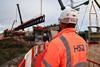
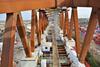
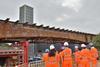
UK: The launch on March 16 of a second TBM to drive from Old Oak Common towards Euston offers renewed hope that High Speed 2 will eventually reach its long-planned London terminus. Chris Howe reports.
Of all the flaws in the planning and delivery of Britain’s second high speed railway, it is the lingering doubt over whether High Speed 2 will ever reach its planned central London terminus that has perhaps been the most pernicious aspect.
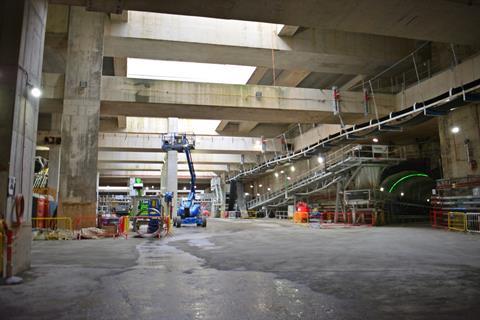
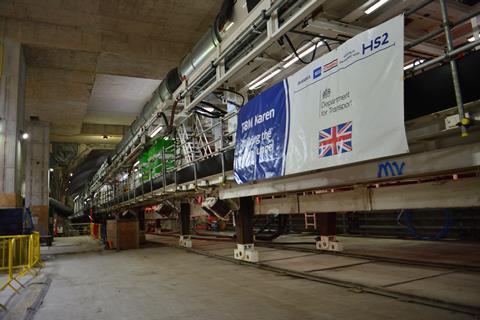
However, after many false starts, there are now signs that the southernmost leg from Old Oak Common in west London to Euston in the city centre will ultimately be completed, in spite the of the frequent jibes that the much-truncated HS2 will end up as ‘an Acton to Aston shuttle’. While HS2 services may not start serving Euston until 2040 or later, on March 16 a ceremony was held in west London to mark the launch of the final tunnel boring machine that will drive from Old Oak Common towards the station.
Celebrating female pioneers
The TBM christened Karen was named after Karen Harrison, one of the first female train drivers in the UK. Karen joins Madeleine, which was launched in January and was named in honour of Madeleine Nobbs, the former president of the Women’s Engineering Society.
The two TBMs will excavate the 7·2 km long twin-bore Euston Tunnel, which will be driven south and east from the Old Oak Common station box towards the southern terminus of the West Coast Main Line. However, such is the complex timescale of the Euston elements of the programme, the two machines will instead come to a stop underground almost 1 km from the station throat.
Assembly of the TBMs began within the Old Oak box in late 2024 before they were driven a short distance into pre-constructed tunnels at the southern end of the station site. Although the Herrenknecht TBMs had arrived in 2024, funding for delivery of the Euston Tunnel had not yet been finalised. A settlement which ensures the delivery of Euston Tunnel was only agreed following the Autumn Budget in November 2025. This also provided support for the approach tracks into Euston, but not for construction of the station itself.
Another Euston effort
In February this year, the Department for Transport began early market engagement to find a private sector partner to fund and develop the new station. Under a public-private partnership model, it is expected that a private sector partner would design, build, finance and maintain the new station over a long-term period.
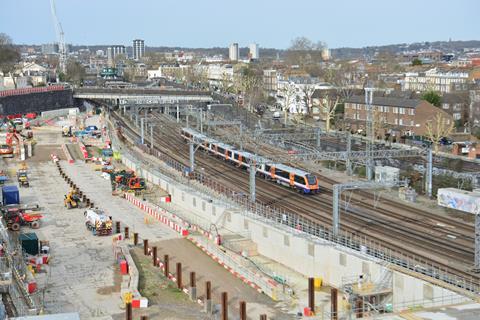
This marks the latest in a series of attempts to deliver a rebuilt Euston complex since HS2 was first proposed in 2009. That none has so far led to a viable project getting underway is a reflection of both the complexity of the site, including the large legacy station which is itself in need of renewal, as well as challenges on the site that extend above and below ground. To that can be added the pressing need to regenerate the wider community around Euston so that the area keeps pace with nearby King’s Cross, which has been transformed over the past 25 years largely thanks to the decision to route High Speed 1 into St Pancras station.
The latest efforts to address ‘the Euston problem’ has seen DfT establish the Euston Delivery Company, which will be responsible for a ‘Euston Campus’ urban redevelopment programme. EDC brings together relevant stakeholders involved with construction of the HS2 terminus alongside those responsible for its integration with an upgraded legacy station.
Beyond early market engagement and the formal creation of EDC, not much is known about the design for the station or the scale of the proposed oversite development. The limited information provided to date suggests that only six HS2 platforms will be constructed initially. However, minutes from a DfT and Transport for London-backed Euston Partnership Board meeting held in April 2025 have suggested that the station could be designed to accommodate additional platforms in future, were HS2 to be extended beyond the West Midlands as had been planned at the outset of the scheme.
Rebuilding bridges
Despite the uncertainty, the SCS joint venture of Skanska, Costain and Strabag continues to prepare the station for the arrival of the new line. The same consortium is also responsible for delivery of the Euston Tunnel. Work on the approach includes the construction of a tunnel portal and the extension of Granby Terrace and Hampstead Road bridges. The structure for the Granby Terrace bridge extension is largely complete. However, it has not yet opened to road traffic and will instead be used temporarily to support the utilities which currently run along Hampstead Road.
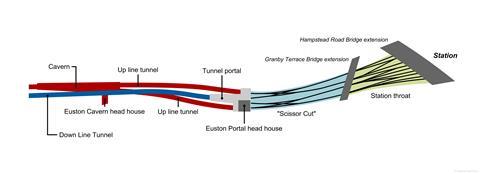
The Hampstead Road bridge, which currently runs over the West Coast Main Line, will be extended to cross the HS2 station throat too. Construction of the extension will first involve the construction of a temporary road diversion. SCS JV aims to bring the diversion into use by early 2027 and complete the bridge extension by mid-2029.
Cavern creation
Although SCS JV is using TBMs to drive the majority of the tunnel, the final 300 m at the Euston end is to be built using the mined tunnelling technique. This involves using excavators to clear spoil material from the face of the tunnel. At intervals of approximately 1 m, a fibre-reinforced concrete lining is sprayed to stabilise the tunnel roof and wall, before the excavator returns to the face to excavate another metre.
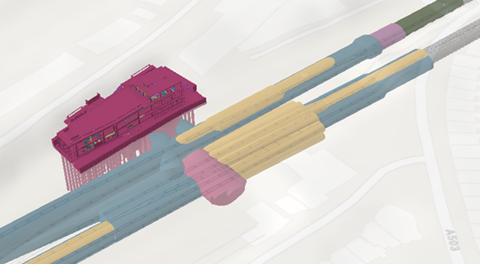
SCS JV will also have to construct a 15 m wide cavern underneath the West Coast Main Line. This will be used to split the Up (southbound) running line tunnel into two further tunnels that will head south to the surface. A third Down (northbound) tunnel will also be constructed, which will be routed up and over the westernmost Up tunnel. Its portal will be located in between the two Up running tunnels.
This arrangement aims to remove conflicts between northbound and southbound trains. The three approach tunnels, combined with a pair of scissored crossovers installed in the station approach tracks, will allow trains to use all of the future HS2 platforms, regardless of how many are ultimately built.
Before constructing the cavern, SCS JV is to dig a 30 m deep shaft for a head house, located next to Park Village East. The consortium is aiming for this shaft to reach its base level by mid-2027, after which horizontal side shafts can be added. The cavern and Down running tunnel will be bored in a northerly direction from the side shafts to the point where the TBMs came to a stop. The cutter heads will then be cut apart and removed. The internal mechanical and ancillary components of the machines will already have been removed by that time and transported back to Old Oak Common via the newly completed bores. The tunnelling shield will remain in place and will form part of the primary lining for the tunnel section. Later, concrete will be poured into moulds placed within the shields to create a reinforced secondary lining.
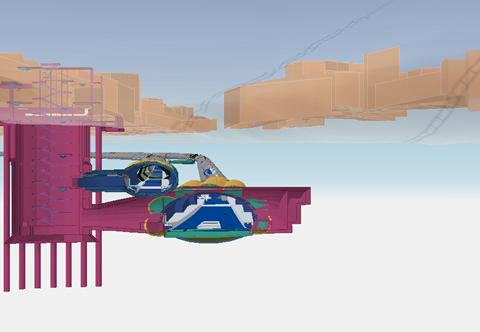
Although there remains a degree of uncertainty around the funding for the station, the Mace Dragados JV has continued to prepare the station site for eventual construction. The companies were awarded a contract to clear the site in February 2019, since when a key element has been managing archaeological material and building a new traction substation for London Underground.
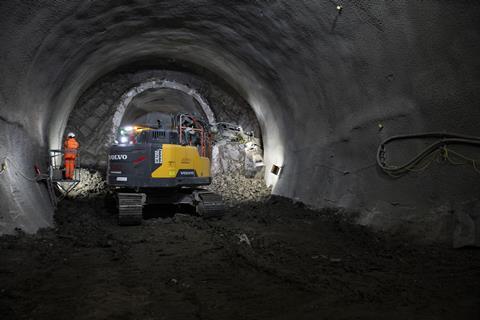
While the two TBM drives are expected to be completed by mid-2027, construction of the remaining 300 m of tunnels is expected to take several years to complete. As for the station opening itself, this is now not expected until at least 2040. When the UK government first launched public consultation on the first phase of HS2 back in 2011, opening of the railway had been envisaged in 2026.