







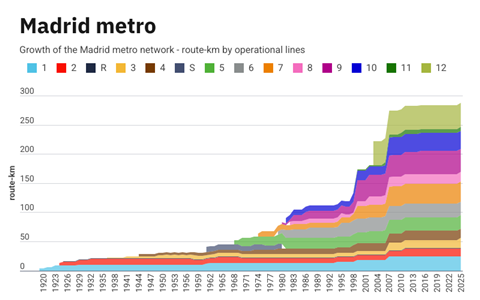
Extending back over a century, the Spanish capital’s metro network has grown gradually, punctuated by more intense growth periods in the early 1980s and again from 1998 to 2007. With no extension for over a decade, 2025 finally saw Line 3 extended – with construction progressing on two other lines.
Up until the 1950s, Madrid had a small, compact network of just 30 route-km, comprising four lines and a shuttle (R). That decade saw a population boom develop and the city sought to expand the network. A suburban line was added in 1961 serving new developments to the southwest; this line now forms sections of lines 5 and 10. Other extensions brought the network to 67 route-km by 1975.
Driven in part by hosting the 1982 FIFA World Cup, the 1979-83 expansion phase saw the network pass 100 route-km: lines 9 and 10 were inaugurated, along with a further section of loop Line 6 (opened 1979 and completed in 1995). The original Line 8 was also opened, later absorbed into Line 10 in 1998 when the current Line 8 opened to Barajas airport. This marked the start of a second phase of major expansion: the 2 km Line 11 was added in 1998, whilst a 41 km Line 12 MetroSur loop serving southern suburbs opened in 2003. Between 1998 and 2007 every line apart from loop Line 6 was extended, expanding the network to over 270 route-km. Three light rail lines also opened in 2007.
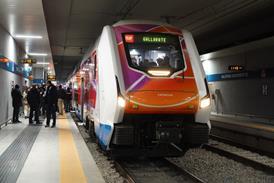
Expansion since then has been slow: Line 11 was extended 2·2 km in 2010, lines 2 and 9 in 2011, Line 9 again in 2015, and then a 10-year hiatus until Line 3’s 3·5 km extension in April this year.
Further extensions of Line 11 are under construction as it is developed into a major north-south route. The first section north towards Atocha main line station and the southeast side of the city centre is due to open in 2027, after which it is due to continue north to Barajas airport. Line 5 is also being extended to the airport, expected to open in 2028.
No comments yet