










Intermodal operator Metrans has picked Szeged as the site of its next rail-connected logistics hub, reflecting the HHLA subsidiary’s growing presence in the CEE freight market. Chief Executive Peter Kiss explains the thinking behind the investment in Hungary to Benjámin Zelki.
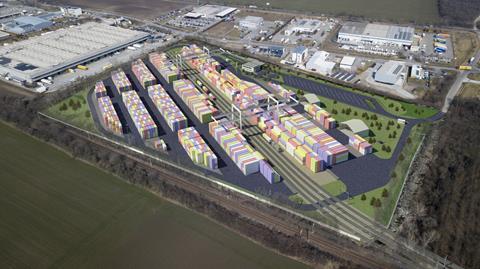
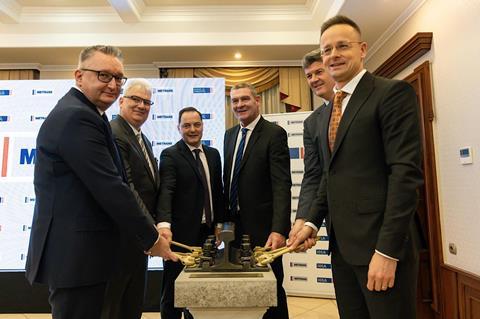
Hamburger Hafen & Logistik’s rail freight business Metrans launched construction on December 12 of a road and rail intermodal logistics hub in Szeged in the south of Hungary.
‘The new terminal in Szeged has been designed from the outset as a high-performance rail hub capable of supporting long-term growth in intermodal transport’, Peter Kiss, CEO of Metrans, told Railway Gazette International on February 3.
The terminal is being built on a 10 ha site, featuring four 330 m loading tracks and two remotely controlled electric gantry cranes. The facility will be capable of handling six inbound and outbound trains per day and an annual container volume of 300 000 TEU, with infrastructure prepared for future technology upgrades, digitalisation and potential capacity expansion.
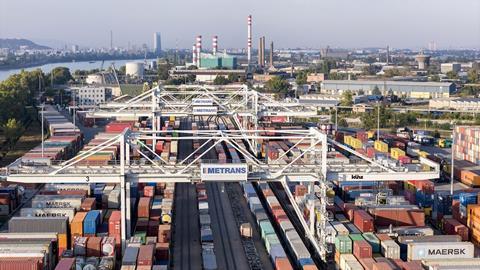
Of the total project cost, the Hungarian government is providing HF860m. The Szeged terminal is scheduled to begin operations by the end of 2027, becoming Metrans’ second hinterland terminal in Hungary after the one in Csepel in Budapest, which has six tracks.
A strategic location
The terminal will have a connection with the 45 km railway connecting Szeged to Subotica in Serbia, which reopened fully in November 2023 following reconstruction work.
‘At the beginning there were no special factors which motivated us. It was simply the idea where to go further. We have monitored the cargo flows and the traffic corridors. And Szeged came as a natural further step in the development of our network’, Kiss explained when asked about the strategic reasons behind the choice to develop a second rail terminal in Hungary.
‘But we have to say also, yes, the modernisation of the Budapest – Beograd railway line is a very important step which is showing that the strategic decision to locate the terminal in Szeged was right. This corridor represents a vital axis connecting central Europe with the Balkans and southeast Europe, and its reconstruction significantly increases capacity, speed and overall reliability of rail freight transport. From a long-term perspective, Metrans sees the Balkans as a region with strong growth potential.
‘The large-scale automotive investment currently being developed in Szeged is the next aspect of the choice of location. The presence of a major industrial project creates strong, long-term demand for efficient and reliable logistics services, particularly good rail-based transport. All this shows how important the cooperation between infrastructure, industry and logistics is. We are creating an entire ecosystem here’, he added.
More terminals, more digitalisation
‘Metrans is pursuing a long-term strategy focused on the continuous expansion of its intermodal network, particularly across central, eastern and southeastern Europe. The objective is to build a dense network of terminals and rail services’, Kiss responded when asked about the company’s aims for the medium term.

‘Future investments will target not only the construction of new terminals such as at Szeged, but also allow the expansion of existing facilities, technological modernisation, automation and further reductions in the environmental footprint of operations. Digitalisation and the deeper integration of rail into global supply chains also play a central role in this strategy.
‘The company’s strategy is ultimately to further strengthen rail as the backbone of sustainable logistics in Europe, while also gradually developing new transport corridors with high growth potential.’
Complementary sites
The Szeged investment is the latest in a rolling programme of investment by HHLA in the eastern European logistics market. In September last year, it acquired a 60% stake in the Eurobridge Intermodal Terminal in Batiovo in Ukraine, which is being developed as a hub for European rail freight.
The terminal is located near Chop at the intersection of international railway corridors between Ukraine, Hungary and Slovakia, with both 1 435 mm and 1 520 mm gauge tracks. After a major conversion in 2025 the terminal is now capable of handling up to 100 000 TEU of containers per year as well as grain and other bulk cargo. Capacity can be further increased if demand requires. It is operated as a joint venture between HHLA International and Ukrainian investment company Fortior Capital.
Meanwhile, Metrans itself completed the purchase of 100% of Adria Rail Group in March 2024, bringing the operator fully into its business following the purchase of a 51% stake in March 2023. Adria Rail offers rail services from Serbia and Croatia and manages an inland terminal in Indija near Beograd, which has daily Metrans trains to the Croatian port of Rijeka as well as connections to Metrans’ terminal in Budapest.