









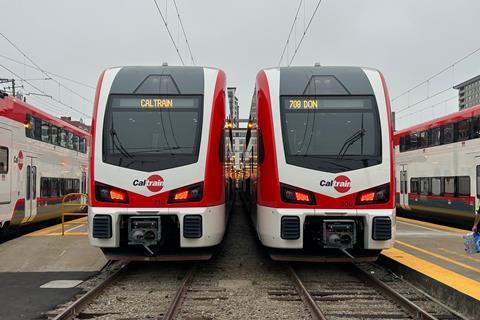
USA: Californian commuter operator Caltrain is to be paid for the power its trains return to the grid, as a result of a regulatory change to classify regenerative braking by electric trains as a renewable generation facility.
Caltrain’s 82 km San Francisco – San Jose route has been electrified at 25 kV 60 Hz. The commuter rail agency currently uses an average of 207 MWh on weekdays and 175 MWh at weekends. It buys 100% renewable energy supplied by Peninsula Clean Energy and San Jose Clean Energy, mostly from solar and wind generation. This costs around $15·3m/year, which is lower than the original estimates of $19·5m/year.
Caltrain said regenerative braking returned about 23% of the power it used back to the grid. With effect from April 2026, it would qualify for a net billing rate, enabling it to recoup approximately $1m/year for this returned power. The use of renewable energy also allowed the agency to benefit from the California Low Carbon Fuel standards programme.
‘Our Green Transportation programme is the first in the state and one of the few in the country to give credit to public transit systems like Caltrain for the energy they return to the grid, helping them save money and reduce pollution’, said SJCE director Lori Mitchell on October 8.
PCE CEO Shawn Marshall added that ‘our partnership with Caltrain and its bold move to all-renewable and carbon-free electric rail service have already improved the quality of life for our communities and illustrates how powerful local, community-driven leadership can be in better meeting customer needs. And now with the new regenerative braking, their cleaner, quieter and more efficient travel will send even more emission-free power back to the larger regional grid.’